


You’re getting this email as a subscriber to the BRXND Dispatch, a newsletter at the intersection of marketing and AI. Forward it to a friend, they’d like that, and so would we.
Today’s post is an exploration of how AI is quietly rewriting the economics of consumer product brands, making it cheaper and faster than ever to build profitable companies. Plus, Ulta is building an agentic commerce team with 5+ open roles and Profound coins the marketing engineer.
A New Consumer Golden Age
Here’s a little game. I’m thinking of an AI startup that:
- Launched its flagship product in mid 2023
- Reached $100M in revenue within 18 months (six months faster than Cursor)
- Was fully profitable within 14 months.
The AI company I’m talking about, of course, is…..Gruns, the adorable super green gummy bear that recently sold to Unilever for $1.2B!
In the wake of breakout successes like Gruns, it’s ironic that Allbirds, a product that you twist an ankle just looking at, is once again dominating the consumer goods conversation. Once valued at $4B, Allbirds was picked up for parts at $39M, leading many to once again opine on the death of buzzy DTC brands. They then proceeded to launch the most shameless pump and dump since Long Blockchain Corp, rebranding to “NewBird AI” and announcing “long-term plans to be a GPU cloud provider. Mercifully, the internet was pretty undefeated on this one.
Allbirds tomfoolery aside, the narrative-violation reality is that we are experiencing an explosion in the growth of profitable consumer brands, driven by AI upending the fundamental economics of how new brands can be brought to market. The result is a near 180-degree vibe shift from when I left the industry 18 months ago.
At the start of last year, my take was that AI would end the last of the growth marketing arbitrage era as media buying became a perfectly competitive and ever more expensive environment. The pendulum would swing back to brand marketers and established legacy brands who were less reliant on paid growth would win market share.
Now, it looks like the exact opposite is true. AI is making all sorts of frenetic and audacious new consumer product concepts possible at profitable unit economics-- things are gonna get weird and established brands are vulnerable. Yet another reminder not to trust anyone who is too confident in how the future will play out, especially when that anyone is yourself.
There are only so many consumer dollars to go around. Each new AI-native consumer brand entrant puts even more pressure on enterprise brands to continue evolving their operations to be AI-native enough to ship at the speed of their disruptor colleagues. Much as is the case in big tech where 20,000+ person organizations are developing a gear they didn’t know they had, marketing leaders at the largest brands in the world are getting a new jolt of frenetic builder joie d’vie. Last week, Ulta announced it is hiring a full team dedicated to agentic commerce.
The Vibe Shift
From 2022-2024, I was the head of growth for a consortium of wellness, parenting, and pet brands that sold across Shopify, Amazon, and physical retail. When I left the day-to-day grind of that industry, the mood was grim. Looming tariffs, eternally rising CACs from platforms, and the accelerating propagation of fly-by-night Chinese brands with names like NUTSAAKK took the oxygen out of the space.
Effectively, I viewed the industry as near hopeless for anything but loss-leading Chinese private label factory brands, a creator-led breakout with an unfair distribution advantage (i.e. Rhode) or a crazy outlier like Gruns, the odd creatine-protein-fibber gummy with 95% gross margins and dialed in funnels.
So I left the business altogether. And then something happened. AI significantly lowered the CapEx required to operate a consumer goods business and brought ad platforms back to delivering sustainable CAC. Add on some of the secondary effects, such as far more precise AI-powered incrementality measurement tools for marketing spend, and the razor-thin growth equations for net new consumer brands are back in the black. AI rebuilt the flywheel in mere months.
In the “95% of enterprise AI pilots fail” genre, pessimists like to sound smart by saying…..well AKSHUALLY, name one industry where the adoption of AI has meaningfully changed the unit economics of an entire sector.
Here in consumer brands. Right freaking here. The broader trade media just hasn’t caught up to the massive vibe shift among the operators.
But here are a few archetypes of brands founded in the last few years that are absolutely taking off, nearly all with AI at the center of their operations.
The $1M / day machines:Ridge, Vuori,HexClad, Simple Modern, True Classic:
Brands founded in the last few years that have reached new trajectories of profitable growth at mass market scale. These brands were already outliers who added valuation in the lean years post COVID but have found another gear.
The New Household Essentials: Little Spoon, Lovevery, Blueland, Jolie, Bobbie
Recurring subscription products that have transformed quotidian habits of American households and are poised to disrupt…or be bought by big CPG.
The Wellness Category Creators: Create, Men to Mars, OPositiv,Bonafide
Brands built in the shadow of AG1 that are creating net new consumer wellness habits in categories ranging from testosterone restoration to perimenopause
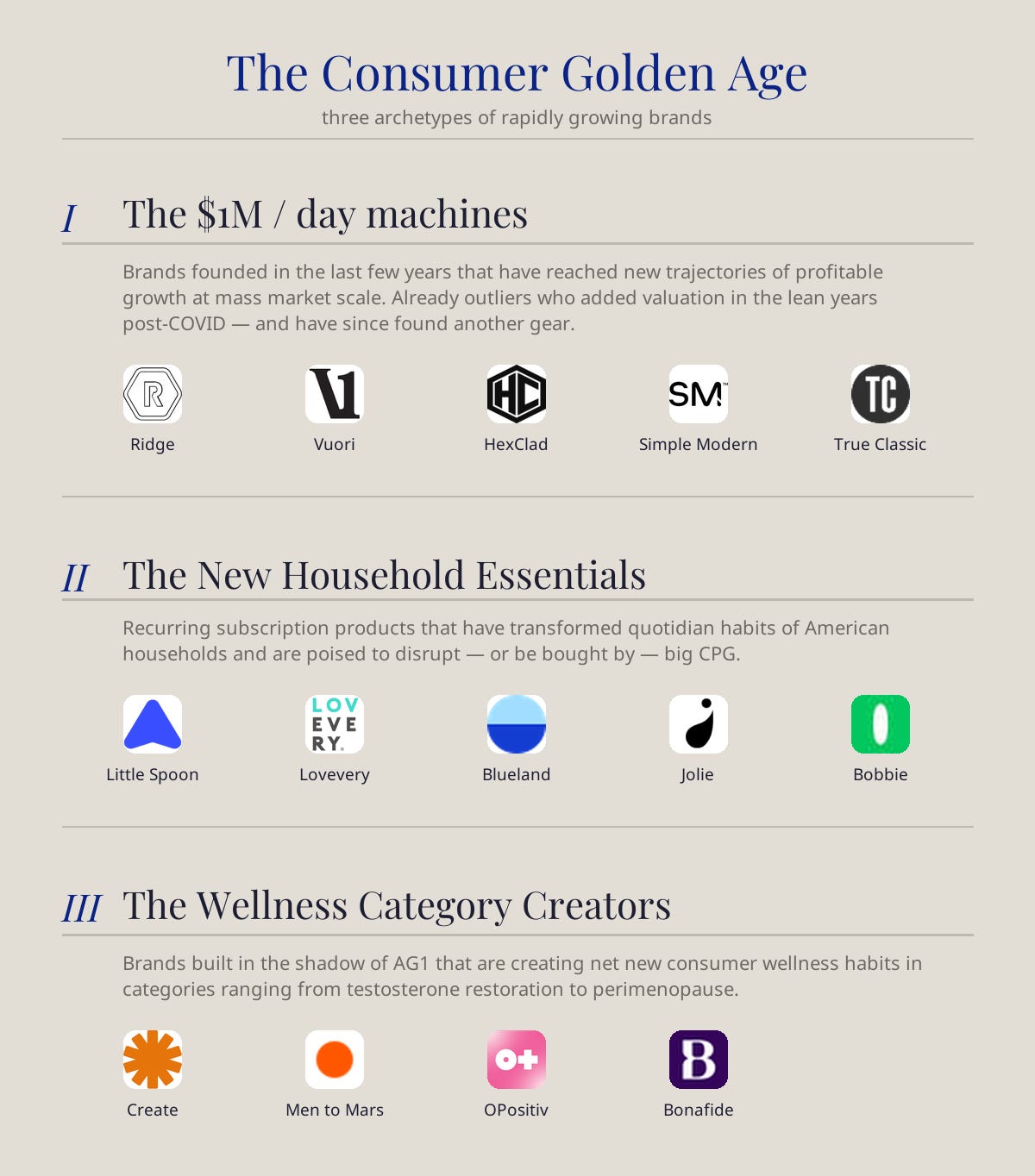
The key difference, of course, from the DTC boom of yesteryear is that all of the brands above are growing profitably with orders of magnitude more revenue per employee than consumer brands of years past. And the trajectory is only accelerating– I venture that by 2030, we’ll have a new generation of brands founded in the last 12 months that hit nine-figures in profitable revenue in half the time of the entities above.
The level of lean that these brands will run at is something of a double-edged sword. Away, Glossier, Casper, and Everlane created hundreds of jobs during their golden years and trained a generation of marketing executives and future consumer founders. Jolie has fewer than five full-time employees.
Of course, the entire consumer durable goods industry is all downstream of the purchasing power of the American shopper. Luckily, the trends there are much better than the prevailing mainstream sentiment would have you believe.
Having spent the bulk of my career in media and tech shipping less tactile products, let me be the first to say that even with AI, physical consumer goods is a ridiculously hard business. Eight-figure purchase orders hang on the whims of a big box retail buyer 18 months out of college. Guns and germs shatter supply chains. Your landlord spends two years in the metaverse wilderness and breaks your main growth channel. It’s a hell of a racket.
But there won’t be any meaningful advances in agentic commerce unless stubborn irrational entrepreneurs continue to toil away at the pesky, low margin business of actually purveying goods. Thankfully, these are generationally bright days for them.
Featured Job Posts
Author’s Note: We’re continuing to features jobs that we believe are uniquely interesting and microcosmic of the types of new-age marketing jobs emerging in AI’s wake. If you see any interesting opportunities in the wild for us to feature, drop me a line at mike@brxnd.ai.
Marketing Engineer, Profound
Fresh off raising a $96M Series C at a $1B valuation, Profound is staking its claim on a future where agents will sit at the center of marketing organizations. In this brave new world, the maestro conducting the agentic orchestra will be known as a marketing engineer.
It’s essentially an interesting domain specific take on the forward deployed engineer concept, betting that Profound can reshape the marketing org in its likeness in the same way Clay has done for sales operations, where the “GTM engineering” title is now ubiquitous.
If you’re a few years into a marketing career and have become the de facto, “go to” person for Claude Code builds, automations or general agentic systems thinking, getting in early on the marketing engineer wave will be a major inflection point in your growth.
Sr. Manager, Agentic Commerce, SEO and GEO, Ulta
Here’s an example of one of the roles on the aforementioned Ulta agentic commerce team being formed under Agustina Sartori. It’s notable to me for two reasons.
I find the taxonomy here particularly interesting as both GEO and conventional SEO are starting to get bundled up under the broader “agentic commerce” terminology. The details also give a sense of how a large public retailer with a complex catalog is thinking about reinventing itself for the agentic era.
“This role ensures Ulta is AI-readable, not just human-readable — evolving the organization from traditional SEO to Generative Engine Optimization (GEO) and Agentic Commerce Optimization (ACO). The Sr Manager leads structured data strategy, feed prioritization, AI visibility governance, and category-level optimization.”
If you have any questions, please be in touch. As always, thanks for reading.
— Mike
> So I left the business altogether. And then something happened. AI significantly lowered the CapEx required to operate a consumer goods business and brought ad platforms back to delivering sustainable CAC. Add on some of the secondary effects, such as far more precise AI-powered incrementality measurement tools for marketing spend, and the razor-thin growth equations for net new consumer brands are back in the black. AI rebuilt the flywheel in mere months.
Cool take. Trying to understand--is the argument here that AI lowering CAC costs has improved margins significantly? And is this for fully AI-gen content or at which part of the pipeline? Forgive my ignorance, and it sounds like CAC has been high enough to make or break a business, and its decrease is a huge win for innovative new ventures?