


Over at our sister publication Forward Deployed, Noah has done an outstanding series of interviews with several of the speakers taking the stage at BRXND NYC 2026. With 10 days until showtime, I’m re-publishing another one of his interviews to help you get to know another leader building on the frontier of AI before he takes the stage.
Today, we’re featuring Aaron Dignan, VP of Product & AI at Rocket Money, founder of The Ready and author of Brave New Work.
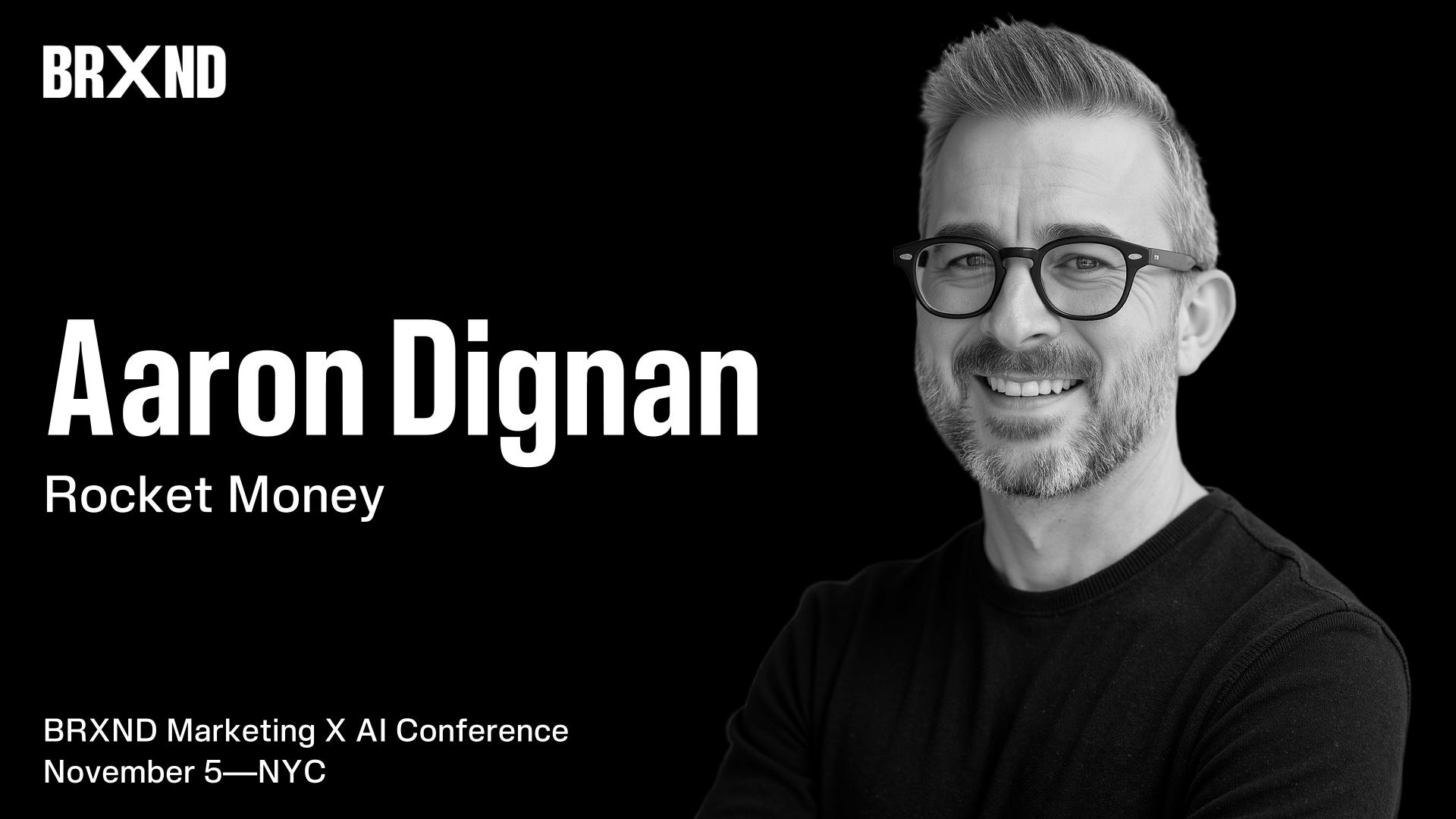

Of course, if you don’t yet have a ticket to BRXND to see Aaron and the rest of our speakers on stage, time is running out. Would love to see you next week.
Aaron Dignan, VP of Product & AI at Rocket Money and author of Brave New Work.
Aaron has spent two decades helping organizations change without calcifying. He founded The Ready, wrote Brave New Work, built Plumb, and now leads AI and digital product work at Rocket Money. That cornucopia of experiences gives him a rare view across human organization design, agent workflows, and the hybrid systems now taking shape inside operating companies.
To set the stage for his talk at BRXND, here’s the full forward deployed episode he recorded with Noah alongside my quick recap of the greatest hits.
1. An agent stack is an org chart. Before Rocket Money, Aaron built an AI automation platform called Plumb, where one of the problems he took on was getting a system to produce writing that actually sounded like him— the eternal struggle against slop that Noah and I have written much about. As he mapped out the steps and handoffs, he realized he had accidentally rebuilt something very familiar.
“oh, shit, I’ve just created a newsroom… I’m basically doing role work, which is what I spent most of my career doing.”
Role work is the org designer’s craft: writing down what a role is for, what it’s responsible for, and what it’s allowed to decide, instead of leaving all of that implicit. Aaron’s claim is that an agent needs exactly the same document, and that a system prompt is simply where it now lives.
“it’s all the stuff that would make a team healthy needs to be present in the diagram.”
The upgrade is that this version actually gets read meticulously which….just might be more than you can say for the last job description you wrote.
2. Restricting an agent’s tools is setting its decision rights. In a multi-step agent system, each step can be handed to its own narrow helper — a subagent — and you choose exactly which tools that helper can reach. Aaron had been doing this for performance reasons and had never once called it governance, until Noah asked whether he used decision rights explicitly with agents.
“that subagent might only have access to two tools instead of 50. And that’s actually a form of decision rights.” … “Like it can’t go update the GitHub because it doesn’t have access.”
Every tool you decline to hand an agent is a decision you have quietly taken off its plate. He is refreshingly frank about the downside of the fashionable alternative, in which you give one all-powerful agent the keys to everything and hope.
“we’ll just have one agent who’s like an orchestrator and they’ll have access to everything. And we’ll just roll the non-deterministic dice and hope that it all works out.”
3. The bottleneck moved from making to agreeing what should be made. Aaron’s group is roughly 300 people inside a 20,000-person public company. They’ve built a loop where unhappy customer text threads are caught by sentiment analysis, a second agent works out what actually went wrong, and a third drafts the fix before any human sees it.
The list of things they could ship got very long very fast, a microcosm for the core challenge of leading a product org in the era of AI.
“So much of the conversations now resolve to communications discussions rather than actually structural discussions, mainly because the bottlenecks have moved.”
“the real problem is if everybody goes and does everything at that pace, the coordination tax is the problem…….if in the past we could only ship three features in a month… and now we could ship nine… you just ship a product that feels like very disjointed”
4. Make your strategy meetings more indulgent. The standup, the weekly update, the where-are-we recap: this is the manual, repetitive work humans do worst. When the real work already runs through systems that log it, those updates can be a byproduct of the work rather than a meeting about the work.
“Everything runs on exhaust.”
The point of clawing back those hours is to spend them on the judgment calls nothing else can make.
“our strategy meeting now can be like a multi-day affair and it should be quite indulgent so that we like really do the things that the models can’t do””
5. Decide what gets argued and what simply gets measured. Human organizations run on persuasion — the pitch, the readout, the room. Models fold the moment you lean on them, and Aaron doesn’t expect post-training to fix it.
“there’s a beauty and a fallibility to the fact that human intelligence is very motivated by persuasion” … “if you try to persuade the model, it’s pretty persuadable… they’re going to be somewhat sycophantic forever, I think.”
So route each decision deliberately. Some questions deserve an argument; others should just be looked up. His example is a retention debate at a subscription business, where a leader’s instinct about why customers are leaving can now be checked against every recorded reason they actually gave.
“where do I want models persuading humans or humans persuading models and where do I want the math?”
“we have 20,000 data points now of like why people are actually left. And we can much more easily query reality” … “there’s a chance to check yourself a bit and still have your reality distortion field.”
I love Aaron’s framing here. He now has two different kinds of intelligence to arrange in an org chart instead of one, and the trick is knowing which to reach for: “now I just got a Phillips head screwdriver that goes right next to my flathead.” His parting advice is to keep track of what you picked up the screwdriver to build in the first place.
“Let’s make sure we don’t just get lost in the theater of productivity on the way to who knows where and remember what team we’re on.”

Links and References in the Episode.
Aaron and his work
Organization design and agent systems
50% off VISIONS for BRXND Readers (from our friends at Future Commerce)
AI is rewriting commerce. Culture is next.
Join Future Commerce for VISIONS Summit NYC on February 10, 2027, at The Museum of Modern Art — a gathering of leaders across commerce, marketing, design, and technology exploring how AI is changing what we create, how we shop, and what we value.
The lineup includes former U.S. Secretary of Commerce and Kellogg CEO Carlos Gutierrez, Sheehan Quirke (The Cultural Tutor), and speakers from Etsy, Hermès, MoMA Design Store, and more. Expect a day of ideas and conversations, with museum admission and an afterparty included.
On a personal note, I’ve been to VISIONS and I find it be a spiritual sibling of BRXND that pushes the boundaries of the discussion beyond cliche conference speak and gathers the best minds in commerce.
BRXND readers can use BRXND50 at checkout.
Explore the lineup and register for a ticket here.
If you have any questions, please be in touch. As always, thanks for reading.
— Mike