


We’re officially at <100 days until BRXND NYC at the Times Center on November 5th! Since we’re in the throes of summer and I’m getting many out of offices from folks interested in attending, we’re honoring the early bird price a little longer.
We have ~15 tickets left that we’ll offer at the early bird rate before we move to GA. Link to purchase directly is here and in the button below.
An Inflection Point for ChatGPT Ads
There’s a bizarre bearish narrative around ChatGPT’s advertising ambitions making the rounds, lampooning the company’s internal projections of building a $100B ads business by suggesting the entirety of the “ad market for chatbots” is $5B. Here’s Eric Seufert last week:
An alternate information space seems to have developed around the chatbot advertising market that has led people to believe that OpenAI’s advertising product is an abject failure, ads in chatbots are fundamentally nonviable anyway, and the entire category will never generate a meaningful amount of revenue.
Like Eric, I find this perplexing for a number of reasons, most of all the fact that it’s near impossible to predict what form factor OpenAI’s core product will even take in twelve months. ChatGPT was a happy accident in the first place, and OpenAI has proved in the last week that it has no qualms about upending its entire user interface to pursue grander ambitions. Codex made a change to its core UI every single day last week.
While we talk about OpenAI speedrunning the Meta ads playbook, an under-appreciated aspect of OpenAI’s culture is how willing they are to make wholesale product changes with the confidence that they have a sticky enough value proposition that users will begrudgingly adapt. Few companies possess that level of product-market fit and audacity.
To this point, ChatGPT Ads has been a lean MVP iterating and shipping tentpole features at a frenetic rate. Three months ago, this was a closed beta selling a single creative placement at $60 CPMs! Thus, the only data point that has mattered so far about ChatGPT’s ad product so far has been the lack of user attrition and user engagement declines when ads are shown. In May, OpenAI reported “no impact on consumer trust rates” from ads being shown and has gone full damn the torpedoes in ramping up efforts to scale their ad business, hinting that the internal data backs up their public statements.
Now, things are about to get real. Last week, OpenAI emailed active clients announcing two marquee features—conversion optimization and app install attribution. Combined with the conversion API/server-side tracking, pixel and self-serve platform launch in May, OpenAI has now shipped the minimum viable product for direct response marketers to optimize for performance on the platform.
Now that conversions can be tracked, there’s going to be a natural obsession here to focus myopically on whether ChatGPT ads “work”, which is to say, whether they meet a brand’s ROAS goals in Q4 this year. Ignore that noise. Historically speaking, every platform that has reached humanity scale (i.e. a billion plus users) has managed to bolt on a highly performant ads business eventually. With an armada of Meta execs at the helm, OpenAI will as well.
The far more interesting conversation is around whether OpenAI can continue to scale a more aggressive ads product without flying too close to the sun on violating user trust. The design of the beta was intentionally minimalist, as if it was almost an advertisement apologizing to the user for being there. It’s likely that future ads will be far more intrusive – will they add enough value and serendipitous new product discovery to ChatGPT sessions that users will accept their presence? This still very much remains to be seen.
The other narrative worth watching closely is around when OpenAI begins experimenting with ads that are designed explicitly to persuade agents. To this point, all of ChatGPT’s (public-facing) ads vision assumes a human buyer and most of its ads pricing is moving to a cost per click model. Agents, of course, do not click. They don’t really view ads either. We’re in the earliest innings of “advertising to agents” taking shape as a concept and the most fundamental questions around what the business model will even look like are still wide open.
Per Juozas Kaziukenas, OpenAI is now experimenting with an ad format that will connect users with custom business agents rather than clicking out to external websites, perhaps a baby step towards thinking about how agent to agent flows will take shape.
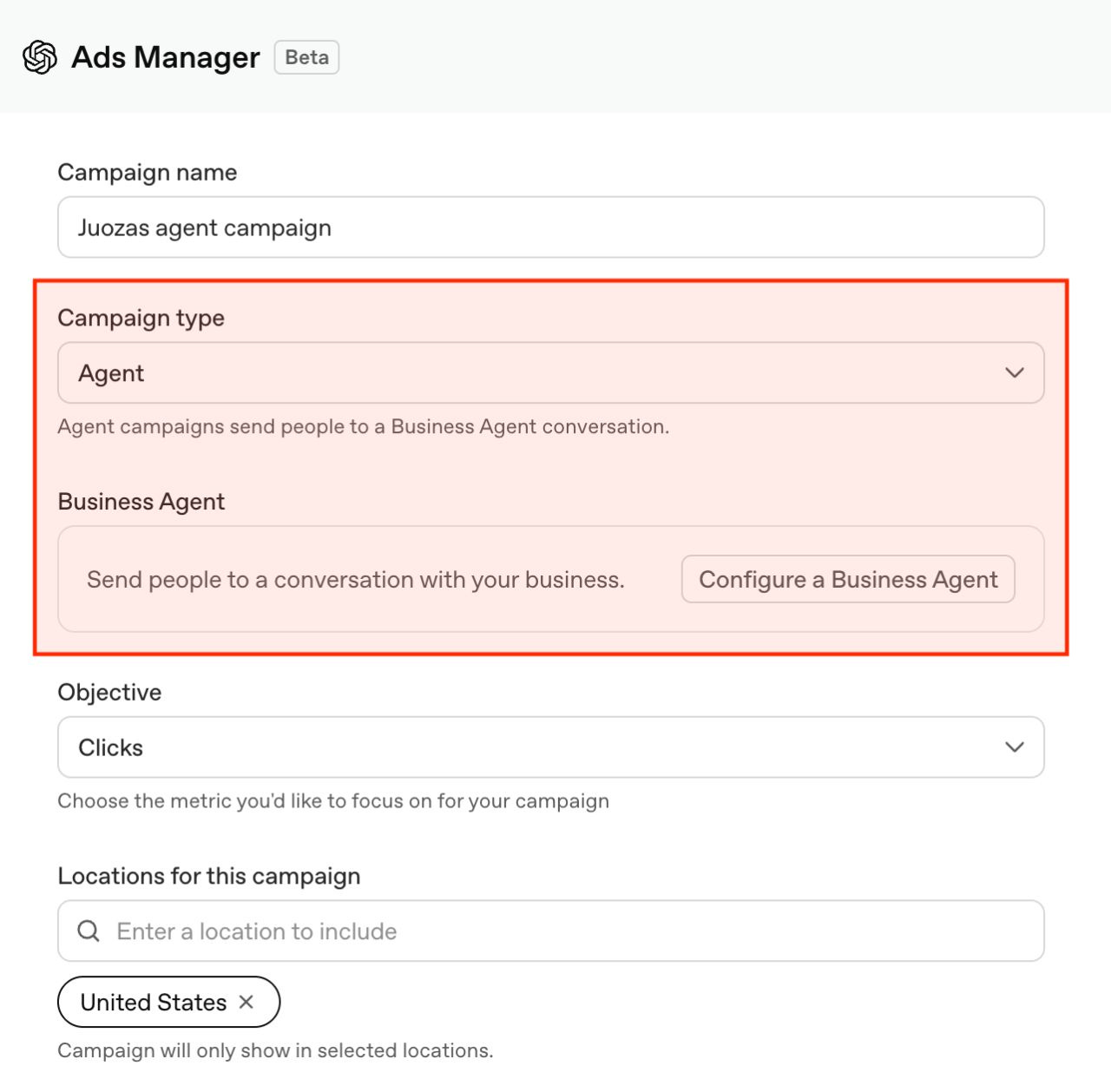
The obvious tradeoff here is that OpenAI is asking advertisers to embrace a new level of disintermediation, unless marketing leaders can find a way to make their agents a true representation of their brand. To date, most agent workflows have focused on getting the basics right. The first order problem is nailing price, stock status and basic contextual questions consumers will ask about a product or service. But for marketers to hand more of the keys to agents, they need confidence that agents will operate as a natural extension of a company’s brand. This is a much murkier challenge and one that I suspect will become an incredibly hot area in enterprise AI adoption work.
In any event, the utilitarian promise of a successful ads product in ChatGPT far outweighs the risk posited by the cynics. Specifically:
1) A performant ads network in ChatGPT would be one of the most positive-sum, egalitarian drivers of growth— especially for small businesses both digital and analog– to come out of this era. If ChatGPT Ads does reach $100B of revenue by 2030, it will do so by driving hundreds of billions of dollars in growth across the economy. This success would also create vital competitive pressure on Google, Meta, and Amazon, who right now have enormous market power to raise CPMs.
2) The faster the ads business takes off, the bolder Sam Altman and OpenAI can be in their frontier bets, especially once OpenAI faces the whims of the public markets. I don’t think Sam took Ayahuasca one weekend and suddenly reversed his dogmatic contempt for ads. Someone showed him the financial model and cooler capitalist heads prevailed. The ability to generate digital rectangles out of thin air and sell them at 90%+ gross margins is truly one of the miracles of capitalism and it can help ensure the onramp to AI remains free for hundreds of millions of users.
3) The greatest career opportunity for up-and-coming hustlers in marketing will likely be to position themselves as closely as possible to the “ads in LLMs” zeitgeist, which will spawn both generational one-man businesses and venture-backed entities. It’s a hard time for many of the classic entry level positions in media and marketing– conventional media buyers, entry level performance marketers and all of the junior support functions brand-side and agencies alike are under intense pressure from AI. A net new platform rapidly gaining scale,, especially one that gen Z grew up with, would go a long way to filling the entry-level pipeline with marketing jobs.
To borrow inspiration from a famous presidential letter, ChatGPT’s success with ads is our industry’s success and I’m rooting hard for them.
Consumer AI’s Claude Code Moment
Across a lot of the more normie quotidian use cases, there’s a pretty defensible argument that the lived experience of using AI has been stuck in neutral over the past year. This is an interesting paradox– AI products can do so much more than they could a year ago, across both work and everyday personal use cases. Browser and computer use in particular unlocks fundamental changes in how people can interact with technology. In just a few months, computer use has gone from mystifyingly frustrating to near magical.

But it’s worth remembering how little of the population has experienced any of this wave in the grand scheme of things. Cross-referencing some data from ChatGPT for Work, Claude Code, Cursor, and Github, a reasonable estimate is that around 15-20M people are using coding scaffolds and advanced agent tools, many still within the boundaries of significant enterprise restrictions.
There are roughly one billion knowledge workers in the global workforce. At best, 2% are operating like most readers of this newsletter.
If your frame of reference for the “AI boom” of the last year is purely based on using mass market consumer products and trying to get Copilot to reference the Word document you’re working in, I can understand how you might be skeptical of what your AI-pilled friends are telling you! None of this is manifesting in your life!
Sam Altman does AI no favors here– he’s built a product that can automate the most mundane aspects of daily existence and magically free up more time to spend with loved ones and he cites an example of outsourcing parenting to AI as the utopia?

Beyond “better search engine”, the main consumer AI use case that has gained mass-scale traction is companion apps. Character AI has ~22M monthly active users, with average sessions in excess of 15 minutes. As a category, companion apps have around 50M monthly actives, with about 68% opening every day. It bears remembering that for how many people interact with AI, ChatGPT 4o was the pinnacle of the experience.
Much like adoption in the enterprise, consumer AI is no longer a raw intelligence or technology problem. In my first-ever piece for BRXND on rethinking agentic commerce, I wrote that “what’s been missing to date is a heavy dose of panache, audacity, and first-principles thinking in designing new front-end interfaces for AI.” This is still the first-order challenge across most consumer use cases.
It’s hard to say exactly what the catalyst will be, but I think we’re on the cusp of a massive step forward in consumer AI akin to what Claude Code and Codex brought to the enterprise. One interesting model for how to think about this is that in a year, the vast majority of knowledge work will happen in a harness and the world isn’t ready for what that will look like. What would it take for the same to be true of consumer AI use? I expect a couple of things to transpire slowly, then all at once.
1) The mobile harnesses will get much more user friendly. Codex Remote launched in May and already provides a model and harness combo that can run locally on an iPhone without taking up a gargantuan amount of memory. Voice mode has suddenly gotten really, really good. For now, OpenAI’s UX makes it hard for any non-Codex user to understand exactly what this means for their phone’s newfound capabilities but this is more of a marketing and design challenge. Thus, a really fun story in AI will be whether ChatGPT can launch their consumer super app before an open-source model provider builds a harness that is far more normie friendly.
Apple is in a fun position here. The company ostensibly “missed” the AI boom by not building or acquiring a foundation model and has seen its market cap rise by $2T (!) since the start of the year to reclaim the title of most valuable company in the world. If open source wins out, few companies are better positioned to win the race to $10T and Apple’s decision to sit on the sidelines and shrug off your insults about Siri will be viewed as an all-time corporate strategic masterclass. That said, you can feel something on the air that Apple’s new leadership has a rabbit in their hat that when produced, will usher in the next big step change in the industry.
2) Simultaneously, I think we’ll see a proliferation of niche consumer AI products that create very narrowly scoped moments of magic for users. Biographer, founded by USV partner Jared Hecht, is a perfect microcosm of this genre. The company leverages AI to help people tell the story of their lives, opening up what was once a highly expensive concierge service to the masses.
Many such businesses long to be built.
A few more things on my mind….
The team at Alephic created an outstanding video on Claude CoWork for Marketing, covering both the 101 of utilizing CoWork and more advanced concepts around context windows, governance and using subagents. The whole video is outstanding but per my section above, if you’ve never tried browser or computer use—or if you gave it a whirl four months ago and were exasperated by the clunkiness— watch the section of the video at 25:00 and give it a go again.
LinkedIn won main character of the internet status with a “Seems Like AI Slop” button that rolled out to users in the wild late last week. It’s been a very, very long time since I’ve seen a new feature launch from big tech that was as universally revered, in no small part due to the sublime irony of LinkedIn playing anti-slop crusader. Maybe nature really is healing.
Speaking of slop, I’m still perplexed by why Substack CEO Chris Best specifically used the term “Claudefishing” to describe the slop phenomena overtaking the internet. Obviously the more refined term for copy pasting raw LLM generated content is “Claude-dogging.”
Jokes aside, while Claude’s slop tells are a tad more pompous, slop is an egalitarian phenomena that is present in all models. Why would Best single out Claude specifically? My guess is that OpenAI and Substack are working on a larger partnership deal and Substack didn’t want the Pangram partnership to rock the boat any further there.
I’d expect Substack’s largest creators to start pushing for more features around how they get compensated by LLMs. Public writing on Substack is accessible by default, meaning external AI web-crawlers and third-party LLM developers can scrape open posts to train their models unless an author takes action.
Daydream, an AI shopping platform for fashion, is now selling its underlying search technology to brands. Founded by former Stitch Fix and Nordstrom executive Julie Borstein, Daydream was a fascinating canary in the coal mine for AI-powered shopping. The company raised $50M and launched a web search engine and app dedicated to providing a better experience to complex queries like “Sleeveless wedding guest dress for formal summer wedding”, a service the company is now selling B2B to apparel companies.
This is likely to be microcosmic of a much larger trend in and around AI where consumer concepts half-pivot into B2B as user acquisition efforts stall. An under-appreciated aspect of building in this era is that the cost of growth is significantly higher than it was in the Meta-Youtube-Google fueled arbitrage days of the 2010s, making it much harder to growth hack into a few million users. Power laws are also stronger now.
Ultimately, this sets us up for a world where there are a few mass-market consumer AI products and a longtail of weird esoteric niche concepts that definitionally are never meant to scale. I’m not sure there’s a whole lot of space for a VC-backed middle class of consumer AI apps.
ClickUp is hiring a CMO or “100x marketer” to lead a one person marketing department (+thousands of agents), at a salary of $500K to $1M. I sorta think of experiments like this in the vein of Bryan Johnson’s longevity quest. I wouldn’t want to be that guy but it’s good to have somebody out there pushing the frontier beyond its logical limit. In the same vein, I can’t fathom how you could possibly construct a brand marketing function this way but I guess we’ll find out.
If you have any questions, please be in touch. As always, thanks for reading.
— Mike