


There are some good posts floating around about AI and writing. As a former journalist and someone who has spent much of my career writing on the internet, I have some thoughts. This morning, I published our Alephic AI writing guidelines which I’m also sharing with the BRXND community.

But first, BRXND NYC is now 80 days away on 11/5, and tickets are currently $749. I look forward to seeing you at the Times Center for a great show.
In 2023, I visited a high school in LA to talk about AI. It was the early days of ChatGPT, and mostly I answered questions about how it worked. After speaking with the students, I sat down with an English teacher one-on-one who was worried about what it meant for her and her teaching. My answer, which I’ve come back to a lot over the years, is that in theory it shouldn’t mean anything: her job was never to make great writers out of 15- and 16-year-olds, it was to convince them that learning to write and getting better at it was a worthwhile pursuit. Fully respecting that I’m far out of my depth as a high school teacher, I’d argue that, in theory, AI shouldn’t change that job.
Fast forward a few years, and I’m sitting with my fifth grader, helping her do her homework. It’s the first time she’s being asked to write paragraphs, sometimes more than one. These “write longs” are graded assignments, and she wants to do well. I offer to work with her on it, trying my hardest to find that proper parental line between guidance, advice, and doing the work. Her natural approach is to read the example her teacher provided and try to adhere to it as closely as possible. This makes my advice easy: don’t do that. We talk through what the assignment means, and what the example represents, and then I encourage her to just tell me what she’d like to say. After that, I encourage her to write it down.
The thing about writing, good writing at least, is that it should sound like it could only come from the person that wrote it. What good writers have is a confidence in their own voice. Sure, they should know the rules—at least the basics. But honestly, the rules matter less than having something to say and finding a way to say it that is true to yourself. Sometimes you know that ahead of time, but sometimes you only find that out by writing and re-writing. The challenge with AI in writing, and just about everything else, is that it’s training as a “helpful assistant” and aims it towards the end product. It always wants to deliver the document or write a ticket, when often what you need is to think through the problem. I have always found the best role of writing is externalized thinking. It’s also why I hate conclusions.
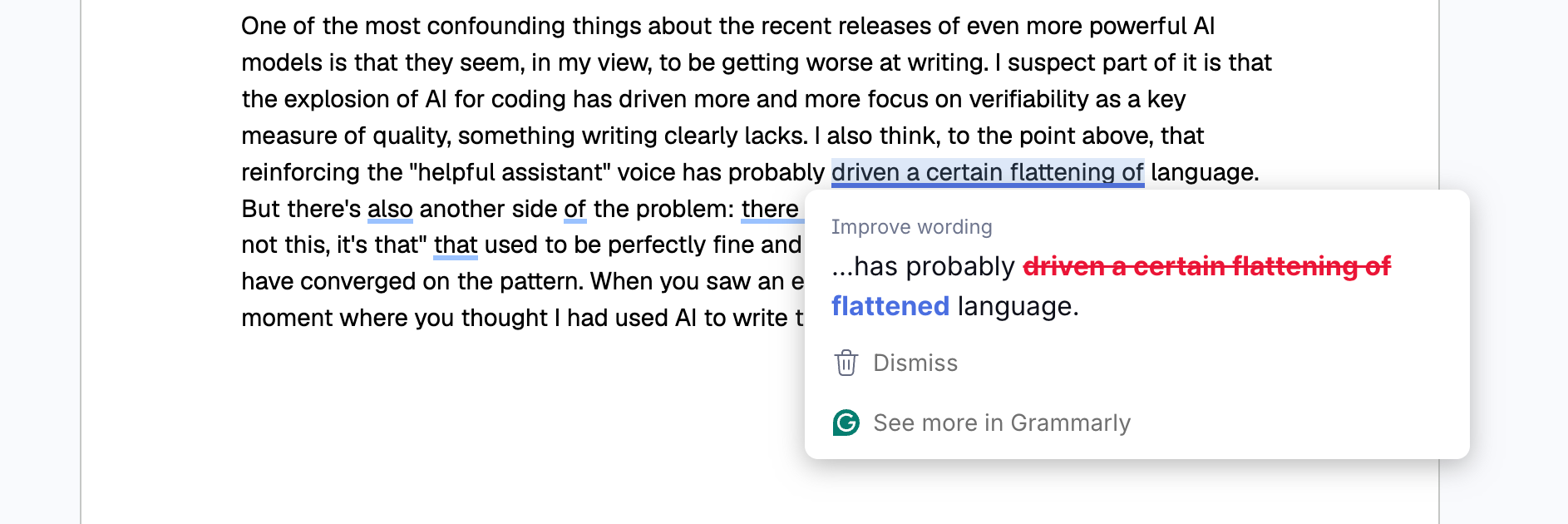
One of the most confounding things about the recent releases of even more powerful AI models is that they seem, in my view, to be getting worse at writing. I suspect part of it is that the explosion of AI for coding has driven more and more focus on verifiability as a key measure of quality, something writing clearly lacks. I also think, to the point above, that reinforcing the “helpful assistant” voice has probably driven a certain flattening of language. But there’s also another side of the problem: there are certain things like em dashes or “it’s not this, it’s that” that used to be perfectly fine and are now a danger zone because LLMs have converged on the pattern. When you saw an em dash above, you might have had a moment where you thought I had used AI to write this (I haven’t).
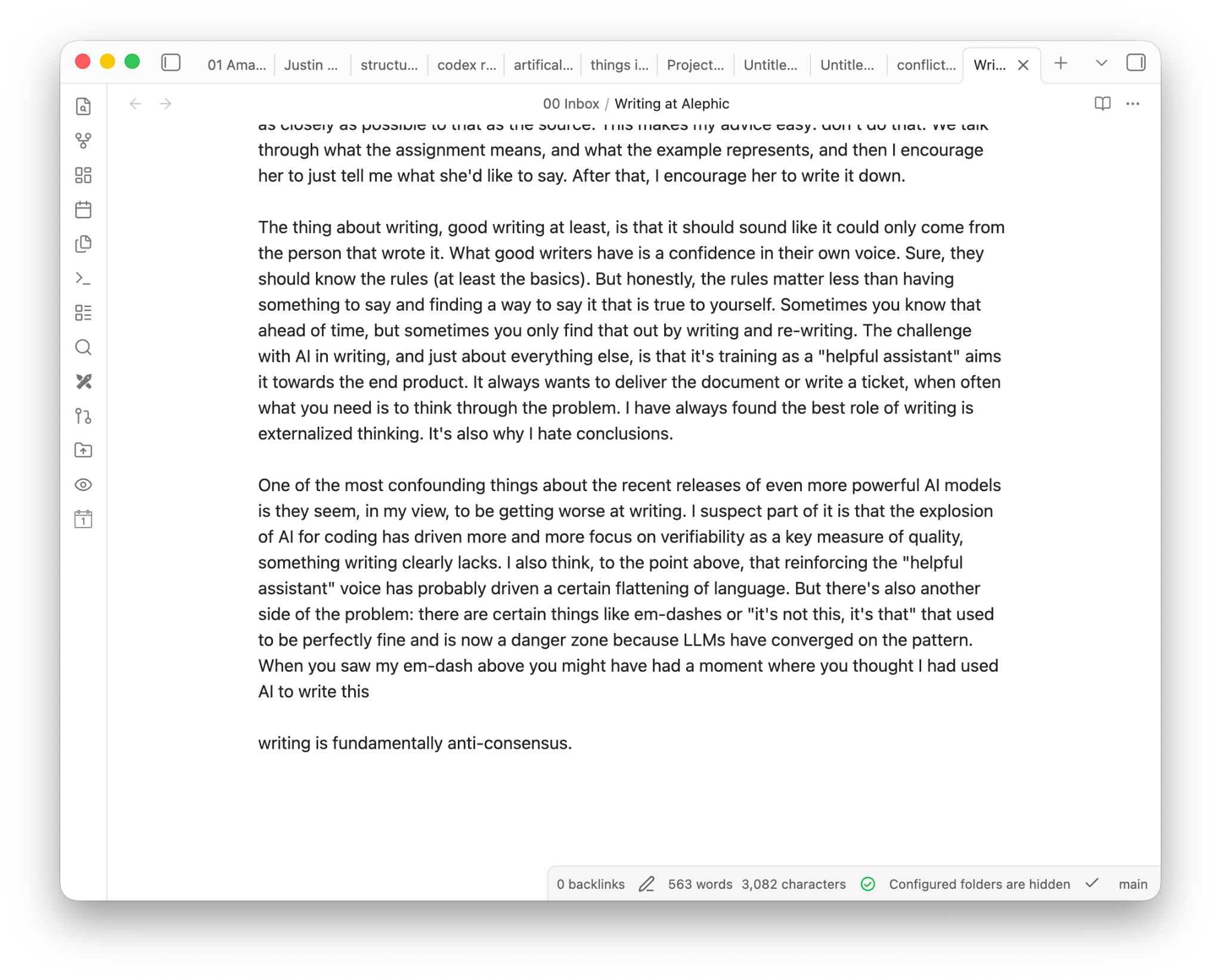
The problem, I think, is that good writing is fundamentally anti-consensus. For writing to be above average, it shouldn’t sound like everything else. My daughter might get a fine grade aping the teacher’s example essay, but the road to good, or even great, is doing it your own way.
On top of that, writing is a creative act and, as a creative act, the process matters as much, if not more, than the outcome. There’s a saying in law I was introduced to years ago: “Does it write?” Writing is figuring out whether there’s a there there. It’s an opportunity to test the validity of your thesis on yourself: can you string words, sentences, and paragraphs into an argument that still captures your intention and attention 700 words later?
With all this said, I’m obviously an AI maximalist. I used AI to collect thoughts, pull together references, and think through this essay. I believe we will and should use AI in certain kinds of writing. But I also believe that AI writing is fundamentally not good at the moment, and you should feel embarrassed to ship slop to readers. Like a lot of hard problems, there’s not a simple way to draw a line. But I think some good rules of thumb have emerged:
Writing is thinking, and if you’re interested in pushing forward your own perspective on an idea or problem, you should be the one hitting the keys.
Every sentence matters, and you should be prepared to stand behind each of them, regardless of whether you or AI wrote it. Respecting your reader means spending more time writing something than it would take them to read. (If your reader is another AI, then aligning to token time is obviously appropriate.)
Never let AI remove you. We are going to use lots of AI. I ran this essay through a few different systems (spelling, grammar, ideas). We should keep doing that, but it’s also okay to say no to suggestions. Grammarly wants me to add a bunch of semicolons and fix some technically incorrect sentence construction, but semicolons are not my style, and using a few extra “reallys” sounds more right in my head, so they’re staying put. If you don’t feel certain, it’s okay to have it read uncertain even though the AI and the writing manuals tell you not to. That’s you.
Slop kills good ideas. Sadly, even if you’ve got something great to say, if you open with six slop tells you’ve lost me.
Good writing is vigorous. Strunk and White said it best, “Vigorous writing is concise. A sentence should contain no unnecessary words, a paragraph no unnecessary sentences, for the same reason that a drawing should have no unnecessary lines and a machine no unnecessary parts. This requires not that the writer make all his sentences short, or that he avoid all detail and treat his subjects only in outline, but that every word tell.” Sadly, most LLMs treat writing like college freshmen: length is the goal.
Writing is anti-consensus: your voice is what makes your writing good, and no matter how much prompting you give a model, it’s not currently capable of getting there without real help.
Becoming a better writer is a worthwhile lifetime pursuit. None of us has reached the top of the mountain, there are always places to improve and new words to learn. We can always communicate our ideas more effectively.
This post was in part inspired by Clay’s writing policy and Vicki Boykis’ Write for people post.
Since you’ve made it to the bottom, one more reminder that BRXND NYC is coming up on 11/5, and tickets are currently $749. Get yours early, we will sell out.
yes! cultivating voice is so important in writing...and more and more difficult when language is getting its edges filed down by AI.