


BRXND NYC is 52 days away and as we get closer to the big day, I’ll be turning over more of the newsletter mic to our outstanding speakers and sponsors who are at the heart of how AI is fundamentally reshaping the way consumers build preference and purchase brands.
Today, we have a conversation with Justin Inman, Founder & CEO of Emberos, the operating system for AI brand management and a sponsor of this year’s show.
Justin will be on stage November 5 at the Times Center along with leaders at Amazon, Rocket Money, Bark, Microsoft and a whole bunch more being announced soon. Click the button below to grab your ticket or reach out to me at mike@brxnd.ai with any questions.
On AI Brand Management
“Knowing what ChatGPT says about your brand is useful. Knowing why it says it is more valuable. Knowing what is likely to change next, what you can do about it and whether that action worked is where this becomes an enterprise operating function.”
This quip is essentially Tom and I’s AI Search Maturity Index in a pithy 40-word nutshell. It’s also the final line in the press release announcing that Emberos, the operating system for AI brand management, raised a $5.5M seed round earlier this month.
Emberos is a newer player on the AI search scene but one I’ve followed closely since inception and marveled at the ambition around. Emberos operates a multi-agent platform that reads how AI represents a brand across the major LLMs, predicts outcomes, orchestrates fixes automatically, and proves lift through the Brand Knowledge Graph and Tiered AI Visibility Index. All in a company that is only a year and change old.
Thus, I’m ecstatic that Justin Inman, Founder CEO of Emberos, is taking the stage at BRXND to talk about how online discoverability has shifted in an AI/LLM driven search world and what brands can do to manage it proactively.
A former enterprise growth leader at Google, Justin was pivotal in helping major brands such as Amazon, Sony, Coca-Cola, and L’Oréal navigate marketing’s last major upheaval: digital transformation. He also serves on the IAB’s AI Board, where he shaped Measuring Visibility in the AI Era, the IAB’s industry playbook for measuring brand and publisher visibility across AI-powered discovery platforms.
Before he takes the stage at BRXND, Justin and I caught up to talk shop a bit on the current state of how AI perceives brands, the concept of a “brand “knowledge graph,” and the rising importance of creators in shaping a brand’s destiny with LLMs.
A lightly edited version of our conversation follows below:
Mike: You position Emberos as “brand management for the agentic era.”
I suppose my light devil’s advocate comment is that your brand should always have been consistent across channels, and this is just good hygiene with a new name on it.
How are the stakes and mechanisms of brand management different now than they were in the proverbial before LLM times?
Justin: Brand management has been around forever and it’s going to continue to be around. It’s just going to look a little different.
For the first time ever, marketers and brand managers have to think about a couple of new things. The first is they’re marketing to machines and bots. That hasn’t historically existed and it’s a different audience they’re going after.
The second piece is that the point of discovery is incredibly fragmented now. If you’re looking at this new world of AI chatbots becoming the front door of the internet for the first time ever, brand managers have to rethink that marketing funnel across awareness, consideration, intent, purchase. That’s all happening through a single layer now. The playbook of pushing people down the funnel looks very different in this world than what they’ve been trained up or educated on.
Brand managers historically marketed to different channels intentionally, because they knew different audiences lived on those channels. There might be different messaging on social versus your site versus PR, because that was intentional. The problem is that breaks in this world, because the LLMs favor coherence. The second you start to have different messaging, it gets confused, and that’s where we get into the hallucinations and all the other things that come with it.
In five years we probably won’t be calling it brand management for the agentic era, or AI brand management. It’s going to be just brand management, because it’s going to naturally encompass this.
Mike: So what does AI brand management look like at the CMO level?
Justin: CMOs are starting to realize that this is a brand coherence issue, and it has to touch not just your typical marketing teams, or the digital team, or the search team, or even the tech team. They all need to be orchestrating together.
They’re feeling the pain. They see their organic traffic getting crushed. They’re going into these LLMs themselves and seeing the positioning and the narrative across their brand and realizing it’s inaccurate.
Mike: AI brand management is a bit different than some of the more industry standard terms like generative engine optimization……but I get the sense that is intentional.
How do you counter-position Emberos against some of the other platforms enterprises are buying that have been in the market a bit longer than you have?
Justin: A lot of these companies are basically saying, here’s a box, play in it. We know, because we work across a bunch of different verticals, that what works within gaming is very different from what big beverage wants or banking wants. It’s a different universe, different relationships. So it’s a disservice to any customer using an off-the-shelf tool, they’re cracking the window, barely looking through, and not seeing the full picture.
A lot of the big platforms today are also looking at this as a content generation solution, you have to create more and more content to compete into these LLMs. They’re looking at it from a concept of push-to-publish, which is AI-generated content, which is AI slop in our opinion.
These are short-term visibility hacks with potentially long-term implications for your traditional search business. It’s a content treadmill that you will never be able to get off of. We don’ tdo that.
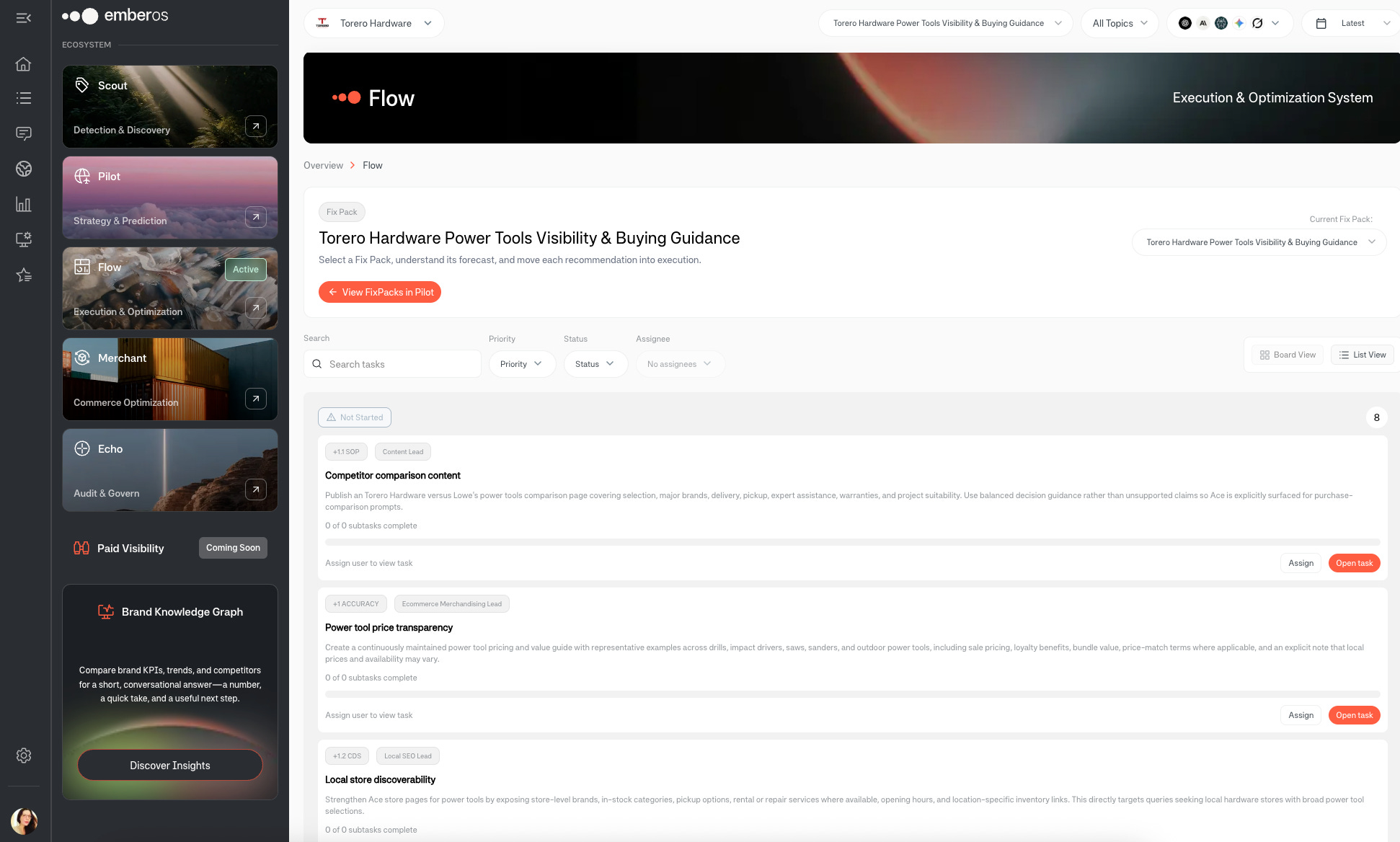
The Brand Knowledge Graph allows us to be way more focused on what you need to do. We look at the most highly authoritative cited sources and make optimizations against those, versus just more and more slop and content.
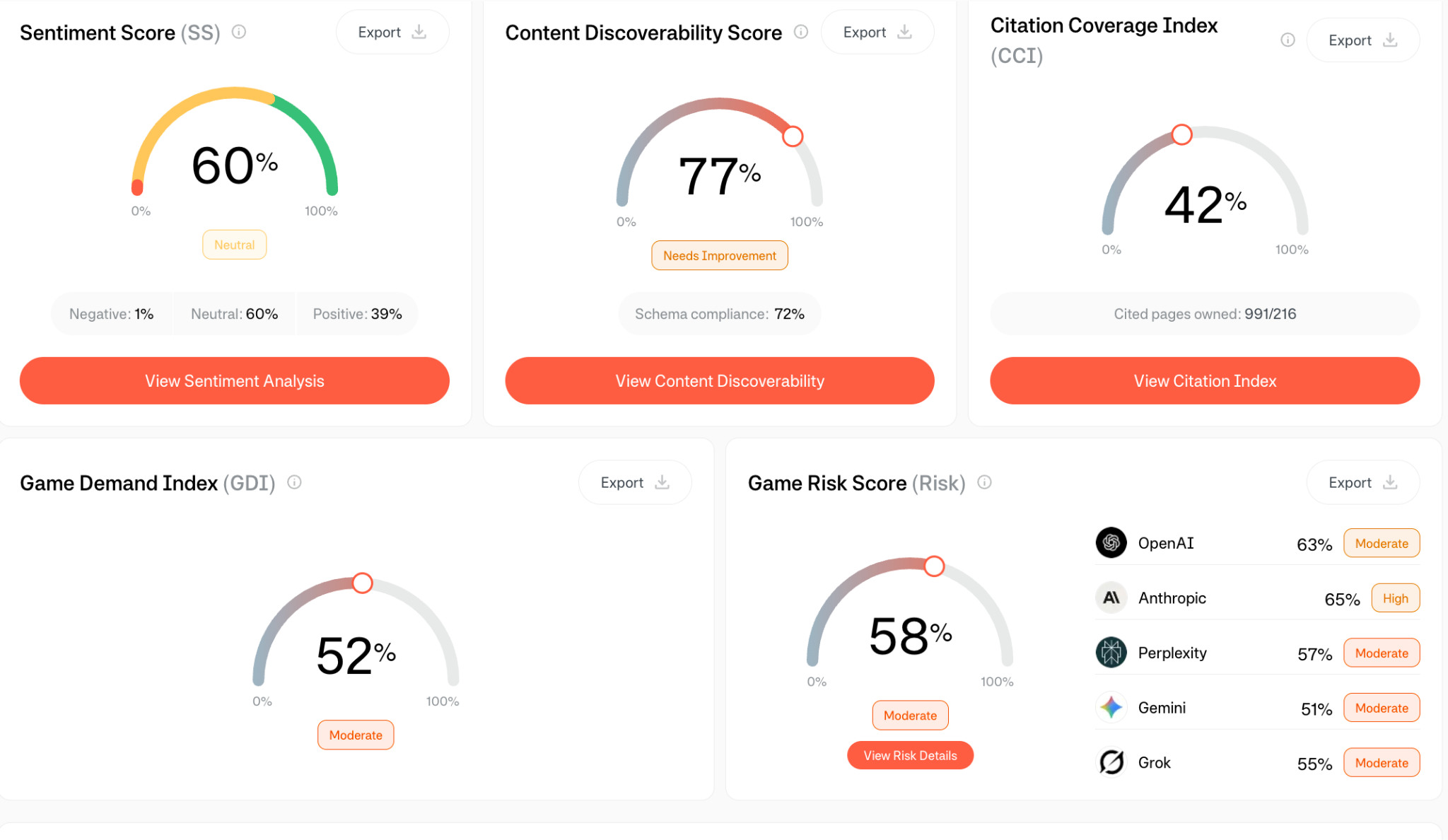
I’d also say a lot of platforms give you a laundry list of optimizations and never tie it back to any type of meaningful lift. At Emberos, we give you the biggest rocks to move with a predicted lift attached to it. We track those changes in our platform and then we show you the actualized lift. We’re the first closed-loop platform in that respect to hit the market.
Mike: Break down the Brand Knowledge Graph further for me. What are the core inputs, and how does that change how a model mediates brand preference?
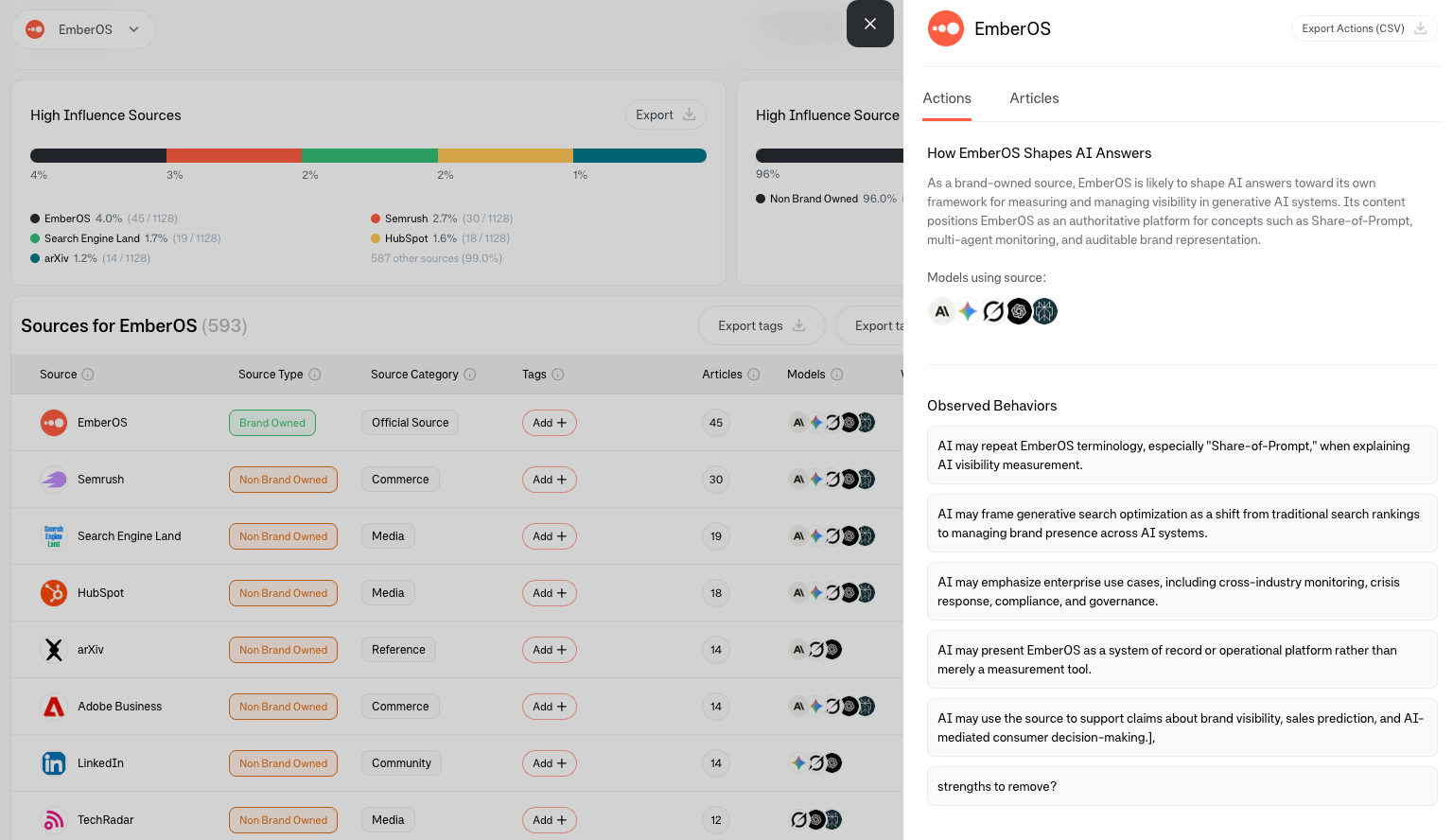
Justin: We can map over brands, products, creative assets, influencers, creators — you name it, it doesn’t matter. Once we map that over to our systems, we build up a node structure, and that node structure is dependent on the prompting layer. We essentially develop a city map of how the internet looks at that specific entity we’re tracking.
So we can see all the biggest influencing factors online, the publishers, the creators, the site itself, and how those all correlate to the entity we’re tracking. The cool thing is we can do it by the ecosystem of that brand. But we can also look at it at the vertical level, or from a competitive set.
Then we track all those relationships over time, which gives us a baseline, which unlocks the predictive capability. So we can say, if you make this change to this site, or get on this publisher, or work with this creator — because of that baseline, we predict that X outcome will happen.
I’d also say the tools today have not historically given a lot of insight for the why. They’re just giving you the how. The more advanced marketers we talk to have been working with a tool for X amount of time and there’s still a gap in fully understanding the reasons why competitors are gaining visibility.
Mike: A lot of your early clients are in entertainment and media where more than most categories, brand management is paramount.
What’s the canary in the coal mine for how media and entertainment businesses navigate the transition to AI search for marketers in other industries?
Justin: Entertainment’s an interesting one, and I learned this in my time at Google. It doesn’t matter what industry you’re in, every marketer looks at entertainment to find out what they’re doing. It’s partially because they have their finger on the pulse of culture better than any other industry.
They’re going to LLMs and seeing, for streamers, attribution in terms of where to stream — you’re Hulu and you’re seeing “stream this on Paramount+,” which is a massive issue. If you’re a studio, LLMs misgenre about 20% of the time.
The LLMs get confused about what these titles actually are about. If you have a title with the word “dead” in it, it automatically thinks it’s a thriller. But it might not be. So you have titles getting the wrong genre, wrong actors, wrong directors, or even wrong dates because the movie industry does a soft release and then the box office opening weekend, and if the model picks up the soft release, it’s wrong.
If moviegoers are asking what they should see this weekend, and the genre is labeled as a violent thriller but it’s actually a dark comedy, it alienates a whole portion of your population that could go see that movie. And it sticks. Six months later someone says, I liked this movie, give me 10 others. You need to be in the right genre and associated with the right comp set.
Same thing with gaming. If there’s Grand Theft Auto 1, 2, 3, 4, it’s very hard for the models to tell the differences between each one. Gamers are asking specifics about a specific title, and a lot of times it’s incorrect character associations, incorrect where to play, where to buy.
Mike: Talk to me a bit more about governance because I believe that will ultimately be the most important battleground for AI search, especially in the enterprise. Why is monitoring truth and compliance across AI such a hard problem and how does Emberos help brands here?
Justin: Every AI answer is generated on the spot, and it comes out different depending on the model, the user, and the day. There’s nothing fixed to review and nobody inside a brand currently is set up to own this governance. Legal owns claims, comms owns narrative, SEO owns content, and AI blends all three into one sentence that’s in nobody’s job description.
We created Echo for this reason. It validates what the models are saying before anyone acts on it, traces where the information came from, flags where they contradict each other, and keeps a record of who approved what. It’s a peek inside the black box of LLMs before you have an issue that you are chasing to fix.
That matters now because brands are moving from watching what AI says to acting on it. Once you’re making changes at that scale, you need to know the information behind them was accurate, and you need to be able to show what changed and why.

Mike: In a similar vein, you’ve been running a live public test of your predictive claims on box office data. Walk me through this and how this work might map to the larger zeitgeist of agentic commerce.
Justin: Back in Q4 we said, can we test our predictive capabilities at a macro level? We looked at a space that’s rapidly changing and allowed us to make a prediction and then relearn and retrain. That space was the box office.
So we have made it a practice. On Fridays we do a box office prediction, on Monday we see what the normalized numbers are, and then we retrain our models. What we’re looking at is how these titles show up in LLMs, and we’re seeing a strong correlation to box office revenue — the types of prompts people are asking, what we call Share-of-Prompt, and how that correlates to real-world business outcomes.
We see signal lead times almost 12 days before traditional Hollywood trackers. And in some cases our box office prediction is two to three times more accurate than traditional Hollywood trackers.
We’re not a box office prediction company, but we’re going to replicate that model across our priority verticals. The ultimate goal is to get enough reps under our belt to say, a 1% Share-of-Prompt increase equals X amount of box office. It gets really compelling when you think about SKU-level optimization and the agentic shopping world.
What we’ve also seen is companies that historically relied on Google search feeds to update their forecasting models — it’s broken, because AI Overviews and AI Mode are no longer a clean feed. We have companies scoping us to see if we can fill that gap.
Mike: So zooming out, where do you see your suite of tools most producing genuinely counterintuitive insight for marketing leaders to take action on?
Justin: What we’re doing around creators, those examples are an aha moment for marketers. We just worked with a running shoe company and said, here are the creators you’re currently working with. We mapped those over and said, these creators are actually getting cited in AI, but they’re not getting cited for your specific company. So that’s an issue. You need to restructure the creator content — and here’s the list of things you need the creator to say that will help get them cited more.
We’re rolling out something called a Creator Graph right now. More and more, the void is going to be filled with creators, because there’s not going to be enough content as publishers start blocking the labs to figure out their true citation influence before they renegotiate. But the issue with the creator stuff is we’re seeing creators who aren’t even creators influence models.
It’s a mom in a car with her daughter saying, I just gave my kid these vitamins, they’re great. And the video has all of 100 views!
Mike: What about the creators themselves and their representatives? How much are they starting to care about how their creator brand is mediated by AI?
Justin: Often, talent is driving influence over AI answers and the talent doesn’t even know it. Creators are always looking at shares, potential reach, maybe affiliate sales. I think the next new metric they’re going to be looking at, probably in the next 12 months, is citation. How much they’re actually driving the influence over the LLM output.
The bigger agencies are starting to wake up that the agents themselves are doing all the research for their clients. So if their clients aren’t represented correctly in these LLMs — where everyone is researching projects and potential brand partnerships — that’s a big issue.
Mike: Close this out for me in style. With a fresh round of funding in the bank, talk to me about what’s next for Emberos, particularly at the nexus of creators and AI search.
Justin: We’re constantly expanding the Emberos Brand Knowledge Graph, adding new models, mapping new categories, and making our predictions sharper. But what excites me most is our work with creators. It’s genuinely category-defining.
We can trace an idea from the creator who sparked it, through the conversations that gave it momentum, all the way to the AI-generated answer a customer ultimately reads. Then we help brands understand that journey, participate in it authentically, and shape it for maximum impact.
We built Emberos as an operating system for a market that refuses to stand still. As the relationship between creators, brands, and AI search evolves, Emberos evolves with it. That’s the kind of partner we want to be: not another platform brands have to keep up with, but the reason they stay ahead.
Justin Inman is the Founder and CEO of Emberos, the operating system for AI brand management. He’ll be on stage at BRXND NYC 2026 on November 5th at the Times Center.
To suggest additional builders that I should feature in this series, please get in touch at mike@brxnd.ai
As always, thanks for reading.
— Mike