


BRXND NYC is next Thursday and with one week until the show, I’m publishing the final interview in our series with our phenomenal speakers and sponsors.
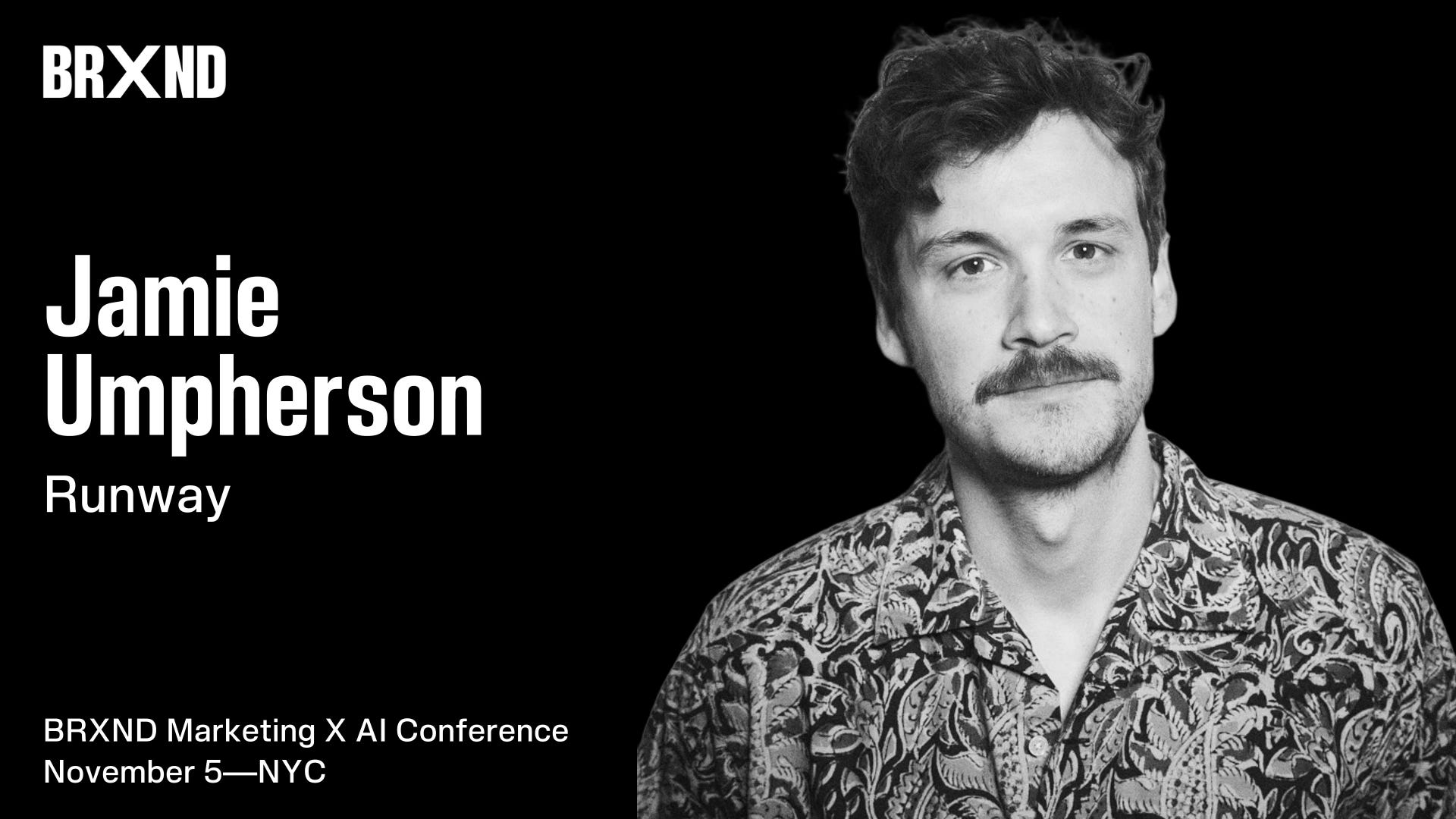
Today, we have a conversation with Jamie Umpherson, Chief Creative Officer of Runway, the applied AI research company building frontier video generation and world models, and the Apex Sponsor of this year’s show.
Jamie will be on stage November 5 at the Times Center with Meta’s Gabor Petlyanszki, plus leaders from Microsoft, Amazon, Hilton and many more. Click the button below to grab one of the last seats in the house or reach out to me at mike@brxnd.ai with any questions.
On Making Impossible Things
“After nearly a decade and a half of advertising, I had piles of notebooks full of ideas that never got made. They were too expensive, too time-intensive, or too hard to explain to a client in a slide.”
I suspect every marketer reading this has a version of Jamie Umpherson’s notebook: the graveyard where big, weird, audacious ideas go to die somewhere around what Jamie calls “round 72 of reviews.” For me, it’s the world’s gnarliest running Apple Note. As Chief Creative Officer of Runway, he’s spent nearly four years helping build the technology that finally gets those ideas out of the notebook and into the world.
When we announced Runway as the Apex Sponsor of BRXND NYC, I wrote that as a lifer in New York tech, it is incredibly inspiring to have a company building true frontier models right in our backyard. TechCrunch framed Runway’s scale of ambition well: “Every major AI lab is betting on language. Runway is betting they’re wrong.” Runway closed a $315 million Series E led by General Atlantic in February, roughly doubling its valuation to $5.3 billion, and crossed $200M in ARR in September. Its tools are now used by 95% of the Fortune 100.
Then came Runway’s AI Summit in San Francisco on September 30, which made clear the ambition doesn’t stop at the edit bay. Runway unveiled Praxis-1, an open-weight “world action model” that turns its video pretraining into control for real robots. It builds on Solaris, unveiled a month earlier, the first of what Runway calls “interface world models,” which generates software interfaces frame by frame in real time instead of rendering them from code.
And finally, there’s the launch that spoke to me most as a former growth leader: Runway Ads, an autonomous engine for performance marketing. Connect an ad account and a brand kit and it generates video and image creative, publishes approved variants to Meta, Google and TikTok, pulls the performance data back and generates the next batch of ads around whatever’s working.
By way of formal introduction, Jamie is Runway’s Chief Creative Officer and an internationally award-winning creative director who leads creative, brand and Runway Studios’ production and entertainment efforts.
Before he takes the stage at BRXND NYC on November 5 with Meta’s Gabor Petlyanszki, Jamie and I caught up on the coupon years, why AI is now closer to a whole production team than a camera, how brands stay on-model across hundreds of variations and why creatives should start thinking about brand experiences as worlds, not pages.
A lightly edited version of our conversation follows below:
Mike: Backing up a little – Jamie, you've been working with Runway for nearly four years now. What led you to the team? Also, I see you had a bit of an untraditional path and didn't go to portfolio school. Instead you managed a bar, designed coupons eight hours a day, and built your book at night.
What did the libation and coupon years teach you that still shows up in how you run creative at Runway?
Jamie: I was really lucky to have grown up in a house with a lot of different technology at my disposal. My dad was a bit obsessed with it and he happened to be a pilot so he was always traveling the world bringing back things that few others had access to yet.
We had a family camcorder before anyone else I knew did. We always had early copies of photoshop and premiere. And because my dad had a friend who owned a computer store, we always got the latest graphics cards and games. Not to mention we were among the first people in our town to have dial-up internet.
So I was always experimenting with new technologies to make things. Things that made me laugh. Made me think. Made it easier to share my view of things with others. And I was just obsessed with it all. And that never really went away.
After university, I was managing that bar and looking for a job that could allow me to be "creative." One conversation led to another, which led to an introduction, which led to me making coupons. Obviously not where I wanted to end up but a great opportunity to learn. And so I studied all the books and started putting a portfolio together. After a lot of doors knocked on, I got an internship that got me a job. But I was almost immediately keenly aware that advertising wasn't going to be a long term fix for me. Clients never wanted to make the work that I did. And on the rare occasions they did, by the time you got through round 72 of reviews, it didn't look much like the thing you were excited about in the first place.
So I was always making things for myself on the side. Often with technology. Which led me to the work our three founders were doing. And ultimately to my role here. It’s an impossibly perfect fit, since the technology we’re building is exactly what I’ve been searching and hoping for ever since I first stole the family camcorder. And that's how I approach things with the team, make the things you always wanted to make. Because that’s what this technology enables.
Mike: Most of your creative director career was spent agency-side. What made you walk away from the conventional creative director life to work on foundation models?
Jamie: As I mentioned already, I learned very quickly in agency life that big, truly novel, ideas rarely survive the process.
And after nearly a decade and a half of advertising, I had piles of notebooks full of ideas that never got made. They were too expensive, too time-intensive, or too hard to explain to a client in a slide.
I was always looking for technology that could help me get those ideas out of the notebook and into the world. That’s how I found Runway.
The irony is, I think things are now changing at agencies because of these tools. Now creatives can actually explore and properly present their big audacious ideas. You don't have to self-edit anymore. Or fear a first check-in with your producers. You really can go as big as you can imagine and there's now a viable path to making that idea real.

Mike: You once called Gen-2 "a new kind of camera." A few model generations later, does that metaphor still hold? Or has it become something closer to a crew, a set, a whole studio?
Jamie: Gen-2 was our first text-to-video model, and at that point a camera was exactly the right way to think about it: something you point at an idea to capture it.
Today I’d say it’s closer to a whole production team. You can cast a character from a few reference images and keep them consistent from shot to shot, which was one of the big challenges not that long ago. You can film a take yourself and transfer that performance onto a character. And if you’ve already shot something, you can use Runway to swap a background or a product just by describing the change.
What hasn’t changed is that this is all made with AI, not by AI. To make something worth watching, you have to be a strong storyteller. It comes down to the same fundamentals it always has: narrative, composition and taste. What’s different is that now anyone can chase their big ideas, not just the fortunate few.
Mike: You've said the technology is finally good enough that the story can be the story. But from where I sit, a lot of the brand conversation is still focused myopically about the tool that made the work and made-with-AI disclaimers
Are audiences actually past it? Are marketers?
Jamie: I’ve always believed true creatives are tool agnostic. They’ll adopt whatever gives them the most artistic range, and that’s been true in every medium. Photography didn’t end painting. It gave us a new art form, and the two have co-existed ever since. The digital camera didn’t end film photography. And so on, I see AI the same way: a new medium.
For a while, the conversation was about the tool because the tools weren’t quite there yet. In the last six months or so, they’ve gotten good enough that the industry is taking them seriously, and the conversation is starting to shift from the tool to the work.
We’ve reached the point where the technology is no longer the story. The story can be the story. And there are so many examples of that on full display with the work we’ve been putting out. From The Watch to Horse to our slate of films in Project Luxo. Viewers don’t care how something was made. They care if it’s good, whether it moves them, and whether it makes them feel something. So no matter who’s making the work, the question is the same as it’s always been: is there a great idea, and is the craft there to bring it to life?
Mike: Aleph 2.0 and Edit Studio are pitched around closing the gap between the video you have and the video you need. That feels like an underrated brand use case I’d love to draw out more.
What are teams doing with existing footage that's surprised you?
Jamie: What excites me is how much of the best work starts with a real shoot. People picture Runway generating something from nothing, but a lot of teams are starting from footage they’ve already captured.
A good example is Tropical, a Havas agency in Chile, which filmed a field hockey ad for Under Armour and wanted flames on the hockey sticks. Fire is one of the hardest things to add. Do it practically and it’s a complicated, expensive shoot. Do it in VFX and it’s still tough to get right, because you’ve got interactive light falling on the grass and on the players. So they shot the ad in daylight, made it look like night, and used Runway to add the flames afterward.
The everyday uses aren’t as flashy, but they matter just as much. You can shoot your core creative the way you always would, then version it for different aspect ratios, localize it, or swap the sweater on a character to change the season. You get a lot more out of the shoot. And can spend a lot more time (and budget) in the places you really want to.
Mike: Brand consistency is still one of the existential questions that comes up when it comes to AI creative.
How do Brand Kits, reference images, and agents now pulling Brand Kits through MCP keep a brand on-model across hundreds of variations? And where does it still take a human eye?
Jamie: The tools need to know your brand before they can stay on it. Brand Kits let your team put your products, colors and reference images in one place, so every generation starts from your world rather than a blank slate. Runway Agent can use your Brand Kit across everything it makes for you. And with Brand Kits now in our MCP, other AI agents can pull in your real brand assets too.
That gets you a long way across hundreds of variations, because the tools can hold the palette and the product. What they can’t hold is the judgment: does this feel like us, is this the right story to tell? Those calls matter more now, because it’s easy to make content and hard to make great content that carries a brand. So let the system handle the repetition, and let your team spend its time on those calls.
Mike: Going through the case studies on Runway, I really loved the Chime story: 85+ real members, a Brady Bunch-style end card, and the kicker line that they "simply would not have pitched or produced this scene practically."
What's the customer story you’re most inspired by, the one that best captures what's possible now that wasn't before?
Jamie: Chime is a great one. The one I’d add is Salomon, the French outdoor and sportswear brand, and their latest global campaign, made by a Paris studio called Unveil. Unveil was founded in 2023, and the founders weren’t directors, photographers or CGI artists before this.
The campaign launched around the opening of the Milan Olympics, and what I love is how Unveil got the job. They pitched the film by storyboarding the whole thing in Runway, 30 shots in all, so Salomon could see exactly what it would look like before anyone picked up a camera. What they ended up delivering was very close to that first vision.
Then they took a hybrid approach. They shot a real person in live action, over two days near Paris with a crew of about 60, and placed her inside AI-generated environments. When they told me there was no CGI in it, I was blown away. They estimated that a CGI or fully live-action version would have taken twice as long and never fit within the time and budget constraints.
What stays with me is that a young studio won a global client and made something that felt bigger than the budget on paper.
Mike: You launched Runway Ads, a product I’m really excited about as a former growth leader.
I particularly appreciated your quip that “there's no worse place for a creative department to find itself than making performance ads” as I remember the innate guilt I had bogging down our creative team with work that they…let’s just say…didn’t find to be the highest version of their calling.
Talk to me about the vision behind Runway Ads and how it gives creatives more time to focus on being creative.
Jamie: Runway Ads started as a solution to an internal problem. Performance marketing rewards volume, and we couldn’t scale ours by hand. Our team was buried in requests for new aspect ratios, language versions and swapped products. I knew this problem well from my agency days, and how quickly it can burn out great creatives.
So we built Runway Ads, an autonomous engine for performance marketing. It generates on-brand ads, localizes and resizes them, publishes to Meta, Google and TikTok, reads back what’s performing, and builds the next round around it. Your team approves what goes out by default, so people stay in charge.
The results internally have been significant. Since July, we’ve grown from 77 ads a week to roughly 900, while doubling our return on ad spend. Conversion is up about 34% with click-through holding steady, and our cost per subscriber is down 41%.
We realized plenty of other teams hit the same bottleneck, so we launched Runway Ads externally, with Lovable as an early design partner. The idea is simple: the repetitive work, the versions, resizes and translations, gets handled by the system, so your creatives can set the direction and spend their time on the big ideas, instead of the thirtieth aspect ratio.
Mike: Let’s talk a bit about Solaris and its implications for the BRXND audience
What's an "Interface World Model," and why should someone who runs a brand care about software that renders itself frame by frame?
Jamie: Today, a website or app starts as a design, gets translated into code and then that code gets rendered on your screen. An Interface World Model skips the middle step. Solaris, which is the world’s first interface model built by Runway, generates the interface itself, frame by frame and in real time, and every click or drag shapes what it draws next.
For a brand, that means the experience becomes something you step into instead of scroll through. A good example is a virtual clothing store where the showroom itself is the interface. You move through the space, pick up a jacket, and the scene responds to you, instead of clicking through a grid of product pages. I’ve been saying for a while that brands will build worlds people can live inside. It’s early, but creatives should start thinking about brand experiences as worlds, not pages.
Mike: Your X bio says "Let's make things. We have the technology."
Close this out for me in style: what's one thing every CMO reading this should aspire to make with Runway in the next 30 days?
Jamie: Take the idea that’s been sitting in a notebook or a forgotten pitch deck. Every team has one: the idea you loved that was too expensive, too weird or too hard to explain.
Don’t make a deck about it. Make the thing. You’ll learn more in a week of making than in six months of talking about it.
And if you’re coming to BRXND in November, bring it with you. I’d love to see what people make.
Jamie Umpherson is the Chief Creative Officer of Runway and Runway Studios. He’ll be on stage at BRXND NYC 2026 on November 5th at the Times Center.
To suggest additional builders that I should feature in this series, please get in touch at mike@brxnd.ai
As always, thanks for reading.
— Mike