


We’re just three weeks and change out from BRXND NYC 2026 at the Times Center and as we prepare for the big event, I’m continuing my interview series with another one of our phenomenal speakers and sponsors.
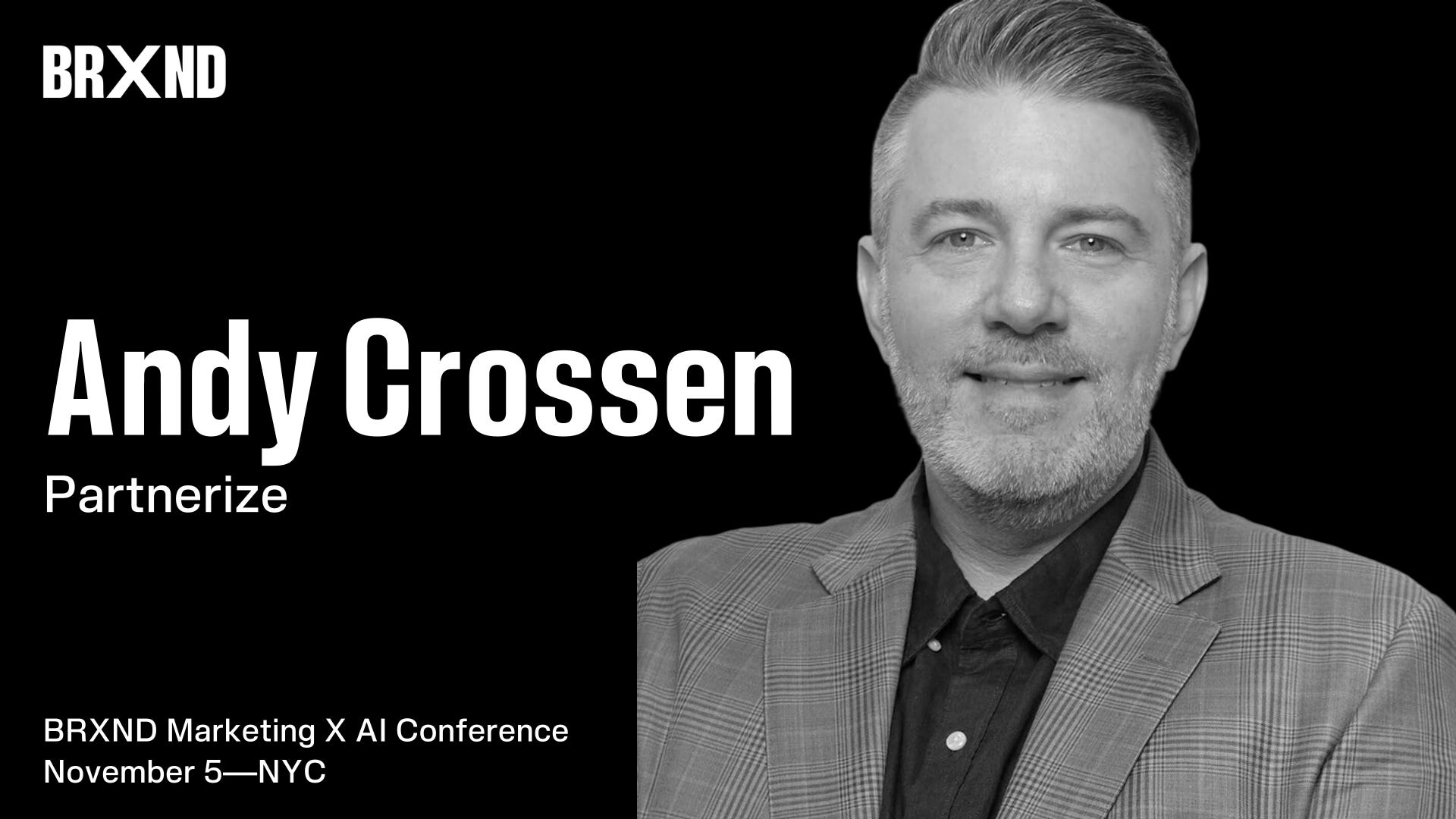
Today, we have a conversation with Andy Crossen, Chief Product and Technology Officer of VantagePoint™ by Partnerize, a company that sits at the heart of measuring how AI is fundamentally reshaping the way consumers build preference and purchase brands.
To see Andy alongside leaders from Microsoft, Amazon, Runway, Rocket Money and many more on stage on Nov. 5, click the button below to grab one of the last seats in the house.
On The Economic Infrastructure of AI Commerce
For most of my career as a marketer, I thought about my reporting and analytics tools the way an economist thinks about the unemployment rate.
While the current unemployment rate in the United States is 4.2%, I doubt you can find a single soul in this nation who believes that only 1 in 25 Americans are actively looking for work but do not have a job. Millions of Americans who the Bureau of Labor Statistics claim have “left the workforce” would prefer to be working. So why do economists watch this collective delusion so closely?
Ultimately, it’s simply the best measurable and directional metric we have where basis point shifts are truly microcosmic of employment trends. As much as anything else, the unemployment rate is probably the best tool we have for measuring the vibes of the United States economy.
Every era of media has run on a system of record like this. Television had Nielsen reports. The web had the click, and an entire industry of cookies, pixels, device graphs and attribution models grew up to count it. Those numbers were never as precise as we all pretended, but they directionally tamed the chaos of digital advertising and hundreds of billions of dollars in media got allocated against them every year.
But every current framework for measuring web traffic and ad performance is based on the notion that a real user with real little fingers is clicking on content. That assumption no longer holds. LLMs don’t just marginally disrupt understanding which entities influenced a purchase; they shatter much of the deterministic marketing attribution-industrial complex. Entirely new methodologies and governance layers will need to be built to probabilistically infer what influences buyer journeys in LLMs and eventually, what convinces agents to buy.
Since I first met Andy Crossen when I was at PayPal last year and got a preview of the thinking behind what would ultimately become VantagePoint™ by Partnerize, I’ve been convinced he and his team are building one of the most important technologies for marketing leaders to navigate a world where most purchase decisions are mediated by AI.
By way of formal introduction, Andy is the Chief Product and Technology Officer at Partnerize, where he owns product vision & execution. He’s spent more than 25 years at the intersection of marketing, measurement, and AI, co-authoring six patents along the way. Andy holds a Ph.D. in Computer Science from the Intelligent Information Laboratory at Northwestern University.
Before he takes the stage to showcase VantagePoint™ at BRXND NYC on November 5, I caught up with him to jam about the end of conventional web analytics, what a system of record for the zero-click era needs to look like, and how understanding AI journeys could reprice the media plan for CMOs.
A lightly edited version of our conversation follows below:
On how AI broke marketing analytics
Mike: Let’s start big picture. I don’t think people appreciate how quickly click-based analytics went from directionally interesting for CMOs to borderline pseudoscience as LLMs eat conventional product search.
You have as good a front row seat to this as anyone in tech: talk to me about what you’re seeing on the front lines and if this narrative tracks reality.
Andy: The narrative tracks. Even when the click survives, it shows up late, after the decision got made somewhere nobody was measuring.
A shopper asks an AI for the best running shoe for flat feet. She reads an answer stitched together from six sources, closes the tab, and types the brand name into a browser two days later. Your analytics credits branded search. The six sources that did the persuading get nothing.
We see that pattern at scale. Across the publishers and categories we measure, the median runs just under four zero-click conversions for every one that last-click recognizes. So the dashboard is still accurate about the receipt. It just lost track of the sale.
I’d go a little easier than pseudoscience. Click analytics was always a proxy. For twenty years the proxy moved with the thing it stood for. Now the two have come apart, and most dashboards haven’t been told.
Mike: When you’re in the room with senior leaders at brands, do you still have to introduce the zero-click phenomenon or is there already an acute pain point?
Andy: Almost never anymore. A year ago I spent the first twenty minutes of every meeting explaining zero-click. Now the room is usually ahead of me.
Earlier this year we ran a study with eMarketer, surveying 100 U.S. marketing leaders, and the numbers say the same thing. 91% agree AI-driven discovery is already changing how they approach marketing. 60% call it the hardest channel to attribute. Only 8% can track its influence on revenue and conversions end to end. So nearly everyone believes it, and almost nobody can measure it.
They’ve already swallowed the pill. They believe strongly that visibility does not equal value. What they need now is validation. Only 13% have a clear way to connect AI-driven visibility to partner compensation. That’s the gap.
The number I’d underline is a different one. Nearly two-thirds worry that publishers and content partners will prioritize competitors who can measure and reward AI influence. They’re right to worry. The content that shapes AI answers is a supply market, and supply goes where it gets paid.
So the question has changed. It used to be whether this is real. Now it’s whether they can prove it on their own numbers before a competitor does.
Mike: So which leaders at brands are feeling the pain from suddenly flying blind most acutely?
Andy: Whoever owns the media plan and has to defend it upstairs. Heads of marketing science and analytics, heads of media, growth leaders, and more and more often the CFO’s office. These are people whose models used to reconcile and now don’t. The Marketing Mix Model (MMM) says one thing. Last-click says another. The AI answers their customers actually read show up in neither.
It’s sharpest in considered purchases. Financial services, travel, performance gear, anything a shopper researches before buying. Those journeys moved into AI answers first, and they carry the most money per decision.
The person I’d keep an eye on is whoever signs off on the branded search budget. They’re about to get some questions.
Mike: In a similar vein, what’s the biggest aha moment you’ve seen from a senior decision-maker when they see what you are building for the first time?
Andy: The one I keep coming back to was a meeting with two senior executives who run all paid media at one of the largest software companies in the world. You’d know the name. They’d sat through every measurement pitch of the last fifteen years and had the posture to prove it. They also already had the AEO tools, so they knew which publishers AI cites most about them and their competitors.
We put the same categories on the screen, ranked a different way. By the conversions running through those publishers with no click, and what that influence is worth. The list changed. A content category that barely registered in their citation reports was driving real purchases, and their main competitors were already there. They went quiet for a while. Then one of them said, “Wow. That is very interesting. We’ve never considered that content category, nor did we know our main competitors were capitalizing on that type of content.”
That’s the gap. Citation counts tell you who gets mentioned. They stop before the purchase, so they never get to who earned the sale or who should get paid for it, and they rank the wrong things first. Follow the influence all the way through, and the conversation leaves the content team and lands on the media budget.
The aha tends to land the same way. People find sources they’ve never paid, never measured, and never thanked sitting at the center of their customers’ decisions, often with competitors already there. Then they do the math on what they have been paying for.
Mike: One thing that genuinely excites me about LLMs eating so much of the attribution-industrial complex is that we finally get some intellectual honesty about how much understanding influence was a guessing game and never as deterministic as pure performance marketers pretended it was.
But it feels like the old Wanamaker quip of not knowing which half of marketing spend is wasted is the strongest it has been in my career. Are you feeling this too?
Andy: Wanamaker was an optimist. He assumed he knew it was half.
The attribution industry spent twenty years selling determinism. Every conversion had a parent, and the parent was usually the last thing that touched it. That was always a convenience. AI answers made it impossible to keep up the act, because the influence now happens inside a model’s response with no pixel in the room.
I’m glad. Honest measurement is probabilistic. You observe behavior across a large consented panel, model it, publish how you did it, and let an independent auditor check the work. TV got measured that way for seventy years. Performance marketing skipped the step because the click looked like proof. Mostly it was a timestamp.
On VantagePoint™ as the new system of record for a zero-click future
Mike: Let’s go deeper around what you’re building. Your site describes VantagePoint™ as a way to “measure, verify and reward AI influence in eCommerce,” and calls it “the measurement, governance, and economic infrastructure for the zero-click economy.”
What should the key CMO-level takeaway be here?
Andy: AI answers are a media channel now, and most brands are buying it blind. The content those answers cite is shaping purchase decisions in your category every day, and almost none of it shows up in your reporting.
VantagePoint™ works in five layers. Visibility identifies where you show up. Influence shows which sources shape what people buy. Verification makes the number hold up with your CFO. Governance sets how it feeds the budget. Compensation lets the sources that earned it get paid.
The CMO takeaway is that this lands on the media plan. It touches the search line, the PR budget, creator spend, and the content team. Park it with one team, and you’ve shrunk the opportunity to fit the org chart.
Mike: Talk to me a bit more about the HaloIndex™ specifically, which compares influence that VantagePoint™ observed against influence traditional last-click measurement recognizes.
What can you share about the methodology here?
Andy: HaloIndex™ answers one question. For a given source, how does its measured zero-click influence compare with its last-click performance? Across what we measure, the median sits just under four. That’s a lot left on the table.
The method starts with a large, consented, opt-in clickstream panel, so we see real journeys. A shopper searches, gets an AI answer citing a set of sources, and later buys on a brand’s site without clicking any of them. We anchor on the end of the journey, the order confirmation, and work backward.
HaloIndex™ tells you how much. A second layer tells you who. When an answer cites eight sources, which ones earned the sale? These models aren’t invertible. You can’t open one up and read off why it chose what it chose. So we reconstruct it, weighing each source on authority, evidence quality, brand and product sentiment, and fit with the shopper’s intent, then we verify the influence across the set.
We publish what goes into the model. The computation stays ours.
Mike: Most of the AI search conversation over the last year has been about visibility: tracking what the models say about your brand and how often they cite you. What’s the gap between understanding zero-click journeys and starting to actually influence them?
Andy: Visibility tools count mentions. Mentions are cheap. One of the larger visibility platforms said publicly that about 95% of the citations they track are earned or social. That was the whole poker hand. The answers are built from content brands don’t own and mostly don’t pay for.
So the visibility dashboard hands you a list. A thousand publishers in rank-sort order. Then what? Are you going to reach out to all thousand and hope the right ones drive the additional value?
The gap is economic. You need to know which sources drive purchases, how many, and what that’s worth, so you can put money behind the ones that matter and stop guessing on the rest. Visibility with no price attached is a vanity metric with better fonts.
Mike: Every era of media has had a system of record everyone agreed to trade on: Nielsen for TV, the click, Google Analytics and various attribution tools for the web.
How do you build a true system of record for marketers in an age where AI is the primary interface to the internet?
Andy: Start with why Nielsen won. Buyers and sellers agreed to trade on it. Precision came later, if it came at all.
A system of record for AI-mediated commerce needs three things. It has to be independent. The platforms producing the answers can’t also grade them. It has to be audited. We’re an AAM Certified Platform, and we’ve formally entered the Media Rating Council accreditation process (Service Under Review). That path is rigorous on purpose. And it has to be transactable. A metric becomes a currency the day someone writes a check against it. That takes stable definitions, a disclosed method, and outputs a brand and a publisher can both look at and accept.
It also has to sit where the decision happens. Shoppers now decide inside AI answers. The measurement has to live there too, instead of waiting at the checkout page for a click that may never come.
On how VantagePoint™ reprices the media plan
Mike: If I’m a marketing leader, one of my chief concerns is that my media dollars go to the places that actually create demand when consumers shop through AI vs. merely capturing it.
How does VantagePoint help me understand this dynamic?
Andy: It comes down to the gap between a source that shapes consideration early and a source that grabs the click at checkout. Last-click pays the second group and misses the first.
HaloIndex™ separates them. Above 1.0, a source’s zero-click influence outruns its last-click performance. That source is creating demand. Below 1.0, it’s mostly collecting it.
Now pan out and put that next to your spend. Imagine your marketing dollars laid out by channel and source against the measured contribution of each. Where spend and contribution line up, keep going. Where you’re paying heavily for capture, ask harder questions. Where zero-click influence is strong, and spend is zero, you’ve found your highest-return opportunity.
Mike: As VantagePoint™ gets adopted in the market, where are there going to be some emperor-has-no-clothes moments where brands are spending big on media today and which channels do you think will prove to be undervalued?
Andy: Branded paid search is the obvious one. Plenty of brands are paying to intercept customers they already convinced somewhere else. VantagePoint™ shows where that somewhere else was. I expect a few marketing leaders to have the moment of, “Actually, wait a minute. I’ve been throwing all this dough at paid search, and I’ve been hand-waving my way through that budget review for years.”
The undervalued side is earned and expert content. Reviews, deep product explainers, the specialist publishers and creators who know a category cold. That’s what the models cite. PR has been the least measured line in the marketing budget for decades. It’s about to get a scoreboard.
I’d add owned content. Brands with evidence-rich product pages get cited. Brands with a thin product page and a big ad budget get skipped.
Mike: You know we have to touch on my favorite subject. As agents mediate more transactions and autonomously purchase on a user’s behalf, there’s going to be significant marketing efforts to try and influence agents at the point of inference.
This will likely give rise to an entirely new class of tools to understand which marketing efforts influence agents and possibly even payment structures that directly compensate for agentic influence?
How does the infrastructure you are building for VantagePoint™ map to that world?
Andy: It maps directly. An agent does in milliseconds what a shopper does in an afternoon. It reads sources, builds a shortlist, picks one, and pays. The click disappears completely. The influence is still there.
Every layer we’ve built carries over. You still need to see what the agent read, measure which sources shaped the shortlist, verify against real outcomes, and pay the sources that mattered. The difference is the buyer. Models don’t respond to brand campaigns. They respond to evidence. Agents don’t have brand loyalty. They have retrieval.
That’s where the partner marketing label stops fitting. Call it media pricing for a buyer who never sees an ad. That market will need common rules for how content gets ranked and disclosed inside agent workflows. Those rules should be open, and no single vendor should own them, us included.
Mike: Take the last word. What are you most excited about building in the months and quarters ahead?
Andy: Getting this into more hands. Today the people who’ve seen their own zero-click numbers are a small group of large brands. Every brand should be able to look up its own footprint, so we’re building a free self-serve view that does exactly that. Then comes the harder part: closing the loop between what a brand measures and where it spends.
The goal is simple. In a couple of years, a CMO walks into the budget meeting with a number for AI influence, the same way she walks in with reach and frequency today. Nobody spends the meeting asking whether it’s real. They spend it deciding where the money goes.
Andy Crossen is the Chief Product and Technology Officer at Partnerize. He’ll be on stage at BRXND NYC 2026 on November 5th at the Times Center.
If you have any questions, please be in touch. As always, thanks for reading.
— Mike