


You’re getting this email as a subscriber to the BRXND Dispatch, a newsletter at the intersection of marketing and AI. Forward it to a friend, they’d like that, and so would we.
Today’s essay is a deep-dive on where ads sit at the center of OpenAI’s grand strategy and how the company is putting its $100B media ambition into frenetic action. We also have a roundup of news from a week where decades happened and a fascinating job posting to build a decentralized ad network for the long tail of AI applications.
OpenAI’s Existential Ad Ambitions
Successful consumer tech businesses are all alike. Every unsuccessful consumer tech business is unsuccessful in its own way.
With apologies to Count Tolstoy, what binds every happy mass scale consumer product is an inevitable embrace of advertising. The main character’s arc is a tale as old as time– a dogmatic stance against advertising replaced by a tweet that looks something like this.
Three months after Sam Altman officially declared OpenAI would launch ads, The Information reports that OpenAI is projecting $11B in ads revenue for next year and $102B in 2030.
Google took 18 years to hit $100B in revenue after launching AdWords. Meta took 15. Now OpenAI is promising to get there in less than five. The math is somewhere between audacious and preposterous. Eric Seufert has a great breakdown of the reverse engineering and requisite product implications.
But here’s what has my attention– if OpenAI is planting a flag in the press that they will build a $100B ads business by 2030, ads are squarely at the center of grand strategy.
Fidji Simo’s plan is now squarely coming into focus and is grounded in two major pillars:
1) Reorient the core ChatGPT free experience to provide an appropriate contextual environment for an ads business. Fully commit to ads rather than commerce as the underlying business model.
2) Kill off darlings (i.e. Sora, shopping research, possibly Atlas soon?) that drain precious compute and don’t cleanly ladder up towards monetizing via ads in consumer or coding in the enterprise.
At first blush, OpenAI can look like a company that is oscillating haphazardly between whether it wants to be an egalitarian consumer product or an enterprise power. In the span of two days in early March, they launched GPT 5.3 to make “everyday conversations more useful and fluid” and then GPT 5.4 for “maximum performance on complex, professional tasks.” But it’s a unified endgame.
As Anthropic surges past OpenAI in total ARR (albeit with some questions on methodology), OpenAI’s current line against them is grounded in flexing its compute advantage, accusing its chief rival of being ill-prepared for the current surge in AI demand. Greg Brockman is even more aggressive in this video, speaking with the bravado of a man who seems to know he has a massive compute advantage. If he’s right, we’ll likely all be using a lot more Codex in months ahead.
Short-term, having more compute is largely a function of bolder demand planning and capital expenditure. But eventually, sheer scale of revenue will matter if this becomes a bidding war for GPUs. And OpenAI predicting a $100B line item in a spot where Anthropic still has a zero burger in ads is a hell of a trump card.
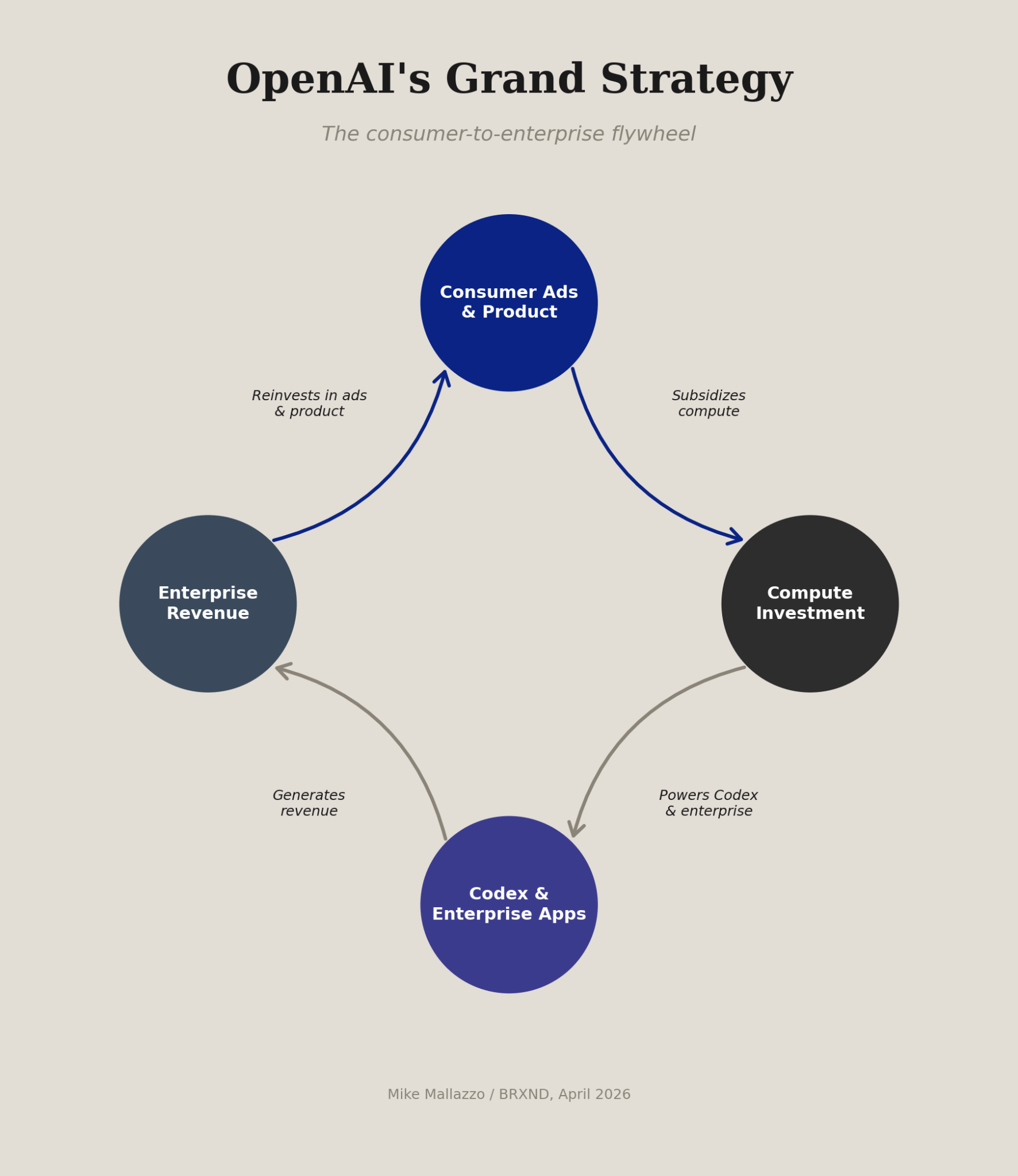
There’s a beautiful flywheel taking shape here. Blitzscale ads in the consumer product to subsidize compute -> use said compute to invigorate Codex and other applications to win enterprise market share -> plow additional enterprise revenue into improving ads engine + consumer product -> rinse and repeat.
While this flywheel sounds great in principle, it is predicated on building a massive advertising business on a surface where the first pilots didn’t launch until two months ago.
Nearly every product update that is made on ChatGPT on anything below the Pro tier must be squarely geared towards creating the contextual environment to support an advertising business. And that is exactly what is happening.
The fastest walled garden ever built
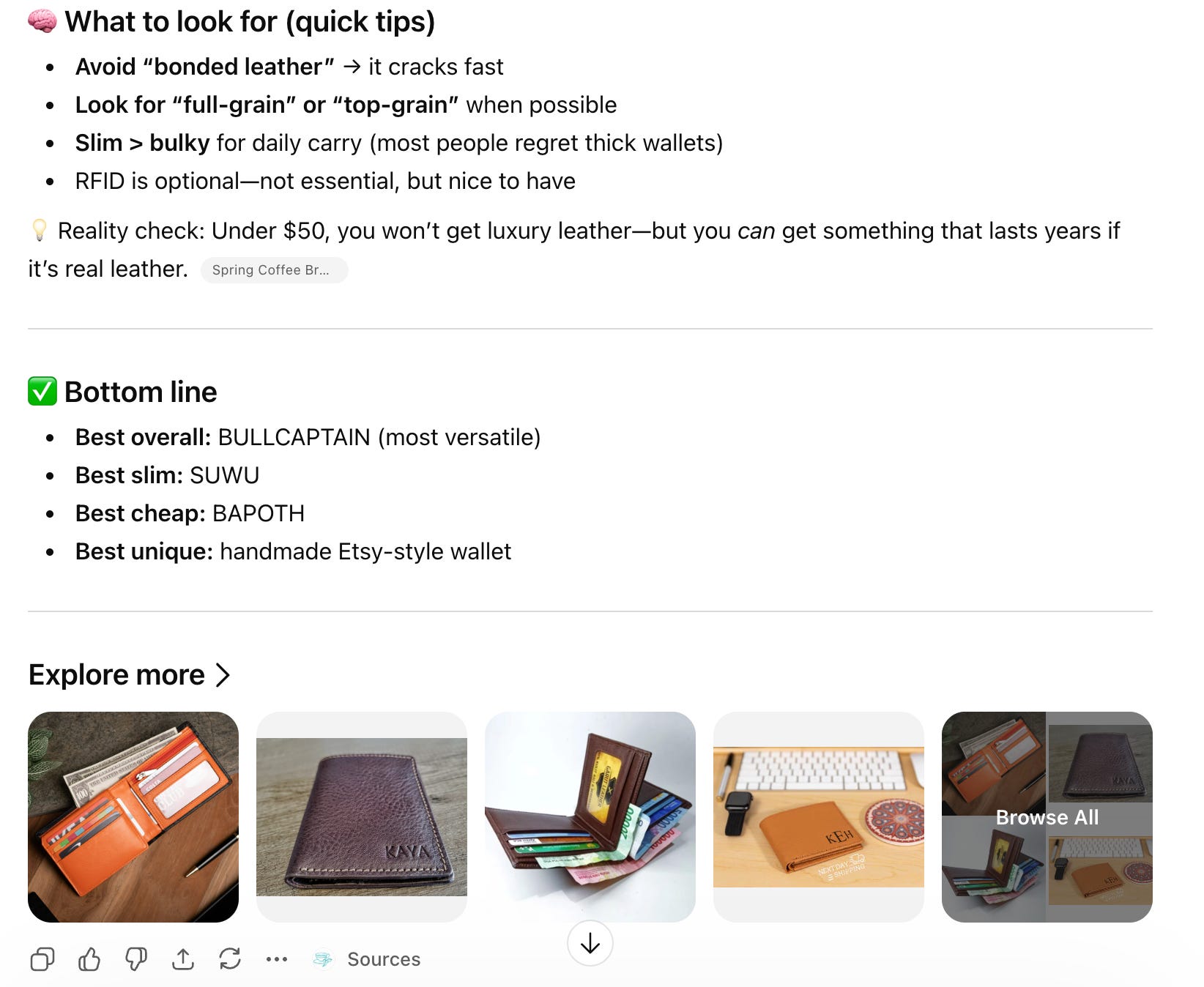
With a massive nod to my friend Joe Kzaziukenas for the find, ChatGPT’s browsable product catalog now lives at the bottom of every shopping conversation. The results can not be sponsored yet…but this is absolutely perfect contextual adjacency for the CPC offering that OpenAI has announced.
The obvious inspiration here is Amazon’s sponsored products juggernaut, a $60B business last year. Jassy’s 2025 letter to shareholders barely even acknowledges that Amazon is a retailer outside the context of its marketplace providing the backdrop to an ads business. Modern retailers are media businesses masquerading as purveyors of goods.
It took Amazon well over a decade and multiple direct interventions from Jeff Bezos himself to open up the bulk of their product recommendations inventory to advertising. OpenAI looks poised to do so barely one year after declaring ads would be a “last resort.”
Pivoting the product around advertising is also starting to have major implications on core ChatGPT design decisions. Buried in this week’s glossier AI headlines is the incredibly important observation that ChatGPT 5.3 is linking out to external websites far less frequently than previous models. This has pragmatic implications for marketing leaders, notably that the highly nebulous art of tracking purchase influence from ChatGPT is about to get a lot harder. Direct referral traffic and citations will become even more sparse, even as more unattributed discovery happens in ChatGPT results.
This is all in service of what I strongly suspect will be the quickest walled garden ever assembled. The technology, the user, the data and the ad inventory will all live inside ChatGPT. For now, OpenAI is using Criteo to rapidly scale its advertiser base and is in conversations with The Trade Desk and others to do the same but those will be tenuous alliances at best.
It’s so early that OpenAI still has zero publicly listed advertising sales roles on its careers page. Eventually the armada of Keiths from Northeast Regional and Jans the Man will come. In time, I venture that OpenAI will source all demand in-house save for one partner that just invested $50B into the business. These are dark days for open web advertising.
Sacrosanct and Enigmatic
Much like the DSPs, I suspect that OpenAI will soon have an uneasy strategic relationship with the rapidly growing AEO industry. On the one hand, they are great enterprise customers—Profound, Evertune, Bluefish and the like are pretty unbridled tokenmaxxers. They also represent a rare category of marketing tech software that is getting direct interest from the CMO. But OpenAI needs that CMO attention to be elsewhere.
OpenAI needs its underlying model responses to be perceived as both sacrosanct and somewhat enigmatic to be successful longterm. If users feel that the models can be gamed by advertisers, they will lose trust. If marketers feel that they can exploit scalable AEO hacks, they are less likely to pony up for a nascent ads product.
The message OpenAI needs to convey to CMOs to succeed here is dead simple: you can’t “beat” a probabilistic model. But you can generate scalable performance by buying ads adjacent to one.
*********************************
Of course, this is all easier said than done. The road to stagnation is paved with companies who never crossed the chasm from attracting brand vs. performance dollars– ask Snap and Pinterest what that looks like. The three companies that cracked performance now command 62% of all digital ad spend. To win, OpenAI will have to nip some amount of Google-Meta-Amazon tripoly budget and absolutely devour what’s left from second tier players and retail media networks.
On X, Zach Coelius argues in an interesting thread that OpenAI is currently “failing badly” in that regard, citing examples of previous failed ad products that adapted yesterday’s interfaces rather than thinking from first principles. The MVP of the self-serve portal looks equally minimalistic and unimpressive.
I wouldn’t draw too many conclusions from either of these things though. The initial beta is likely to be a red herring in the ads product that OpenAI ultimately builds. What really matters for marketers is that OpenAI is now unapologetically all in ads.
In their initial formal comms, OpenAI sounded bizarrely trepidatious and almost apologetic for introducing advertising into ChatGPT. Now, the company line is that ads help to cure cancer.
Featured Job
Founding Head of Ad Sales, Koah
A fascinating new class of firms is popping up that are effectively building ad networks for AI outside the walled gardens of the foundation models. They include ZeroClick ($55M raised), Thrad and Koah, who is looking to bring on a founding sales leader.
For a first principles media seller or marketing leaders who wants to jump to the other side of the fence, it’s hard for me to imagine a more exciting gig. Raw demand from performance marketers for new arbitrage opportunities in LLMs is insatiable.
Thus, while every startup endeavor is a grind, I’d expect this to be far more a cerebral sales gig than most. How do you educate marketers on thinking about incrementally from a new surface? Do you default to traditional business models (i.e. CPC) or dream up new monetization engines that have not yet existed?
Broadly, I’m bullish on this space for three reasons despite the obvious risk that the walled gardens eat everything
1) The TAM for advertising in LLM applications is gargantuan— see OpenAI $100B shot call above
2) Precedent exists for highly lucrative, elegant specialty AI application with an ads based business model (see- OpenEvidence)
3) Subscription fatigue in AI products will get very real very soon Affiliate LTVs won’t suffice for the CAC to acquire new users. Said another way, if there is to be a proliferation of vertical AI products longterm, they will have to be ad-supported.
If you’re interested, drop me a note and I can put you in touch with the Koah team!
Quick hits
OpenAI CMO Kate Rauch is stepping down to focus on her recovery from breast cancer. The company has opened a search for her replacement, arguably the most important job in the entire AI ecosystem.
Workday’s CTO has left to join Anthropic as a “member of technical staff” after just 11 months. This is doubly awkward as Workday has repeatedly touted Anthropic as a flagship customer, a common rallying cry for stubborn SaaS bulls.
Everything about Anthropic’s marketing of Mythos has been odd but in fairness, Anthropic’s marketing leaders have one of the strangest jobs in the world right now. What even is the function of a marketing department when a product is adding the combined ARR of Palantir, Anduril and Databricks in one month? Has there ever been an offering with natural product-market fit at this scale? Best I can tell, the current remit of Anthropic’s marketing department right now is effectively auramaxxing. Build maximum mystique but tactfully suppress actual demand until more compute can be secured.
John Carreyrou of “Bad Blood” fame unearthed the identity of Satoshi in a fascinating New York Times expose. Even two years ago, this would have been the biggest story in tech for weeks. Now, it seems to barely have registered as a blip on the radar despite Carreyrou again demonstrating he is in a class of his own as an investigative journalist. Yet another example of AI just sucking all the air out of the narrative zeitgeist.
Annie Lowery has a solid piece in the Atlantic on “how to predict if your job will exist in five years.” It’s a solid primer on Jevon’s paradox for normies and closes with an absolute banger last sentence that I won’t spoil.
Dan Hock’s “How to Use AI” without losing your mind is well worth your time and a solid antidote to the hypeboi style of writing that permeates so many AI advice columns. It also includes a subhead titled “into the future, serenely” which is now at the top of my vernacular jealousy list.
Trung Phan still always manages to make me audibly laugh
One final ask!
As ChatGPT’s aforementioned self-service ad platform further opens up, I’d love to jam with any readers who are using the tool to run campaigns, especially for consumer brands. Drop me a note at mike@brxnd.ai if you’re playing around in the tool with any first impressions
If you have any questions, please be in touch. As always, thanks for reading.
— Mike