


Over at our sister publication Forward Deployed, Noah has done an outstanding series of interviews with several of the speakers taking the stage in a couple of weeks at BRXND NYC 2026. With 16 days until showtime, I’ll be publishing highlights from many of them here to help you get to know folks building on the frontier of AI before the event.
Today, we’re featuring Jesse Vincent, creator of Superpowers and founder of Prime Radiant. Jesse has spent decades building software and managing the people who build it, from Request Tracker and Perl to K-9 Mail and Keyboardio. The people who do well with agents, he argues, tend to be good at explaining what they want, thinking through the consequences, and managing several things at once. The job has always been outcomes.

Of course, if you don’t yet have a ticket to BRXND to see Jesse and the rest of our speakers on stage, time is running out. We are likely to sell out late next week. Snag your ticket today or drop me a line at mike@brxnd.ai if you have any questions about the show.
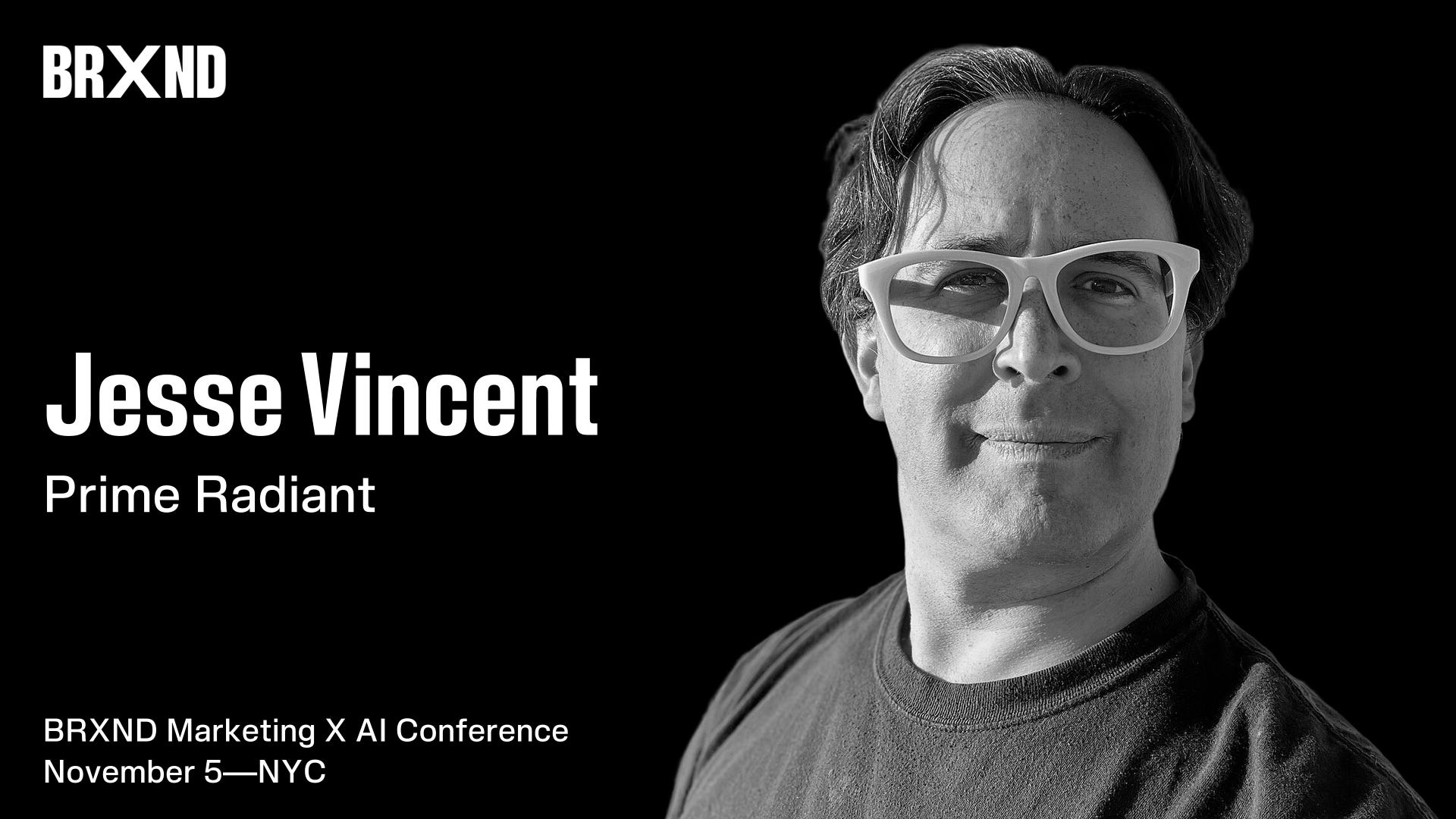
Jesse Vincent, creator of Superpowers and founder of Prime Radiant.
At its core, Forward Deployed is a publication and podcast exploring the intersection of AI, software development, and the enterprise from the point of view of practitioners who are building with these technologies. While the conversations are inherently technical, I find immense value in each episode as a generalist who is mostly integrating AI into non-development work.
Jesse’s episode in particular is chock full of wisdom on how to work with AI for both trained developers and vibers alike. See below for the full episode and five takeaways still living rent free in my head.
1. The job has always been outcomes. Asked who thrives with agents, Jesse names managers, product people and subject-matter experts — people good at clear writing and at thinking through consequences. The ones who struggle are those whose identity is the artifact rather than the result.
For marketers, simply swap “lines of code” for deck, asset, or campaign.
“The folks who don’t seem to do well are engineers who believe that their job is lines of code because the job has always been outcomes.”
2. Stop reaching for the biggest model. Frontier models overengineer, run slow and cost more. For most work, a cheap, fast model is best. Jesse is a fan of DeepSeek 4.1 Flash while Noah (and most of our team) is Luna-piled.
“I would argue that you don’t want the best available model on the planet for most of your engineering tasks.”
Jesse’s analogy for managing frontier models is also the best I’ve heard.
“it feels a lot like working with staffing agencies… They score better on all of the tests. But they’re a little bit quirky and there’s some things you need to know about managing them.”
For nontechnical users on a premium Codex or ChatGPT Work plan, it’s very tempting to just set the harness to Astra and continually use a blowtorch to light a cigarette. But even for non-coding tasks, Astra is best utlilized as a quarterback and planner. To actually do the work, let Luna cook.
3. The system’s first job is interrogating the human. Superpowers doesn’t start by building; it starts by cross-examining you about what you actually want. Jesse reinvented the creative brief, then automated the part where someone has to ask the hard questions.
“If an agent doesn’t understand your intent, they can’t do the thing you want. They will do the thing they guess you want.”
“the requirements as stated are never really what needs to happen”
4. Give your agent a professional identity with a resume: Jesse’s go-to-market agent, Nora, DM’d him unprompted about a conference CFP that had already closed, named the one person known to take late submissions, and had the outreach drafted. Then the catch:
“that is strictly better than a bunch of the marketing folks I’ve worked with”
“this was before I realized the mistake I had made by telling it that this was its first job and it was a junior marketing person”
Once he rewrote Nora’s role as a senior marketer, the scale of her ambition and altitude of her work moved recalibrated to the new role.
The same lever works on voice and is perhaps the best tool in your arsenal to reduce pedantic slop. Simply tell your the agent that before it got its CS master’s from Stanford it got a BA in journalism from Wesleyan.
“It caused the agent to start writing in reverse pyramid. It caused it to drop a lot of jargon. It went for short, simple declarative sentences. It led with facts.”
Funny enough, a colleague of Jesse’s tried it, left out the words “in journalism,” and got nothing back. I guess my journalism degree ain’t so useless after all dad.
Author’s Note: As Jesse suspected on the podcast, Wesleyan doesn’t actually offer a BA in Journalism. I should also note that I have a bachelor’s of SCIENCE in Journalism from Northwestern. When I want to truly be insufferable, I make it clear that I’m a scientist.
To make matters worse, my wife has an art history degree. A truly employable pair.
5. Your reviewer will find infinite problems and can’t rank them. Point an AI brand-compliance checker at a campaign and it will flag forever; deciding which flags are worth addressing is becoming more and more of the job.
“They’ve gotten increasingly good at spotting bugs. And what they haven’t gotten good at is the judgment of whether a bug matters.”
“it doesn’t have the judgment to say this race condition you found that you’re about to write 10,000 lines of machinery to fix. Would result in a 50 millisecond visual glitch in an admin screen, that’s okay.”
Jesse’s one hard limit is worth ending on. He’ll hand almost anything to an agent, but not safety-critical, health, or security work without a human reading it. This principle generalizes well past code: “you are responsible for the things you make.”
His test for whether you’re managing agents well is the one he’d apply to any junior hire — “the answer is never, I’m going to go off and go on vacation and not give anybody direction and not make anybody prove that it works.”
Everything that ships under your brand is still yours.

Links and References in the Episode.
Jesse and his work
Stories and related conversations
Reading recommendations
The Mythical Man-Month by Frederick P. Brooks Jr.
Maneki Neko by Bruce Sterling.
On Marketing to Machines
While we’re on the pod train, I called my own number this week with our friend Sam Knight for a wide ranging interview on agentic commerce and the nascent art of advertising to agents.
If much of this sounds familiar, it’s largely because this is effectively a portmanteau of several essays I’ve written here over the past few months. But hey, writing is a grind. Sometime’s it’s nice to just get to yap a bit.
If you have any questions, please be in touch. As always, thanks for reading.
— Mike