


Coming to you off a couple of high energy kickoff calls with BRXND sponsors for our November 5 event at The Times Center in NYC. We’ll be announcing our partner lineup soon— if you’d like to inquire about one of our last sponsor slots, please get in touch here.
If you’d like tickets to the show, the button below will take you right to the purchase page.
RIP GEO Redditrage, 2024-2026.
Last week, several research reports emerged showing that Reddit, listicles and comparison articles– long the holy trinity of the GEO-industrial complex – were each significantly devalued by OpenAI with the launch of GPT-5.6.
In a sea of reductionist clickbait, Lily Ray has the most comprehensive take on the details that is well worth your time. I agree with the crux of her analysis. OpenAI isn’t trying to curtail the influence of Reddit writ large. Instead, they are trying to disincentivize the practice of brands using grey-hat spam tactics to poison the well before Reddit passes the point of no return. This is the correct approach to ensuring that models aren’t gamed by people who have stacked fake karma or have the best under the table deals with mods.

It will be interesting to see if Reddit comes out the other side of this in a stronger position. There’s a dangerously consensus opinion forming among those close to AI search that we’ve reached the peak of Reddit’s influence over AI, especially as the Google deal looks unlikely to renew. On LinkedIn, I put out a call for some more contrarian bull takes on Reddit which converged on an interesting argument. If they can stop the spammers, Reddit is a constantly refreshing source of up to date content that is “pre-mediated” by both an algo, users and moderators to provide multiple signal points to LLMs on what content is valuable.
Less covered but equally impactful AI Search news is OpenAI also getting fed up with the listicle and programmatic comparison page scheme that many challenger brands have exploited to great effect. Here’s some research from Peec analyzing the prevalence of citation share in both formats the week before and after the GPT 5.6 rollout.
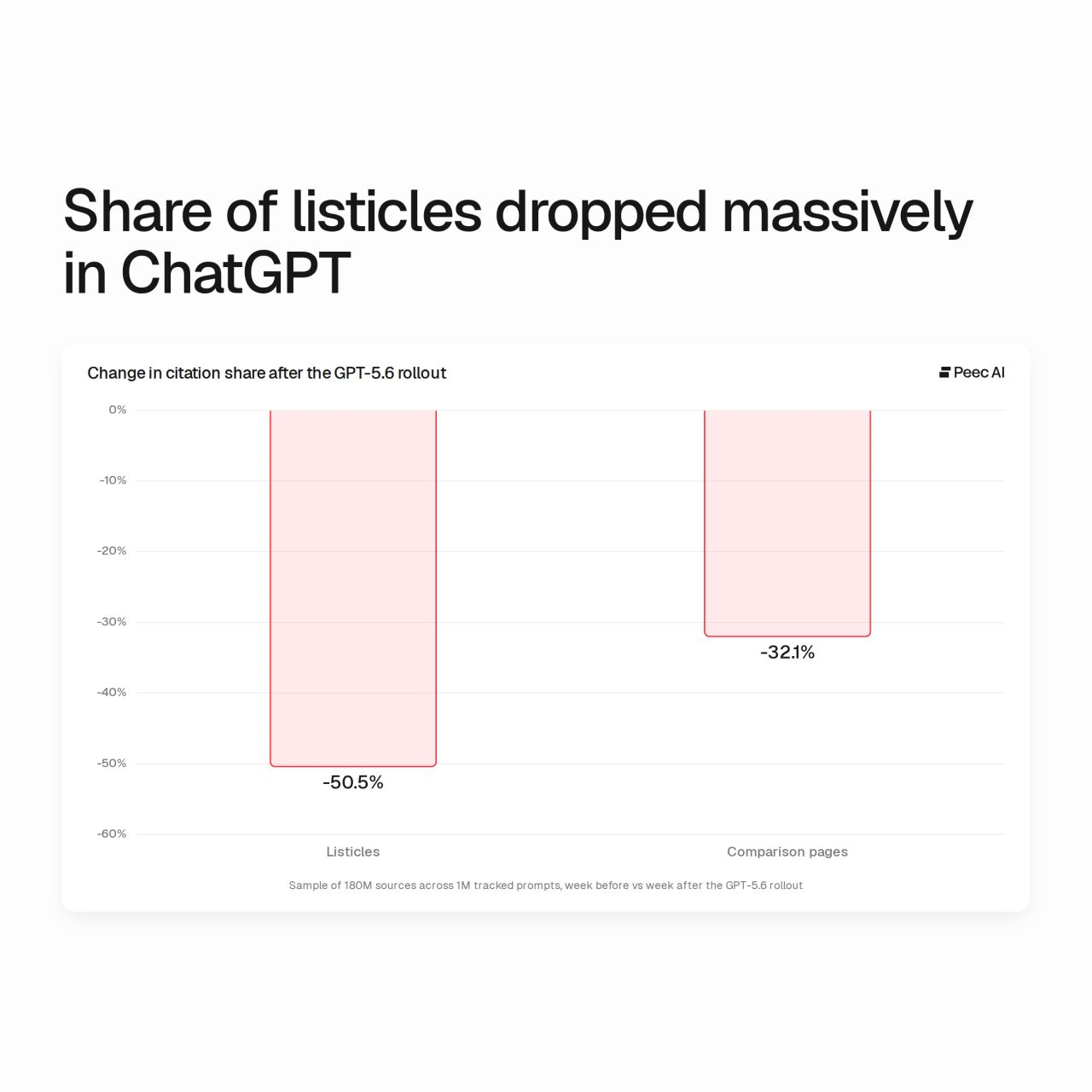
OpenAI is doing right here by its users in making bold moves to limit the efficacy of programmatic slop schemes. But it comes with a major externality. As arbitrage tactics generally mastered first by challenger brands are nerfed, large enterprises will command more of the lion’s share of shaping organic LLM results. The upshot here is for nascent brands, mastering ChatGPT Ads will be far more important than any current GEO tactics. Expect more GEO companies to converge on becoming operating systems for running AI ads.
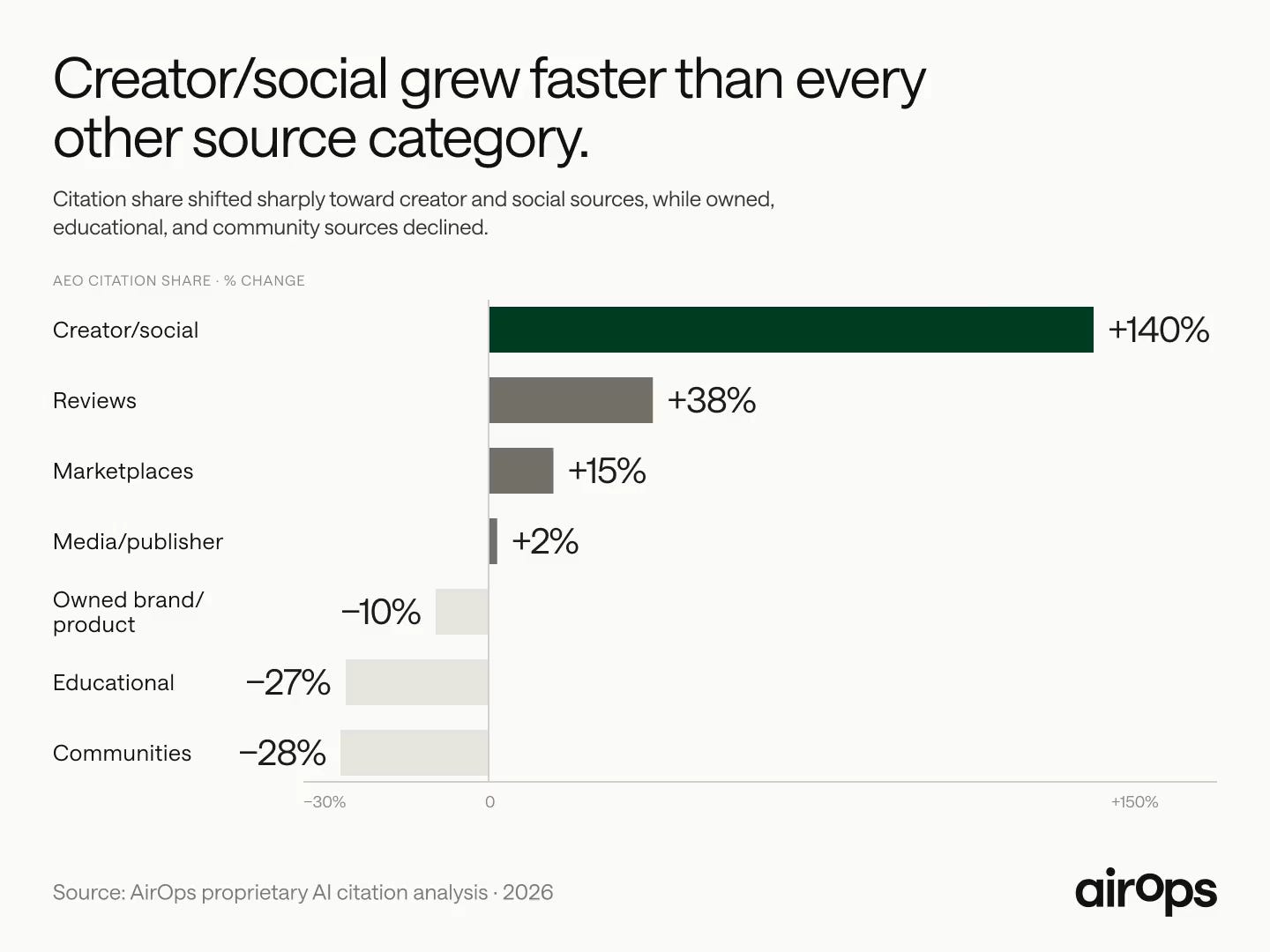
Broadly speaking, the winds of sustainably influencing models are blowing towards owned content from authoritative brands, creators (especially in AI Overviews where the dynamic of Google leaning on Youtube is only getting stronger) and authoritative, third-party takes from publishers who have deals in place with the labs. In other words, good brand marketing tactics will compound in AI search.
Of these three archetypes, I’d expect to see creators increasingly start to shape LLM responses far more than they do today– much more on this in a future post. The AirOps data below is slightly flawed (given that it largely looks at pre GPT-5.6, it underrepresents how owned brand content is trending currently) but directionally correct on creators commanding far more citation share.
Overall, one pretty safe assumption to make is that by the time the latest AI search hack silver bullet hits your X or LinkedIn feed, any alpha from deploying that strategy is gone. Great marketers generally aren’t in the business of giving away their best secrets on main.
Instinct Eats the World
Last Friday, I got drinks with the most AI-pilled developer I know, the kinda guy where I’ve grown accustomed to sharing his attention with multiple Claude Code sessions that he is concurrently babysitting from his phone. This week, we had a different third wheel, a white hot new AI product called Instinct.
For those mercifully not on VC twitter, Instinct is a personal assistant agent that straddles both consumer and work use cases. The selling point is that it essentially unlocks OpenClaw like functionality for normal people natively through iMessage or WhatsApp, no Best Buy runs on Mac Minis required. In the onboarding flow, Instinct says to “effectively treat me like a human with a computer” and touts the following capabilities:

Instinct is launching into a crowded space that includes other tech twitter darlings like Town and Lindy. There are also more niche consumer agents emerging such as Anna which targets busy parents, whose product leader slid into my LinkedIn DMs as I was doing the Instinct sign up flow. And of course, OpenAI’s marketing team would like you to know that ChatGPT Work can do all of this too!
Or maybeeee not quite. Instinct’s capabilities are wild. Over a Guinness and the worst old fashioned I’ve ever had, I watched my friend’s agent flawlessly purchase several school supplies on Amazon with very nebulous prompts, navigate the rigamarole of a complex insurance portal and surface available Dune IMAX tickets that don’t require spraining your neck to watch the film.
But there’s another side to this story– the early version of Instinct plays…..…just a little bit fast and loose on the security side. Here’s Claire Vo who is an absolute must follow for early reads on any AI product.


The craziest part of the Instinct story so far is that some of the most powerful people in Silicon Valley have handed over unfettered access to their email and bank information to a tool that is in the infancy of shipping basic security features and has a website that looks like this! It’s still unclear to the general public who the hell exactly has built this thing!
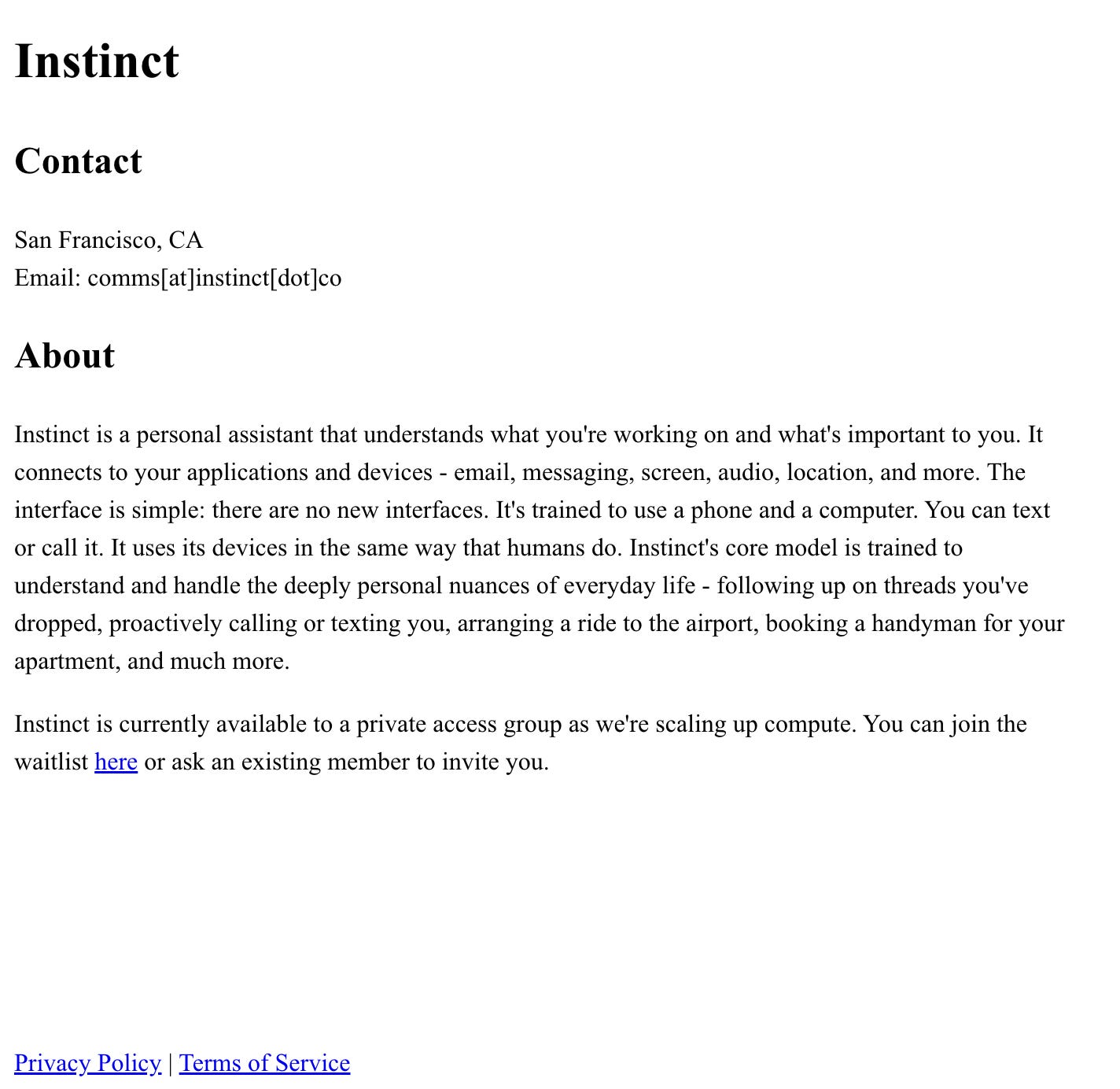
If any of this is nefarious, building an agent like this as a psyop to get the most powerful people in the world to hand over sensitive information would be almost too easy a script for a modern day Silicon Valley. The Occam’s razor here is likely a lot less interesting:
1) The investor class that is hyping this up knows the founders well and it is a well credentialed team of AI veterans, not a renegade outfit
2) Investors are so eager to not get disintermediated by a world in which ChatGPT just becomes the default personal and enterprise harness that they’ll pump a promising competitor. It’s not sheer public interest that has traditionally press shy leaders in VC suddenly extolling the virtues of open-source.
I ultimately went through with signing up for an account with Instinct but didn’t connect my email, passwords or any of my work accounts. It managed to snag me an appointment with a primary care provider I’d been calling for months by pinging me the moment Optum released new appointments a few weeks out. But then the weekend beckoned and I didn’t do much else with it.
The next day, I got this text. Presumably, my new friend wasn’t thrilled with my lack of engagement.

Here’s a bit more of our back and forth:

Is this a moment of magic or a creepy dash of black mirror? Yes.
Overall, Instinct has forced me to examine some pretty profound shifts in my own Overton window. One year ago, I would have laughed at the notion of giving any tool like this access to my sensitive data. Now, I came within inches of smashing the YOLO button and likely would have handed Instinct the keys to the kingdom if not for this tweet from Alex Cohen. And here I am, still using the tool in a limited capacity!


A big part of this is a simple utilitarian calculation. As AI can accomplish so much more, I need to rethink my priors around the value I get in abandoning some of my concerns around privacy. But another part of it is a sort of tacit admission that the panopticon has mostly won.
As excited as I am to have an agent do an end-run around institutional bureaucracy, I can’t help but think that this is another example of one of AI’s eternal memes.
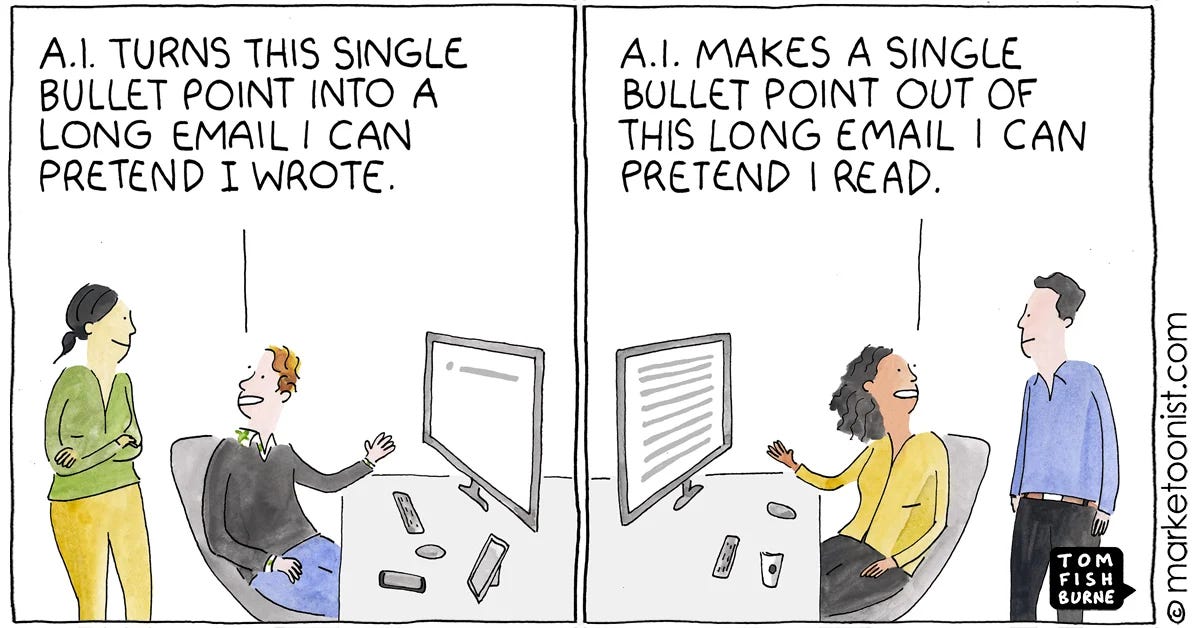
Tools like Instinct could well usher in a more egalitarian future where agents replace cumbersome software portals as the access point to most web functionality. Or they could just as easily create a world where a small, privileged group of AI-native elites circumvent the system while the overall quality of ubiquitous internet products goes down. Both will probably happen to some degree in tandem. As more customer service sessions get mediated through tools like Decagon and Sierra, we’ll probably see more companies launch premium tiers where one of the core benefits is that you can always go straight to a person. For better or worse, Cullen represents the sentiment of the populace on this one.
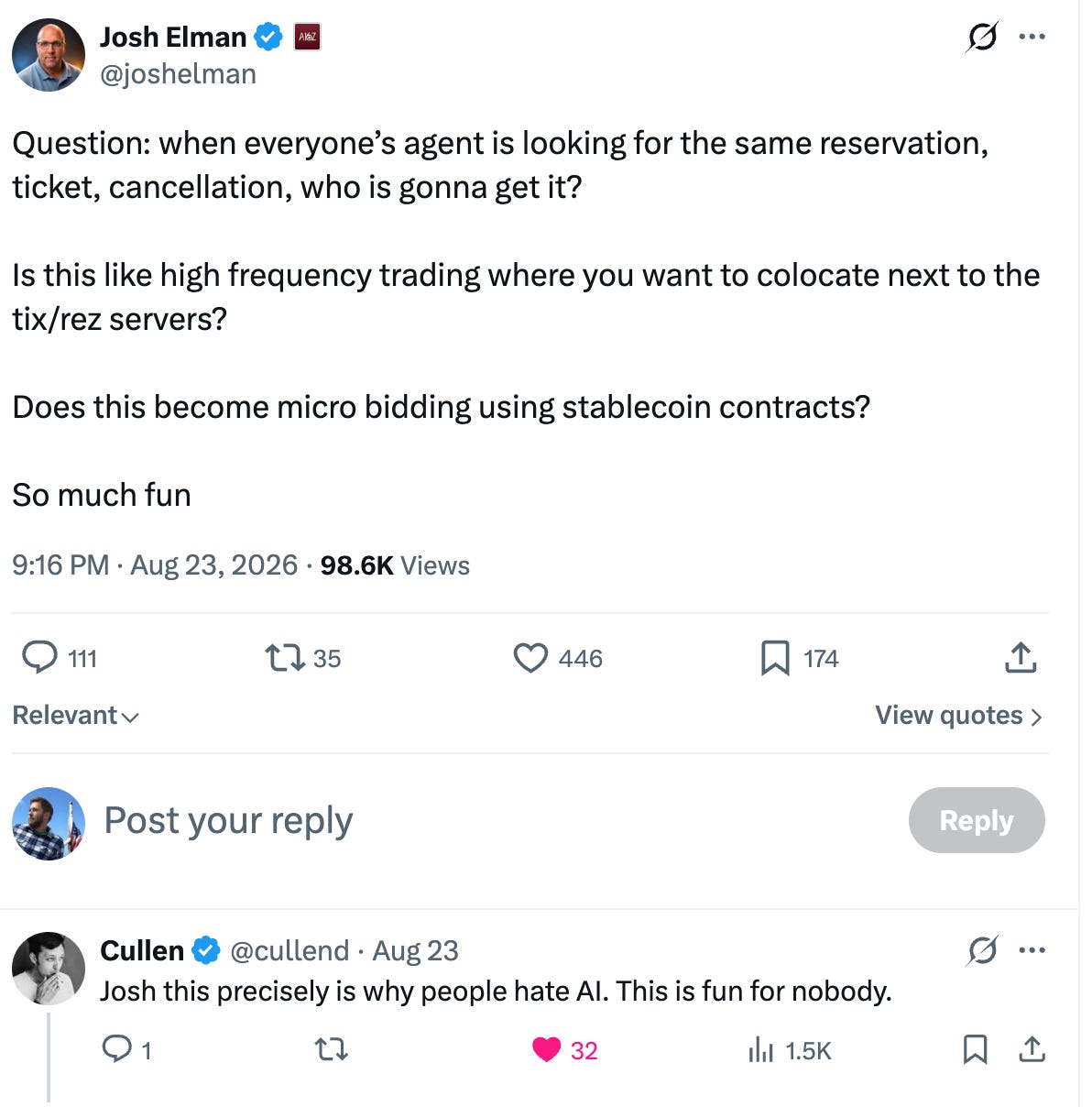
I also agree with Reggie James here. The irony is that as agents eat more of the online ecosystem, more things will run on “knowing a guy” and that the swagless will perish. This is true in both a consumer and professional context and I believe, increasingly in marketing as much as any other function.
Anyway, I have five invites to Instinct to give away. If you’d like a glimpse into the weird frontier of personal agents, drop me a line at mike@brxnd.ai
Consumers Don’t Pay for Productivity Tools
If you listen to one long-form interview this year, make it this Ben Thompson session with Patrick O’Shaugnessy. It’s incomprehensible to me that one analyst could have so much range across topics but Ben galavants effortlessly between AI, geopolitics and game theory analysis in a way that only he can. Most relevant to marketing leaders, he devotes about ten minutes at the 20:30 mark to waxing virtuous about ads, notably reminding listeners of the two core lessons that Silicon Valley learns every decade or so.
1) Consumers do not want to pay for software
2) Consumers do not care about being productive.
Going back to the Instinct discussion above, there are really only two commercial paths forward for most of the “personal agent” tools and most entities building in consumer AI writ large:
1) Pivot to an enterprise / B2B focus and dive headfirst into the gauntlet of competing with ChatGPT Work, Claude and Cursor to be a professional OS / harness.
2) Monetize a free or heavily subsidized paid consumer product with ads.
(One could argue that there’s a third path forward on an affiliate model and in the 2010s consumer tech boom, affiliate models did scale some consumer businesses well into the billions of dollars in valuation. But the cost of new user acquisition was much cheaper back then. There’s a reason Sam Altman was once hot for affiliate economics and quickly pivoted to ads)
I suspect that most large consumer agent upstarts will try both in tandem– the power laws of VC economics will force them to try everything under the sun to hit venture scale. And when they do, there’s going to be a lot of incremental new advertising inventory created.
For a long time, I was skeptical that many of the companies focused on placing “ads in LLMs” outside of ChatGPT would find meaningful scale on the supply side. I’m now much more bullish on this category, which includes companies like ZeroClick (coming soon to a Friday BRXND interview), Koah and Thrad.
This creates a fascinating laundry list of second-order questions! If personal agents and consumer AI tools are going to be monetized via ads, will these be primarily ads directed at humans using the product (i.e. an overtly sponsored response) or ads directed right at influencing the agent at the point of inference? Will people continue to trust their agents if they know that their responses are occasionally being sold to the highest bidder?
These are effectively the same big picture conundrums facing ChatGPT’s advertising ambitions and will largely dictate the pace at which main street gets onboarded into the agentic wave. If AI is going to be anything more than a better search engine to a billion people, it’s going to have to be ad supported.
If you have any questions, please be in touch. As always, thanks for reading.
— Mike
Mike, your insight is endlessly fascinating and useful. Thank you.