


We’re making the first speaker announcements for BRXND NYC 2026 next week— stay tuned as we drop the first part of our lineup for November 5 at the Times Center.
In the meantime, we’re down to one week left on the early bird rate of $749 and would love for you to join us before we raise prices for GA. If you have any questions or thoughts on what you’d like to see from us at this year’s show, I’m always a friendly note away at mike@brxnd.ai.
The GEO Leaderboard
The modern marketing leader’s inbox is a dystopian postmodern art form. If there’s any inkling that you might influence a software purchase, you live perennially awash in a deluge of pitches for identical-sounding software. Right now, the hottest technology is all about how brands show up in AI search, which, from here on out, I’ll describe using the generative engine optimization (GEO) lexicon.
Amidst the litany of market maps, VC graphics, and customer review boards covering the 50+ vendors that have appeared on this scene in the last two years, there was one question that I had not yet seen answered: Which company that is selling me the ability to be present when users are querying LLMs is best themselves at showing up when marketers search for GEO solutions?
Or said more simply, which GEO company is the best at GEO?
To answer that, I grabbed a couple of Cometeer capsules, fired up a DataforSEO account (thanks to an assist/suggestion from Zero.xyz), and spent an afternoon vibe-coding the resource I wished to see in the world.
What emerged is a simple leaderboard that ranks the top 10 companies based on how prominently they appear across 175 prompts that marketers would use to search for a GEO solution. The link to the live webpage is here:
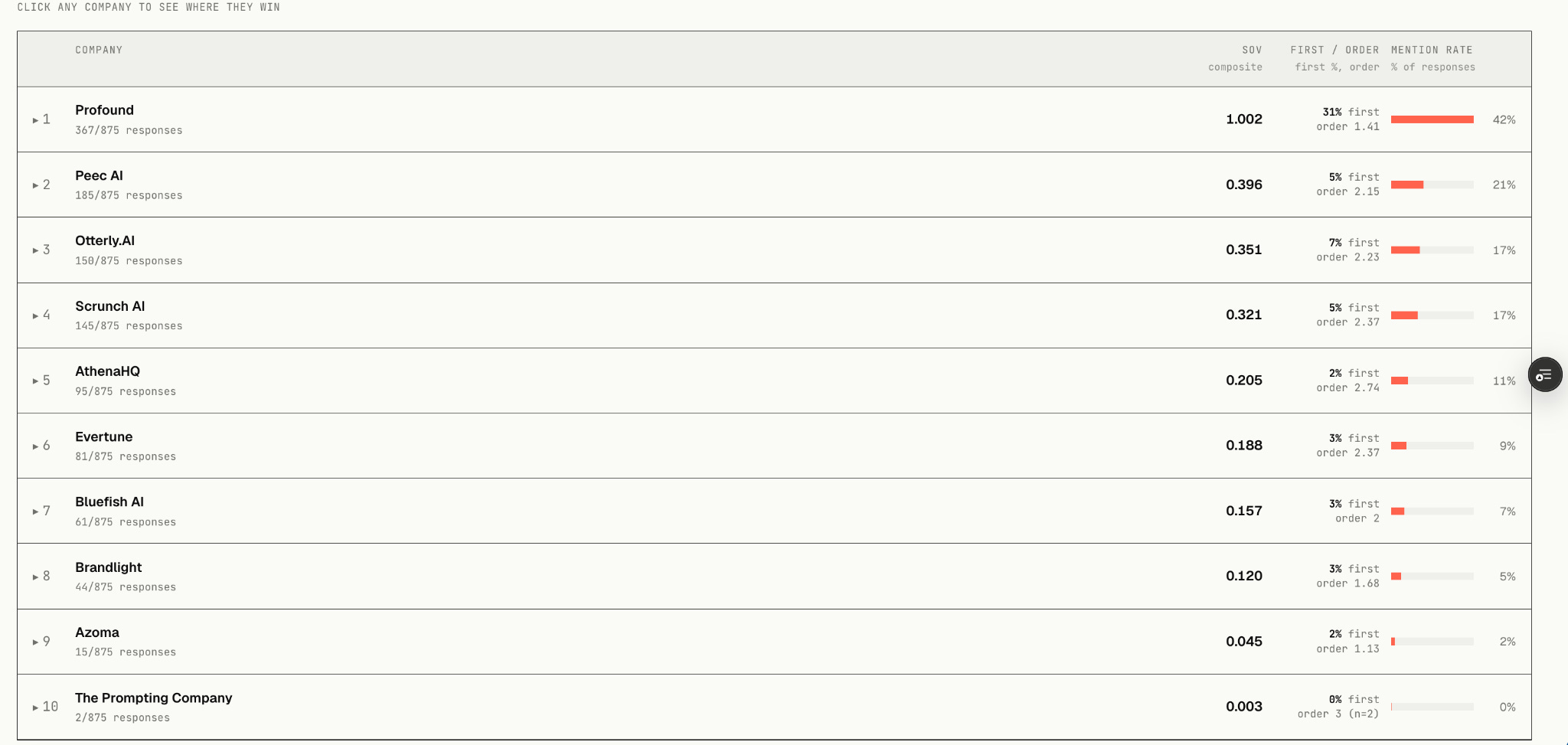
In addition to the overall table ranking, for each company, you can drill down to see where a GEO vendor is most visible across model, prompt archetype, and specific queries:
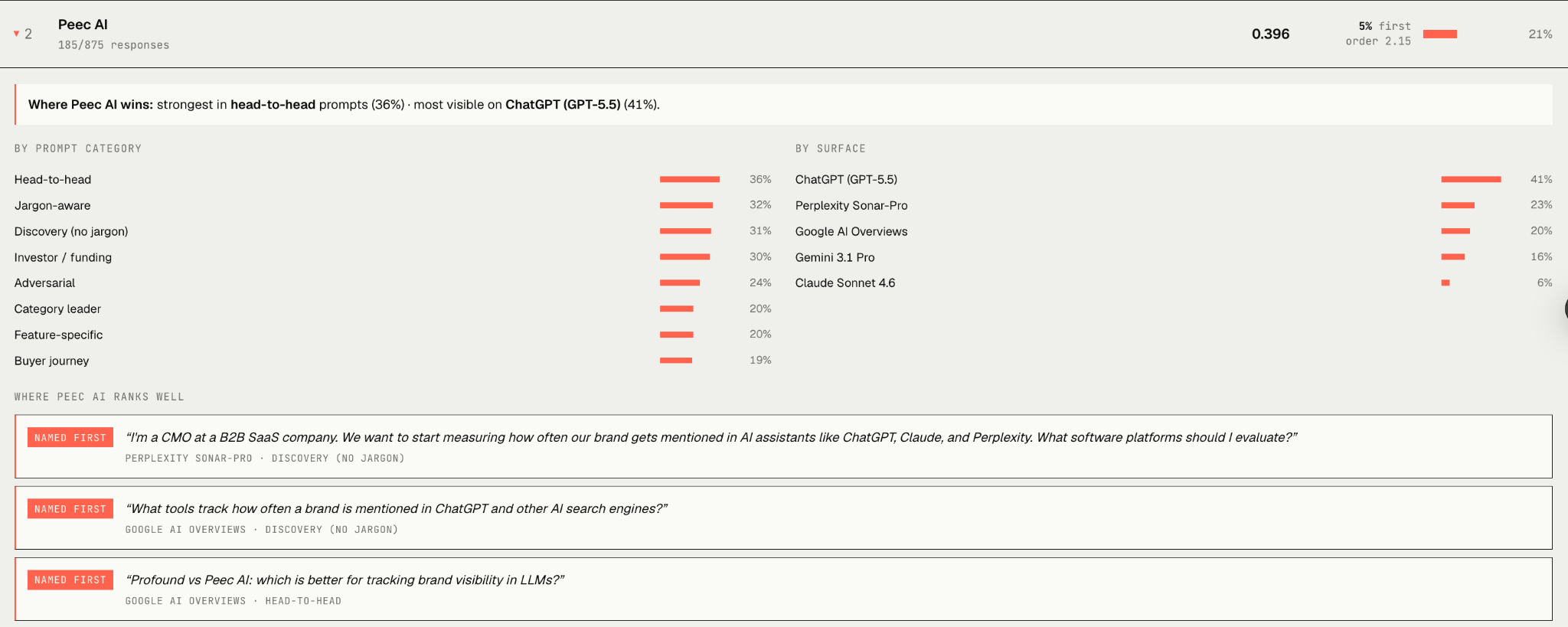
I encourage you to explore the leaderboard, dive deep into the methodology and peruse the full set of prompts the tool tracks. Please send me any thoughts on what stands out or what I got wrong! I intend for this to be a fluid project that I’ll re-run monthly and add additional companies to.
To me, what’s far more interesting than the tool itself is what the process of building it revealed about both the nature of AI search and where much of the value in vibe coding experiments like this ultimately accrues.
Learnings and Observations
1. The high-level results were fundamentally pretty unsurprising… which is kind of the point! The companies with the strongest “brand” footprint in GEO rose to the top of the list.
Every day, AI search becomes less of a convoluted morass of grey hat arbitrage schemes. It’s much, much more akin to serving as a mirror for brand marketing!
As the models mature and get more sophisticated about how they access real-time web data, the hit rate of spamming Reddit, blasting listicles with your product at the top and indulging in programmatic content schemes will increasingly be reduced. In its place is just good consistent work across building credibility with top media, telling a clear and differentiated brand story and building clear owned content lanes and tentpoles.
2. LLMs have a frenetic, token-thirsty desire to build incredibly complex projects that test the boundaries of their capabilities. For this project, Claude Code (running Opus 4.8) was eager to build out a full Next.JS app with all kinds of interactive components that would effectively have constituted shipping the minimum viable product for a full-on GEO platform. It took a lot of heavy steering to dial this down to a basic output that could ship in hours, not days.
At one point in the session, I dropped a, “my brother in Christ, I’m not trying to fully recreate the ten companies on this list.” I’m simply trying to build a simple HTML tool to help marketers better understand which GEO companies are best at GEO!”
Even still, I ended up building an MVP with far too much wiring that Noah wisely suggested knocking down to the final webpages that you see on brxnd.ai.
3. At the same time, I pretty easily could have gone a step further and vibed up an application that looks a lot prettier and recreated something cosmetically close to the dashboards of GEO companies. Claude was begging me to do it!
This is not at all a dunk on the technology these companies have built—all of the serious executives I’ve spoken to in GEO are the first to tell you that basic prompt and citation tracking is a commodity. Albeit a commodity that has had enormous CMO-level demand to date.
The far more difficult and important question is understanding the sentiment and nuance of how LLMs perceive your brand and ultimately building agents and workflows that shape that perception and destiny. This is where we’ll start to see meaningfully different companies emerge in the space.
Profound is all-in on helping marketing leaders build agents, championing the concept of a marketing engineer. Evertune is building an ads manager to closely align GEO with the potentially far more lucrative whitespace of buying media in ChatGPT. Bluefish is now helping brands build agent-optimized catalogs that align SKUs to semantic brand stories, a vital GEO concept that is still in its early innings.
Whether GEO companies grow into their valuations depends on whether they can cross this chasm from analytics software to truly running end-to-end workflows where brands take action. More on what all this means for brands in a “GEO Maturity Matrix” post to come.
4. In the vein of Noah’s software for one experiments, it’s not that hard to see how an enterprising CMO (or more realistically, an AI-pilled member of their team) might decide it’s worth spending an afternoon vibe-coding a little project like this to make the best possible decision on which software to buy. Bain Capital has PE associates vibe-coding legacy SaaS replicas to understand whether their acquisition targets have true moats.
If a marketing leader took up this mantle and ended up in the same loop I did with Claude, they might just find themselves tempted to “build the thing” around their bespoke use case rather than modifying off-the-shelf AI software. Why pay tens of thousands of dollars per year for something you can build that is purpose-created for the brand metrics you want to track? More than most categories, AI search requires technology that touches a brand’s “unique judgment, workflow, brand voice and edge.” There’s a real build case here.
5. Before AI, the point of a great strategy doc like the famous Amazon six-pager was that it forced the person writing it to deeply grapple with an idea, identify fundamental flaws, and ultimately, sharpen the thinking around a proposed product launch or strategy. Driving executive and team alignment was a secondary benefit—the bulk of the value came from the agonizing clarity that only comes with deeply thinking through a problem.
At its best, vibe coding is just another means of pressure testing ideas and identifying fallacies in your thinking, only the medium is an artifact rather than a document. The challenge here, of course, is that LLMs seek to strip you of agency at every turn. They want to quickly make decisions, ship code, and yada yada over any paradoxes in a project. I consider myself an ultra-amateur vibe coder, which is to say, I still hand over way too much agency to LLMs when I work on things like this. But with each rep, I find myself slowly imbuing a little more “me” into my AI-assisted work.
When anyone can brainlessly build, doing the work is the point.
If you have any questions, please be in touch. As always, thanks for reading.
— Mike