


There’s an autumn nip in the air that tells me we’re 37 days away from BRXND NYC 2026 at the Times Center. Huge thanks again to Runway, Emberos, VantagePoint, Dstillery and WRITER for helping us put on an incredible show.
If you’d like to join 350+ of your fellow marketers tinkering on the frontier of AI, we’d love to have you at the show. Buy tickets below or simply reply to this email with any questions.
With a palpable swagger in his step and his trademark 1.5X speed podcast-style diction, it took Sam Altman all of 117 seconds into his DevDay keynote today to announce Dots, Open AI’s “remarkably capable, always-on agents built to handle everything.”
Yesterday, Instinct raised $1B at a $10B valuation and hired a chief business officer who built the commercial and partnerships engine at Snap, a company that Instinct is now worth more then. Yes, you read this correctly, Instinct’s valuation exceeds Snap’s (and Lyft’s, and Dropbox’s and Etsy’s) market cap despite the fact that Snap has 500M daily active users compared to Instinct’s <1M.
Since I said last week in “The Great Disintermediation” that AI is the internet now, the collective weight of Silicon Valley has thrust itself further on the accelerator to make agents the primary way we interface with both our work and life online. It’s moving at an insane clip and all I can do is think out loud with you all to try and keep up.
So consider today’s piece a brain dump of everything on my mind as agents emerge everywhere all at once. If any of it resonates or you’d like to banter further, drop me a line at mike@brxnd.ai and let’s keep the conversation flowing.
1. While I’m not impressed with the gist of Dots overall (the demo felt largely to me like a product built for the unique ways OpenAI employees work), I really appreciated Sam’s initial counterpositioning against other agents in the space. Within a minute of taking the stage, Sam gently needled demos from other agents by listing out what they saw as low value use cases. Some OpenAI product marketer cooked here.

While Dots is primarily a professional tool, consumer focused agents would be wise to follow this lead. In a long ranging interview with Patrick O’Shuagnessy, Instinct founder Noah Shinn fell back on the familiar tropes of booking hotel and making restaurant reservations as top Instinct use cases, two areas I find wholly underwhelming. The “tyranny of the travel demo” struck again as companies demonstrate agents against problems that marketplaces have largely solved for an average user who isn’t obsessed with hyper-optimization.
Google Duplex’s breakout 2018 demo was booking a restaurant reservation. Gemini later showcased agentic AI by planning a family vacation. Microsoft pitched Copilot Actions around dinner reservations and travel booking. OpenAI introduced Operator with examples like making reservations and booking campsites; and Amazon has long used “dinner and a movie” as the proving ground for Alexa’s ability to coordinate multiple tasks. Again and again, tech companies reach for the same proof point: the future of personal computing is saving us a few clicks on dinner and vacation.
And every time, people who live in the real world (correctly) say that they want to go on a bit of a meandering adventure when they look for a resort. Booking a vacation is the consummate example where some friction is a feature, not a bug. It’s actually the cliche that the journey is the destination!
2. My main question about “personal agents” still centers around whether they will truly be a game changing new paradigm for how normies interact with technology or just the next iteration of “AI as better search.” I strongly suspect it will be the latter– it turns out most people don’t need a chief of staff to manage their everyday lives.
But there’s a lot of incremental value in better search! My kids are doing a Bob’s Burger’s motif for Halloween this year and I decided it’s finally time for me to realize my destiny as Jimmy Pesto. Instinct found me all of the components of a Jimmy Pesto costume flawlessly in less than a minute, including the exact Italian flag pattern tie he wears. This type of fuzzy semantic search is a nightmare for conventional commerce interfaces and a clear example of where I only bought something because the agent made it significantly easier to do so. Better search is true TAM expansion and where I believe the bulk of the value in agentic commerce lies.
3. I want to be optimistic that the rise of mass consumer agents will be positive sum for how technology interacts with the real world but….. the cynic’s case is very compelling here. Even if most people still use tools like Instinct and Muse as “better search”, there will still be a rush of sophisticated consumers deploying agents to seek rewards, damage claims and other special perks that previously assumed a human would go through a cumbersome process to redeem. In other words, the perks only exist in the first place because they are hard to access!
As a result, corporations will get far more Draconian about how they adhere to policy and will be far stingier with manufactured moments of serendipity for customers. Rather than being a democratizing force, mass adoption of agents will mean more of the world will run on “knowing a guy.” Along the way, we’ll see more “AI for thee, humans for me” tiers of customer support offered.
But there’s a fascinating second order question I’ve yet to see pondered as much – how do Sierra, Decagon and other companies building AI for CX respond here? Does their core business effectively become building “counterstrike” enterprise agents that parry back the consumer agents trying to beat the system? To this point, agentic CX systems have been built under the assumption that the “customer” is a person. How do they adapt to this sudden game of prisoner’s dilemma that they now will play with their fellow agents?
One company that few people have heard of to watch here is Scaled Cognition, which recently raised $100M from Khosla to build a frontier model for CX that is deterministic in how it enforces enterprise policies. Begun, the agentic wars have.
4. A take I’ve seen many variations of recently is that this new influx of agents will accelerate the “financialization of everything” and create a world where more business transactions effectively become a programmatic ad exchange sold to the highest bidder. When thousands of agents are looking for the same concert tickets at drop, we get real-time price discovery that provide the spoils to those with the deepest pockets.
I’ll take the other side and say this mostly won’t happen simply because I can’t think of an idea with worse vibes. A historically unpopular technology ushering in an anti-egalitarian reality that most consumers and policymakers hate is not the way. I suspect this is one place we will see meaningful regulatory frameworks take shape to fight perceived price gouging. But it will be a rocky road to get there– if you thought the “senator, we sell ads” hearings were rough, imagine trying to explain inference to octogenarians in Congress.
5. As harnesses eat the world, I’m finally beginning to entertain the possibility that the “death of websites” is a real concept worth grappling with…but dead internet theory, which ostensibly is now a measurable reality, is so nebulous to the point it is barely meaningful.
Per Cloudflare, autonomous AI agents and scripts have surpassed human web traffic and now account for 57.5% of global webpage requests. But these “agents” are not all alike! The vast majority of this “traffic” is simply dumb scrapers or bots that are utterly meaningless noise. But a small, but ever-increasing number are agents that are truly acting on a user’s behalf and might hold real commercial intent. These agents are potentially the most valuable Pareto customers visiting your digital properties. And by and large, there is no way to tell them apart from useless or nefarious scraper bots! What a time to be alive!
Both Cloudflare and Google are working on web bot auth offerings and I think there’s a good chance this is the space that the next out of nowhere AI rocketship company gets built.

6. Muse announced a slate of partnerships last week with Wayfair, Best Buy, Fanatics and several other large retailers, spurring some great memes and rumors of a grand anti-Amazon alliance forming at Meta’s behest.


I wouldn’t read too much into most of these deals for now. Most of these same retailers very publicly rushed to form partnerships with OpenAI’s native checkout and then quietly moved on. These are all very low-stakes deals on both Muse and the retailer’s side.
That said, it is intriguing to see Walmart here again after the Barons of Bentonville were so vocal about how poorly the ChatGPT instant checkout experiment went. Walmart has made significant investments in an owned agent called Sparky and has a $7B ads business that agentic workflows outside of its walled garden threaten. It’s fair to wonder if the Muse partnership is a hedge that they are quietly hoping fails.
7. Speaking of Muse, I’m really interested to see if/when Meta tries to really press its unfair advantage of having millions of Instagram creators at their disposal and looks to more directly embed creator recommendations and reels into the core Muse experience. Li Haslett Chen had some good thoughts on what this could look like back in BRXND 118 in June when we discussed the concept of a “Codex for Shopping” that would embed creator recommendations into an agentic commerce flow.
While it is familiar and comfortable, chat is ultimately a stale interface for consumer technology and may well not be the final AI interface. At its core, chat is utilitarian in nature and in aggregate, the people yearn for entertainment over utility. On a long enough timeline, consumer products generally get TikTok-ified. I venture that consumer AI and social networks will effectively be one “thing” by 2030ish.
For commerce specifically, authentic first-hand demonstrations and expert explanations are often the most valuable source material for understanding a product or service. AI can always generate another slop article. It cannot easily generate a person’s lived experience.

8. Of course, the strongest creator network belongs to Google who still remains conspicuously absent from the personal agent wars. Google Labs launched an experimental agent designed for families called CC two weeks ago and it barely even registered in the AI news cycle! Surely, Sundar is lying in wait and will reveal himself after all the other companies have shown their hand. Right? Right?
9. As a potential new front door for consumer AI experiences, Snap is starting to feel comically undervalued. Again, we’re talking about a product that has 500M DAU’s and is trading at <$9B market cap!
10. I’ve been thinking a lot about my friend Joe Kaziukenas’s quip that TikTok Shop might prove to have a greater TAM than agentic commerce. I’ll say it until I’m blue in the face–so much of the incremental dollars to capture come from shopping as entertainment, not utility.
Already, Instinct has cleared $1B in “agentic commerce transaction volume” with 40% of users uploading their credit card information, an impressive feat for a company that is invite only and barely a month into public release. It’s safe to assume Muse will quickly 10x that number with its built-in distribution and we’ll see what’s still to come from OpenAI.
For its part, TikTok Shop will likely clear $100B in GMV in 2026.
Your AI Needs a Computer. Here’s Why
Over on Alephic’s Youtube channel, Sam Knight and Noah had a great wide-ranging discussion on some of the newest model release, going deep on how to put Astra, Opus and Luna to work.
Specifically, they compare what each model is good at, why speed matters, and what it looks like to leave an AI task running for 18 hours. They also get into Apple’s new hardware, Meta Muse, and why Noah is moving his AI work off his laptop.
For my part, I continue to bang the drum that computer use is the AI capability that has progressed the most in just the last couple of months and that AI being truly competent at navigating the most cumbersome web and local device interfaces will transform enterprise work in ways we can’t yet fathom.
One last thing….
As he so often does, Benedict Evans perfectly compressed an entire thesis I’ve spent multiple newsletter editions trying to land into a single sentence.
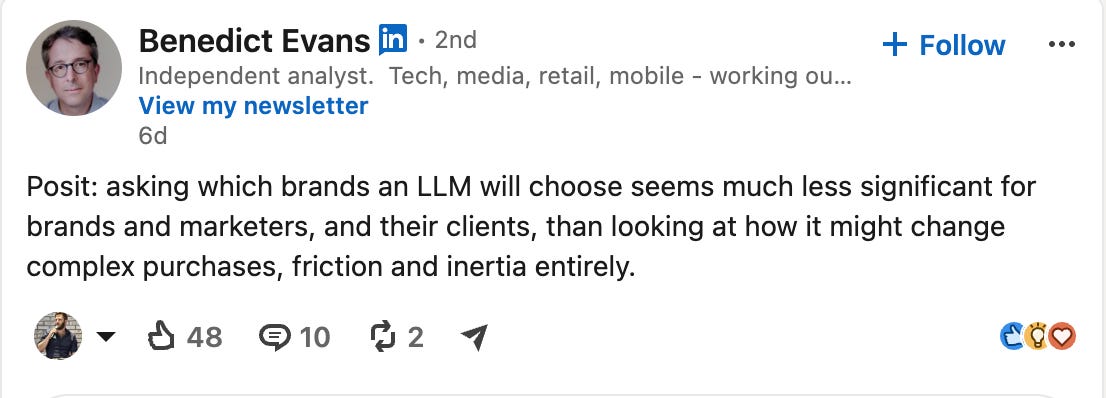
This is precisely the discussion we’ll be convening in 37 days at BRXND. Would love to see many of you there. If you have any questions, please be in touch.
— Mike