


You’re getting this email as a subscriber to the BRXND Dispatch, a newsletter at the intersection of marketing and AI. Gentle reminder, about one month left to snag tickets to BRXND NYC 2026 at the $749 early bird price. Can’t wait to meet many of you in November.
The AI Discourse’s Original Sin
I’ve been thinking a lot recently about why the AI discourse is so frenetic and why it often feels like a cacophony of people shouting around each other. What I keep coming back to is that so many of the prevailing narratives (jobspocalypse, permanent underclass, AGI etc.) lack any definitive sense of timeline or move the goalposts so constantly to the point that they become meaningless. It’s the original sin of the discourse.
Here’s Noah from his appearance on Bloomberg’s Odd Lots pod in January:
I try not to wade into what’s AGI and what’s not. I think my guess on AGI, for what it’s worth, is that it’s probably going to be a conversation like the Turing test. Everybody thought it was really important for a really long time. We thought the Turing test was the biggest thing for 70 years or whatever.
And then ChatGPT very clearly passed the Turing test, and now everybody pretends like it never mattered. They just forgot about it. So I’m kind of guessing that’s going to be what the conversation is like with AGI—it’s just going to be a sort of forever moving goalpost.
Being vague on timeline, especially when writing about AI, is a trap even the better pundits fall into. I find myself too often guilty and only notice after hitting publish. Our friend Jung reminds us that the flaws we’re quickest to notice in others are what we detest about ourselves. Yet again, AI has that pesky habit of operating as a mirror.
As it pertains to AI topics at the heart of marketing, there are a few things that I believe are very likely to be true on a longish term timeline, defined here as four years or more.
- OpenAI’s ads business will work— no consumer platform that has ever achieved mass scale (Google, Meta, Amazon, TikTok) has found itself unable to pair that with a massive ads business.
- AEO hacks built around firing slop cannons will get crushed by Google and OpenAI and ultimately what will win out is the best possible experience for the user.
- Agentic web traffic will significantly outpace human traffic on the web and for quotidian purchases, influencing an agent will become more important than persuading a human buyer.
- Meta will endure as the most performant ad channel for brands…because it always does.
But where on earth will all these things be in their maturity cycle in say, Q2 2027? That’s a much harder question! If you’re a FORTUNE 500 CMO, you have to decide imminently whether to allocate hundreds of millions of dollars earmarked for other channels to ChatGPT. Will their frenetic set of targeting bets pay off in time? Meta might thrive in the midterm, but right now its wonkiness is whipsawing the fates of public companies! Marketing leaders have to make massive bets here with wildly conflicting signals on which way the wind is blowing.
When the average S & P 500 CMO tenure is <4 years (by far, shortest in C-suite) and a marketing leader often has months to quarters to prove themselves, the longterm state of things is often just an intellectual centering exercise.
In this vein, one of the most important questions that I believe enterprise marketing leaders should more proactively ask themselves and their teams is effectively a version of “how long will this arbitrage window last?” If the answer is weeks to months, probably best to leave that alone to the hardcore direct response folks. But if there’s genuinely a multi-year opportunity, that’s worth chasing even if transient.
A great tangible example of this is Reddit. There is no chance that I would touch a Reddit astroturfing campaign with a 39-foot pole today as a brand leader, particularly as grey hat hackers poison the well to a degree that Google and OpenAI are going to have to respond. But the Reddit-AEO conversation started in earnest in early 2024, creating an interesting first mover advantage for large brands that prioritized the channel early. If you moved fast then, you got 2+ really good years of setting a powerful foundation in AEO and capturing a lot of LLM mentions on the way up.
AI becoming the true “agent” that mediates brand preference is the most important platform shift of our time. Like all other platform shifts, this will create a lot of weird arbitrage windows. What may well define the best marketing leaders of this era is knowing which have a timeline worth chasing.
Unwinding AI’s Investor Narrative
Switching gears a bit, Brian Morrissey does not mince words in his latest piece– everybody hates AI. This chart is a big problem.
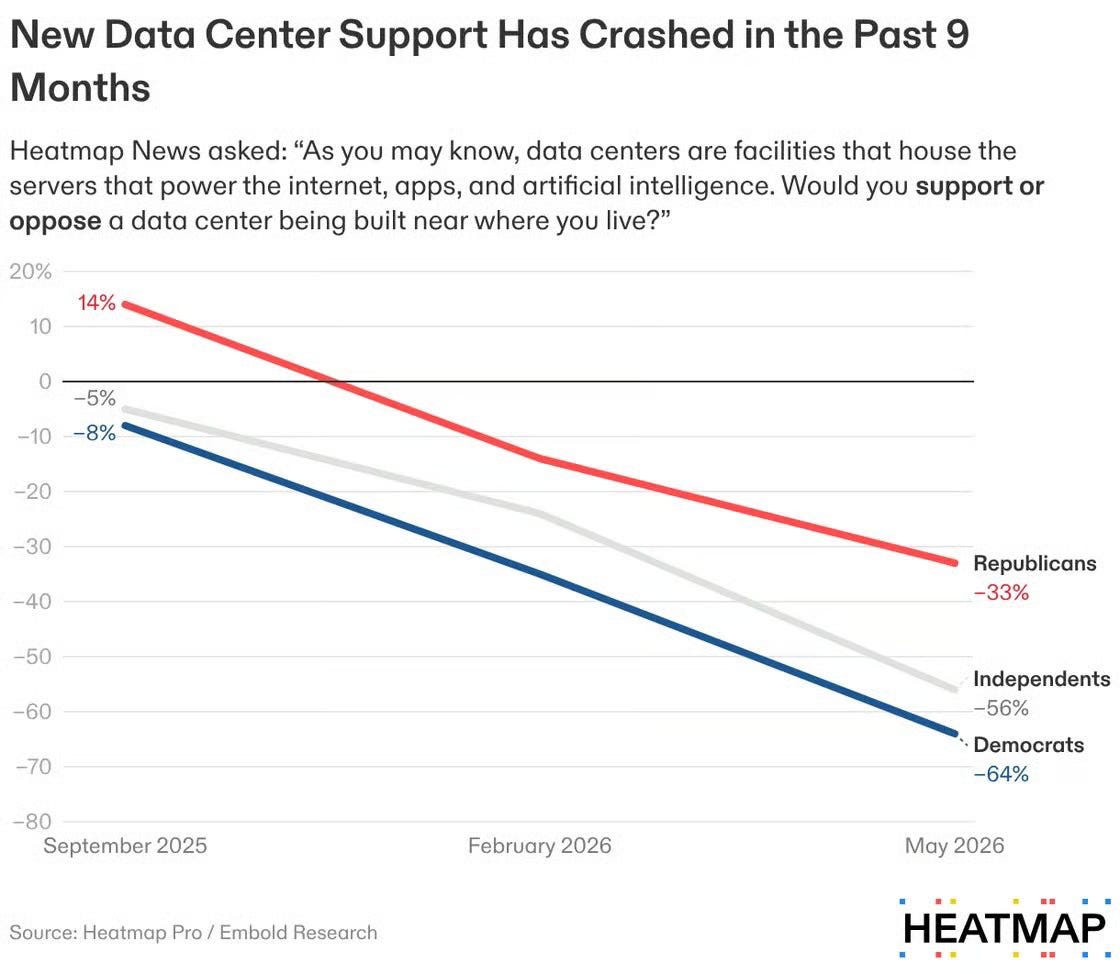
Here’s the current vibe a little closer to home in NY where I saw someone this weekend wearing, I kid you not, this shirt that said “data center, I’d rather date a centaur!”


So how the hell did we get to this point? I think the story is far less sinister than many would have you to believe. Yes, some of the most prominent leaders in AI do believe genuinely wacky and dystopian things about where the world is headed and have not been shy about sharing them. But there’s a far more boring invisible hand at play.
In a frenetic arms raise for capital and compute, all of the hyperscalers have been fundamentally wired to tell an investor story, not a customer or societal narrative. Naturally, that story has to make any technology look as maximally disruptive as possible, primed to upend the fabric of entire industries. This is strictly rational. When raising bookoo bucks is the first order challenge, all communications and brand work needs to serve that end.
Second, in the early days of selling AI into the mainstream enterprise, triggering as much FOMO as possible is the consummate tactic for compressing deal cycles. Taken together, this ends with an overarching narrative that AI companies are the new deity, here to shape the world in the image and likeness that best suits them.
That needs to change fast. Communications consigliere extraordinaire Ashley Mayer does a great job breaking down what this job is fundamentally about here. In December she wrote:
The most visible tech companies are increasingly casting themselves as the hero in their own story, and in doing so, risk becoming the villain in everyone else’s. Apple was never the hero - the creative misfit was.
In March, Mayer argued that large AI companies are essentially compromised from a narrative perspective– alea iacta est in the eyes of the public. She suggests the torch must be passed to up and coming startups to tell better stories about AI and the future. It’s a nice thought but ultimately, it’s OpenAI, Anthropic and a small handful of multibillion dollar companies that will set the sentiment for AI’s broader perception.
This will take uniquely bold bets on the part of AI companies. Realistically, it will probably take the best creative and editorial minds in the world to have any chance at pulling off what essentially amounts to a rebrand of the most important concept in industry. I’d expect a lot more full-fledged media concepts to emerge from AI companies in the months ahead to attempt to tell a story of progress that will resonate with persuadable regulators.
Stripe Press does a uniquely fantastic job of this. Anthropic, which every day feels just more like Stripe culturally reincarnate, has staffed up an incredibly talented media team (though it will be fascinating to see how much leash they get to counter Dario). Expect this level of narrative ambition to become status quo among AI companies, alongside massive investments in traditional brand work and design.
For all the bruehaha about the importance of storytelling, the average editorial or brand is still paid considerably less than a 70th percentile account executive at most AI shops. And look, I hate to be that guy, but with the level of product-market fit that most of the top AI tools have right now, many sales calls look something like this:

Maybe this is a little bit of pandering, but I’d vehemently argue that no matter what brand leaders at AI and AI-adjacent companies make, they are still the most underpaid people in the room in this climate.
When the news broke that OpenAI was buying TBPN, I thought there was really just one facet of the deal that mattered. If OpenAI believed that John and Jordi were S-tier marketing and communications leaders, they were worth far more than the $100M that OpenAI had to pay for the company.
Personally, I was skeptical of the fit. The TBPN hosts were about as in the Silicon Valley bubble as one could be– were these really the dudes to reposition AI to win hearts and minds of the masses? But I think of this like a team trading up (the Rams drafting Ty Simpson?) for a quarterback that they are convinced is “their guy.” Except for OpenAI, $100M is what you’d safely spend on a backup punter.
It’s impossible outside-in to know how much to attribute the broader OpenAI marketing vibe shift to Jordi and Jon specifically but the entire fundamental story OpenAI is putting out into the world has changed on a dime in the last few weeks to center AI as a technology that “viscerally puts humans in control and supercharges them.” More of this please.
Featured Jobs
If there’s a silver lining to AI’s current unpopularity, it’s that brand, editorial and design executive jobs are hitting the presses at a torrid rate. Six months ago, many of the brand and narrative leadership jobs in tech were being treated by the press as an almost cutesy, whimsical trend. Now it’s clear these jobs are wartime consigliere brand management and among the most important roles in AI.
For audacious marketing leaders looking for a new challenge, here are a few brand leadership jobs at top AI and AI-adjacent firms that came across my desk just this week:
- Cohere: Editorial Director
- Parallel: Head of Marketing, Head of Comms
- Vanta: VP of Brand
- Mercury: Head of Brand Marketing
And one more on the consumer side. Pound for pound, few brands from the pre COVID era of DTC have executed as well as Caraway. They are hiring an SVP of Marketing & eCommerce to oversee a nine figure marketing budget and 35 person team for a brand that has helped redefine the millennial home aesthetic.
One more thing…..my cream cheese chive
If you aren’t local to New York, it’s hard to convey how immaculate the vibes of have been around this entire Knicks run. I am— against any semblance of better judgment—a frickin’ longtime Nets fan and even I’ve gotten sucked into the sheer exuberance permeating the city.
It’s hard not to feel the magic when there are watch parties in funeral homes and Episcopal churches. So here’s the updated sonnet of the city to play us out:

— Mike