


Eric Pakurar is a strategist, entrepreneur, and old friend of mine from our days working together at Naked Communications. He sent me over a draft of this last week, and I thought it was interesting enough that I asked him if he’d be up for us publishing it here. A big part of the theme for this year’s BRXND Conference (coming up 11/5, tickets available now!) is that we need to push forward the conversation around AEO/GEO because it feels woefully stuck in “how do we get on Reddit” when it begs much more fundamental questions about brand building. I appreciate anyone poking at those questions with me and am happy to have Eric join us this week. - Noah
A brand used to be what you said about it. Now it’s about what a reviewer, algo, creator, or agent says. It’s not that the brand doesn’t have any say, but it’s likely out-voted.
My LinkedIn feed has lots of really interesting conversations about the problem, but not so much about what to do about it. How does a brand build the meaning it wants to build in this environment? Which brands are built to thrive? What does the discipline of brand positioning and comms planning even look like anymore? It feels like folklore to me, bits of stories passed around, with people and machines adding their own bits to the stories as they go.
This newsletter has two things in it: The first is an experiment to see whether we can test whether a brand is built well and whether it’s being “retold” in a way that’s useful to the brand. The second is an essay about a possible path forward for the people who are in charge of brands.
An experiment: The Retellability Test
How do we evaluate whether a given brand is able to build meaning in this environment? A starting hypothesis: We need to look at two things. First, whether the brand is ready to be retold or carried. Second, whether it’s actually being retold accurately and favorably.
This test scores 15 variables, all pulled from public evidence. None of these brands asked to be in it. Together, the variables make up two key measures:
Brand Readiness (9 variables): Whether the brand is built to be retold by other people and machines (whether it has distinctive assets, a world worth repeating, a record clear enough to attach things to)
Brand Rendering (6 variables): Whether it actually is being retold by them (whether they’re recommending it, discussing it, and writing about it), and whether what shows up is accurate and favorable
Consider this a starting point. The whole process will undoubtedly get better as we go on.
Here’s an example of how it works: In the sunscreen category, Coppertone scores 51 on Brand Readiness and 47 on Brand Rendering, which is decidedly middle of the pack among the brands we measured.
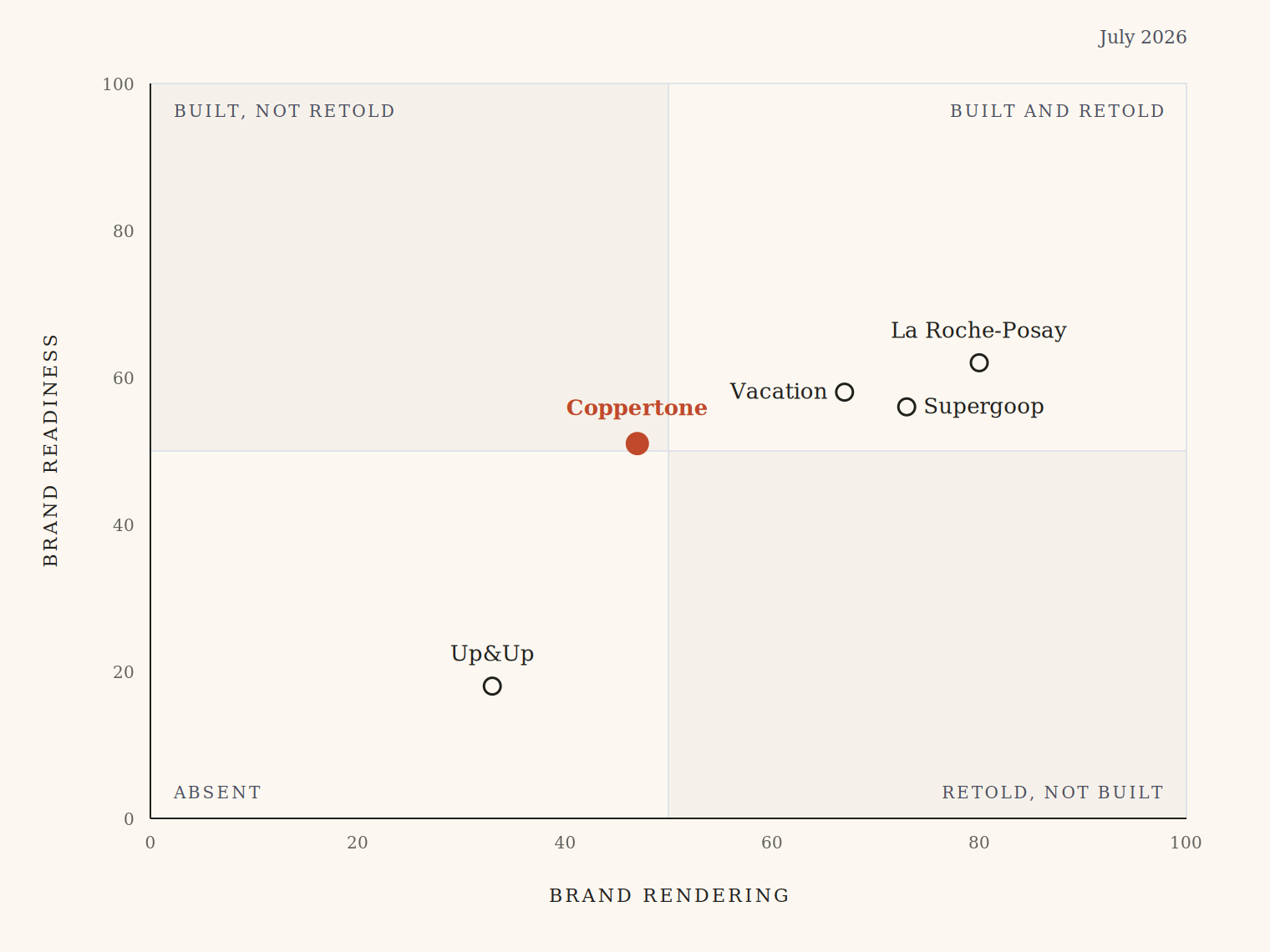
The diagnostic found that Coppertone has the deepest heritage and the most complete public record in the category. Eighty years of history, a photo archive, twelve years of Reddit threads. But almost none of it converts. The brand is not recommended or retold in any meaningful way. When people and machines talk about sunscreen, Coppertone is mostly absent or, every now and again, it’s the affordable one that smells good.
Maybe counterintuitively, this implies that a deep brand heritage does not necessarily mean it will be retold. One hypothesis is that Coppertone’s brand feels monolithic and finished. It’s not something that either people or machines want to share or recommend. Leading it to be cited, but not retold.
The new folklore
In June 2026, the CMO of one of the world’s largest advertisers, Unilever, delivered a keynote at Cannes and said his company had “stopped asking what our brands want to say” and started asking “who would care enough to carry it.” Here’s his talk.
That one sentence sums up where the marketing world finds itself today as well as anything I’ve read. “A brand is what people say when you’re not in the room,” the old saying goes. It’s always been true. This is folklore. A story passed from mouth to mouth, changed a little by each teller, and (importantly) owned by no one. Cinderella, for example, has countless variations across time and cultures, but we all recognize it when we hear it. Brands work the same way.
Historically, brands would heavily contribute to their own folklore by authoring stories and sending them into the world. But now, the balance has tipped. We don’t control our brand’s stories anywhere near as much as others do. Today, a brand is far less what it says about itself, and far more about what a wide ecosystem of third parties, both human and non-human, can find, trust, rank, recommend, and sell.
Lots of people are already talking about this issue, not only Unilever. Almost all of the conversation, though, has been about identifying and naming the problem. It goes something like this: A brand is a shortcut for meaning in our minds, but how do we keep that meaning coherent and effective when we aren’t the ones making it any more?
We used to be able to control a lot of the brand’s ecosystem. We could pay for a thirty-second spot, better shelf placement, and a mention in a top-tier magazine. We staged the launch and approved all the outputs. We held that control-everything stance even as production got cheaper and sped up. The discipline for putting guardrails on all of those brand touchpoints was called comms planning, or engagement planning.
Now that world has changed, and we cannot control the great majority of our brand’s meaning-making. A reviewer writes a pointed post on Reddit or Substack. An AI agent turns it into three sentences a shopper reads instead of your site. A creator turns your brand into a routine, or a joke, or just the latest “can’t miss” hook. A fleet of them spams those hooks at their followers, racing each other to the best ROI. A retailer turns the brand into shelf position or sponsored search. A marketplace turns it into a thumbnail, a review count, and a rank.
This is a real problem, and I’m here for it. But the more interesting question is what we do next?
The reflex is to make more stuff. More is more. Something will hit, and we’ll just amplify that. If done well, that’s not wrong, but there is fallout. Meanings multiply and contradict. The brand turns to mush.
“Because we do mass volume, there’s no way this can’t work.”
— some dude in a sponsored post on my FYP, selling access to a TikTok creator pool, July 2026
How do we build brands to be better equipped for this environment? A well-equipped brand, when it is “carried” (to use Unilever’s word), or “retold” (to use mine), gets stronger through retelling. And it does so in a consistent way, with lots of people, over time.
I think the answer lies in better upstream conditions or incentive design.
The old way is executional control, where we carefully shape every output, one at a time. But we cannot possibly approve every Reddit thread, every comparison article, every creator riff, every AI answer. Tighter guidelines just can’t scale across all of that. That lever is disappearing.
Instead, imagine a discipline that lives upstream of the go-to-market plan. This discipline is responsible for designing the conditions and incentives that make good outputs more likely: The codes, claims, participation hooks, incentives, and feedback loops that let a myriad of outside actors, both human and non-human, produce something recognizable without approving every single thing. This discipline probably shouldn’t even be called comms planning anymore.
We are still after the same end goal, namely a strong brand that is able to build those consistent memory structures that drive buying decisions. But we are building the conditions for it, not building the touchpoints themselves.
Letting go of control is difficult. It means letting others play around with the brand in their own way, for their own reasons, and using their own words.
What’s more, it’s difficult to design the conditions and incentives to make good outcomes more likely, because the thinking has to happen up front. Get the inputs wrong, and the ecosystem compounds the error at a scale that the brand police cannot possibly catch up to.
Brand meaning will be made whether the brand participates or not. If it doesn’t participate, the brand doesn’t fade to nothing. It just slow-drifts until it means something else entirely.
I have theories about how to do it, and have started using them for clients. But no one has the exact right answer yet. We all need to explore and experiment more. My first public experiment is the Retellability Test. It tries to measure whether a given brand is built to be retold (Brand Readiness), and whether others are actually retelling it accurately and favorably (Brand Rendering).
The Unilever CMO says brands should be fires, and creators are the people who carry them. It’s a good metaphor, but not a new one. Folklore has always worked this way. The best stories have always survived because they got retold, not because anyone owned them.
So the part I care about, and the part not enough people are talking about, is how you build a fire worth retelling in the first place. What’s that fire made of? Why do some fires catch but most go out? Which brands are doing it well already?
We should be able to build brands strong enough to stay themselves, no matter who’s telling their story. And I believe, if we build them well, the retelling will make them stronger.
If you have any questions, please be in touch. As always, thanks for reading.
— Noah
Really interested to hear more about the variables you use to score these. Will you be writing more about them?