


In 29 days, several hundred of you will be joining us at the Times Center for BRXND NYC 2026. Tickets will remain on sale until we hit max capacity but we will sell out. If you have any questions about the show, please drop me a line at mike@brxnd.ai
Agents, Ads and Demand Creation
As of about two weeks ago, I am a HUGE Chicago White Sox fan. Between the clear mandate from heaven, Munetaka Marakami’s umatched zeal for life, and whatever the hell this dance ritual is, the vibes are beyond immaculate and I’m firmly straddled to the bandwagon.
To look the part, I’ve instructed my venerable armada of agents to find me the best possible Sox gear. One has notably been quite a bit more proactive than the others in trying to push product…..
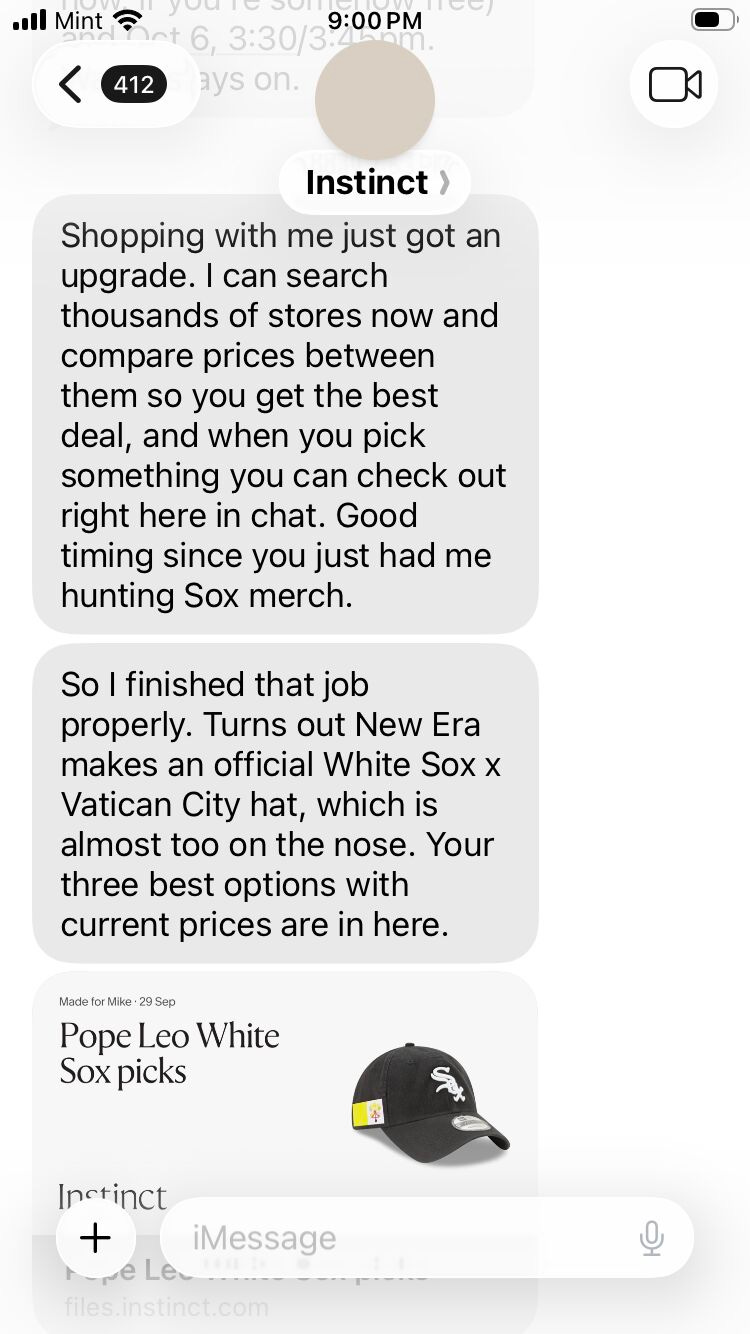
For the past few days, Instinct has been getting dragged quite a bit on Twitter for these sudden thirsty notifications that prompt a user to open an artifact containing a storefront of recommended products based on past queries. To me, there is only one explanation for why Instinct would move so aggressively in this direction— this is a test to set the groundwork and context for rapidly introducing advertising into the core user experience. And I’d argue it’s quite elegantly done! There are a few things I firmly believe here:
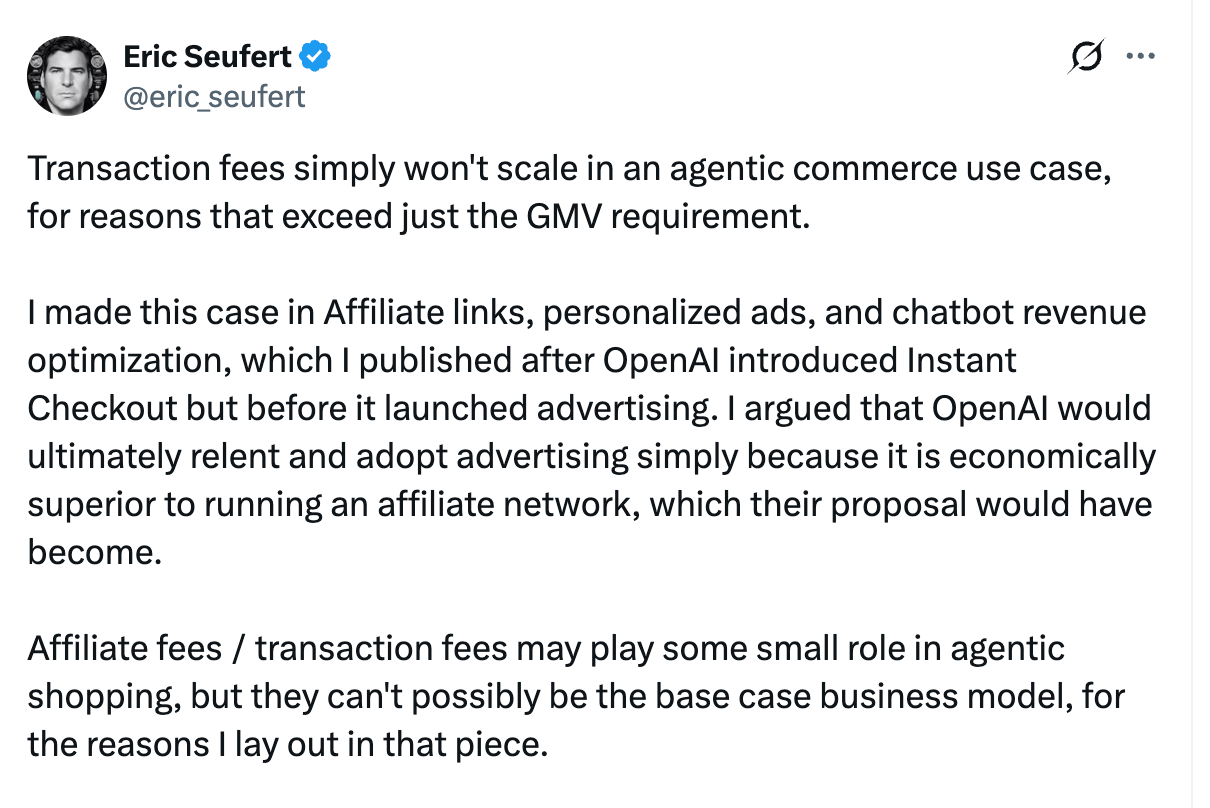
1) Any consumer AI product with scale is going to be ad supported....it's the only sensible business model. We’re going to be tapping the sign below so many times in the next year that our finger oils will melt the paint.
2) Instinct has the right general idea here of pushing incremental products that are related to a past query I initiated but abandoned, surfacing genuinely new finds that are interesting to me as a shopper. I had no idea this line of Pope Leo merch existed until Instinct surfaced it but I am basically the n of 1 audience for this.
Said another way, this is setting up for an ads experience that is closer to incremental demand creation than pure demand capture.
3) The “personalized storefront as an artifact” is a really interesting format to play around with to introduce dynamic components so that an agentic commerce experience moves out of text and actually starts to actually resemble something like shopping. While the artifacts are pretty bare bones listings of products today, the general form factor of an artifact is a great canvas for introducing say, creator video recommendations of products and other dynamic formats that move the needle for higher consideration purchases. Yet again, the HTMLedium is the message!
Done correctly, these artifacts are baby steps towards a “marketplace for one” experience that accelerates discovery of new products rather than just tasking an agent against something you already know you want to buy.
4) In a beautiful twist of irony, users are going to think the recommended artifacts are ads already anyway (they aren't yet) so the actual introduction of ads might not be all that jarring.
Notably, we saw this exact same pattern of commentary late last year, right before ChatGPT formally introduced ads. Initially, the company started recommending some of its embedded marketplace app partners (i.e. Target, Expedia) with small widgets below the organic prompt responses. Users thought they were ads and for 24 hours, my feed turned into a righteous dog and pony show.


Then, ChatGPT ultimately introduced ads in March and there was some more grumbling but within weeks, OpenAI felt confident that ads had a negligible adverse impact on user engagement and went full throttle. I expect a similar dynamic to play out with ads in personal agents.
It’s a tale as old as digital media time. Nearly all consumers will say they hate ads but in aggregate, their observed behavior will tell a very different story.
Notes from A Lil’ ChatGPT Ads Experiment
Speaking of ads, OpenAI continues to ship improvements to its ad product at a torrid pace, launching new visual ad formats that appear when users generate images in ChatGPT to complement the introduction of sponsored “agents” into the ChatGPT interface in September. These are two really good product launches from OpenAI that go a long way towards solving the two toughest design challenges around introducing ads into a chat interface.
1) By introducing a sponsored agent that exists outside the core chat, users cleanly opt-in to deeper engagements with a brand and very clearly expect to be “sold to” if they interact with the widget. I’d imagine that clickthroughs into an experience like this might be less than conventional ads but advertisers know they are getting highly qualified users who haven’t been hoodwinked into something they didn’t know was an advertiser led offering.
2) The more ad formats and contextual adjacencies that OpenAI can experiment with, the more they can lean into anchoring ad targeting to the user’s query when it has clear commercial intent and testing ads that drive serendipity independent of the underlying prompt when it’s clear that the prompt is not commercially driven.
That said, while enterprise advertisers get shiny new toys, the majority of the ChatGPT ads experience is still simple static images and text boxes that activate under relevant prompts.
To better understand the functionality available to the longtail of advertisers as it exists today, I’ve been running a small test, spending $25-50/day on ads promoting BRXND. Here’s what they look like in the wild.
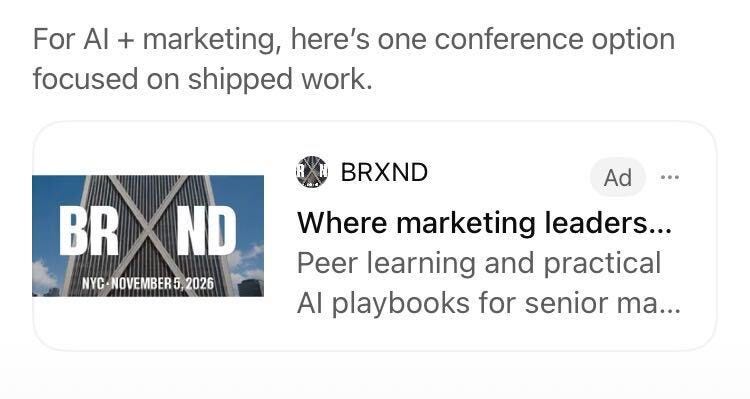
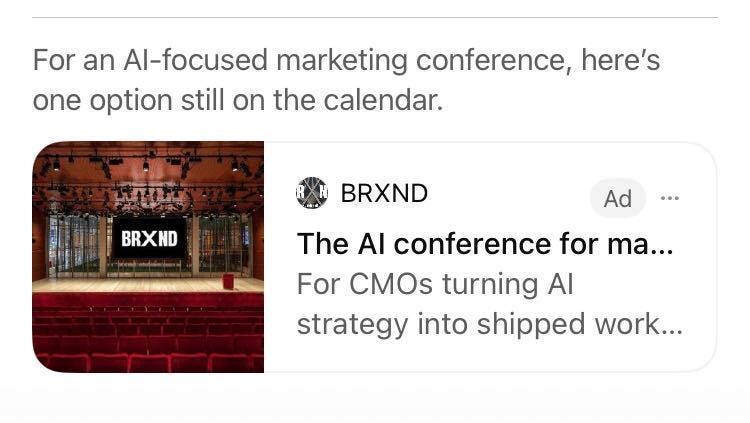
A few observations on the ChatGPT ads platform after a week or so of running live:
1) It’s absolutely incredible how sparse the reporting interface is for all the ambitions OpenAI has around ads.
2) I’m all for brevity in ad copy but I have no idea how you are supposed to write compelling copy in such a tiny text box. ChatGPT Ads has an AI interface where it auto-generates pithy variations that do fit but the copy is comically minimalist. 95% of ChatGPT ads I’ve seen in the wild just have text that runs over which OpenAI curiously says is fine and even best practice.
3) I’ve noticed some sneaky dark patterns, both within the interface and within how Codex/ Chat GPT Work interprets OpenAI’s guidance when you try to work right from the harness that seem designed to get you to spend more money on pricing models that are more favorable to OpenAI.
Specifically, ChatGPT Ads offers a CPC pricing structure but consistently tried to push me towards paying on CPM for campaigns where conversion was the primary objective. This is a pretty common company line in ad tech, based on the claim that the system can better optimize towards conversion outcomes if it sees more view-through in addition to clickthrough attribution.
This will all become a trivial and semantic discussion if ChatGPT can ultimately dial in its conversion funnels to optimize for performance outcomes but for now, I prefer to test on a cost-per-click model and I venture most budget-conscious longtail advertisers will feel the same way.
4) We’re spending about $40 CPM/ $6 CPC so far to reach an executive level marketing audience. This is expensive but in line with most public information I can find on the “going rate” for ChatGPT Ad campaigns in B2B. It’s also cheaper than LinkedIn, albeit with more opacity around targeting.
5) It is pretty remarkable that I was able to easily set up a full as campaign right from Codex on Luna Max, albeit mostly powered by computer use rather than a dedicated integration. Media buying right from the harness is here.
I’d love to cross-reference this experience with any enterprise agency or brand-side media buyers running ads in LLMs at a larger scale. If you’re tinkering with ChatGPT Ads and would be comfortable sharing your experiences (can be anonymized) in a future edition of BRXND, please get in touch—-mike@brxnd.ai.
Metal to Market: AI Is The Workspace
James is back from his travels and I’m absolutely in awe of how much ground he, Noah and Sam cover in this episode. The whole hour is fantastic but I particularly recommend tuning in for some of James’s spicier takes on Dots and how it is a precursor to much larger ambitions that the frontier labs have for the future of hardware. Amazingly, it’s been almost 18 months since Jonny Ive came into the mix at OpenAI but so far, we’re still interfacing with AI through phones and computers. It’s about time for things to get a little bit weirder.
If you have any questions, please be in touch. As always, thanks for reading.
— Mike