


Final reminder that BRXND 2026 early bird tickets are available for $599 through Sunday. The show is November 5 at the Times Center in NYC. More info on the vibe of the day here.
Apply for a slot today before we raise prices on Monday morning!
The HTMLedium is the message
I’m breaking my first rule as a writer who covers marketing to avoid tortured McLuhan clichés because we’re at an inflection point right now in communications that allows an exception to the usual rules. Communication is being fundamentally rethought as a function that must now crisply convey information to both humans and agents, both outside and within an organization. This is an incredibly hard problem, and one we’ll write much more about in the lead-up to this year’s BRXND.
Slack’s roadmap is now geared around the idea that by next year, there will be more agents using its products than people. They are facing competition from upstarts like Ando that are building first principles products for a world where agents and humans work side by side.
Amidst this change, humble formats from the early days of the open web are experiencing a renaissance. First, it was Markdown, first introduced by Apple blogger John Gruber in 2004, and now it’s HTML. On Anthropic's blog, Claude Code engineer Thariq Shihipar adapted his viral X essay to argue that using HTML to engage with Claude Code creates richer outputs and is generally best practice for conveying information to an agent. While that’s above my paygrade, I’ve noticed myself building far more quick HTML artifacts in scenarios where I’d previously reach for a document, deck, or conventional one-sheet type asset.
Even for purely human consumption, without the agentic comprehension layer, I believe that interactive HTML pages are the perfect medium at the moment for internal communications that would previously have been done via documents or slides. In a world besieged by easy content creation, creating a simple HTML-style artifact to guide a strategic decision, present curated data, or present an organizational plan introduces just enough friction to force clarity of message.
When you add the dual-track ability to align people and agents, I suspect we’ll start to see these assets pop up more and more in forward-thinking marketing organizations in the coming years.
Historically, strategy documents, a la the famous Amazon six-pager, have typically been my love language, but they have two fatal flaws in an AI-dominated world.
1) Documents are uniquely easy to crank right off the line from the slop factory and ask more cognitive load from the reader than the writer. It’s by far the easiest format to create slop masquerading as thinking.
2) If my experience in larger companies for the last few years taught me anything, it’s that executive attention spans are getting shorter for extended prose vs. pre 2020 times. I don’t mean this cynically; I mean this much more to say that modern executives uniquely value thoughtful brevity.
As for slides, the models are only going to get better at creating decks that look erudite and say absolutely nothing. Simple HTML-based webpage artifacts split the difference between slides and documents. While it is nominally easy to create an artifact draft in Claude, it is surprisingly hard to crisply convey information in a web page format unless you are thoughtful about every word and design decision. Said most simply, something about the act of creating a live web page forces a level of thought in what you are trying to say that AI generally makes it far too easy to ignore.
Beyond just tactical media for corporate comms, there’s a broader thread I’d like to explore here about why HTML and more interactive components may work so well for engaging with agents broadly. This has to do with challenging a fundamental assumption about how agents best perceive information.
We’re led to believe that, as hyper-rational actors, agents will seek out the simplest ways to process information. This is basically the theory behind why the markdown file will rule supreme. This is certainly true to a point. But the models are also weird!
With each new release, LLMs take on more anthropomorphic eccentricities we can’t fully explain. Who knows what irrational cues they will respond to! Who is to say that agents will be immune to panache and flair in comms? The same unique communication styles that drive serendipitous attention from humans might well be appreciated by AI.
It’s worth keeping this idea in mind, as we’re told that “marketing to agents,” more broadly, is going to be a simple, minimalist pursuit that strips the profession of creativity and humanity. Winning hearts and minds on the agent-dominated web is much more unpredictable and likely to be a whole lot weirder. Thank goodness.
-Mike
Noah’s take
Part of the reason all this works is that it works with the momentum of the model. One of the things I talk about often is that working with AI has a certain martial arts vibe, inasmuch as things are easier when you work with the model’s momentum rather than against it. HTML works with the model’s momentum because its pre-training corpus is chock full of information about HTML works. These things were taught to write code; they learned them because, on the internet, there is no larger body of information than instructions for building the internet. This, for what it’s worth, is also why AI has historically been better at writing JavaScript, which is quite abundantly available online, than at writing Swift (a language from Apple for building apps), which is in shorter public supply.
This is a bit more theoretical, but I would also guess that the training info is so abundant that when a model sees HTML, it actually intuits the picture. I assume that’s true only because it’s so good at writing and locating things in HTML that it seems to break some of the other weaknesses in spatial reasoning that models sometimes face. If you’re interested, check out developer Simon Willison’s experiments getting different models to create an SVG of a pelican riding a bicycle, which feels like a similarly shaped problem.
While most of the time models are still consuming via search, which means they’re not getting a picture of the model, the advances in Computer Use (especially in Codex, which you really need to try if you haven’t), say there’s a future where the models don’t need to just intuit the picture the HTML is drawing, they can actually see it in full fidelity in a browser.
To the Codex point, and this really has nothing to do with Mike’s piece at all, one of the things I’ve been experimenting with is building living HTML apps that display in the built-in browser window and which Codex actually listens for clicks in and can take action on in the main chat tab. There’s something very very interesting there that feels like a fundamentally new shape of AI.
With all that said, I do think some amount of this is just happening because the models aren’t quite good enough at using our computer yet. Once they can, I suspect we’ll go back to docs, decks, and the regular artifacts of work.
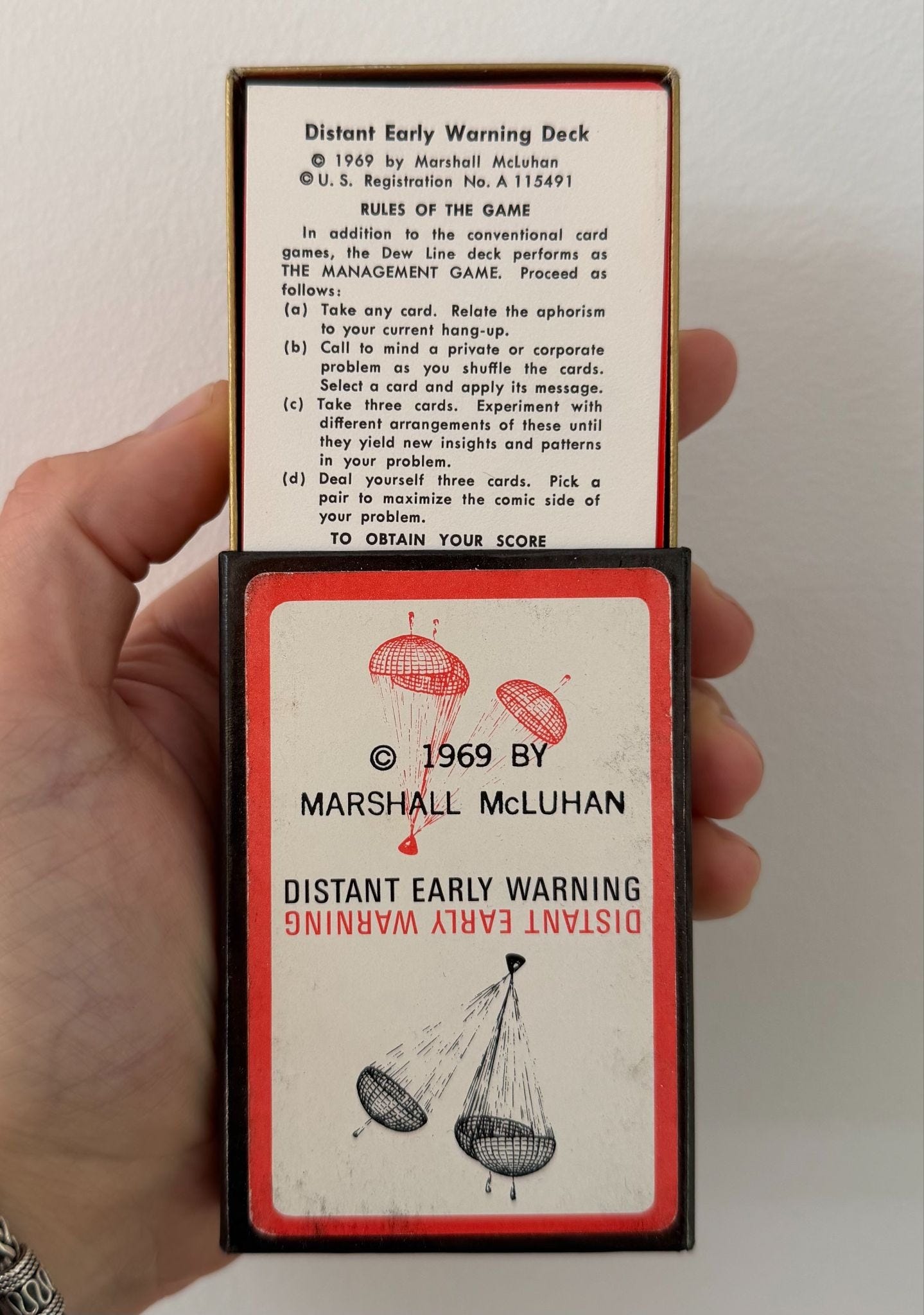
Finally, as an ardent fan and supporter, McLuhan clichés are always welcome here. Here’s a photo of a deck of McLuhan’s Distant Early Warning cards, which are a bit like Brian Eno’s Oblique Strategies cards, but created 6 years earlier. Andrew McLuhan, Marshall’s grandson who now runs The McLuhan Institute, sells them on the site. (He also almost exclusively tweets McLuhan-esque puns, which is also always appreciated.)
-Noah
If you have any questions, please be in touch. As always, thanks for reading.
— Noah & Mike
From McLuhan Clichés to McLuhan Archetypes ;)