


Editor’s Note from Mike: BRXND NYC is 50 days away and as promised, we’re continuing our interview series with leaders who are taking the stage at the event.
In today’s edition, Noah chats with Pip Bingemann, who purpose-built a model designed specifically to inspire, not give you the answers. To see Pip showcase this live alongside our incredible set of speakers building on the frontier of AI and marketing, grab a ticket to join us in the Times Center on Nov. 5 here.

On Divergence Models
Back in May, I talked with Pip Bingemann, the co-founder of Springboards. He showed me Flint, a small fine-tuned model they built because the frontier models all tend to give us the same stuff.
The canonical example he likes to cite here is to go ask ChatGPT or Claude for a random number between one and ten, and you get seven. But when you ask for a car, you get a Camry or a Civic; or when you ask for a running shoe tagline, you get “Run your way.” Despite being developed by different companies, they all come back with the same answers.
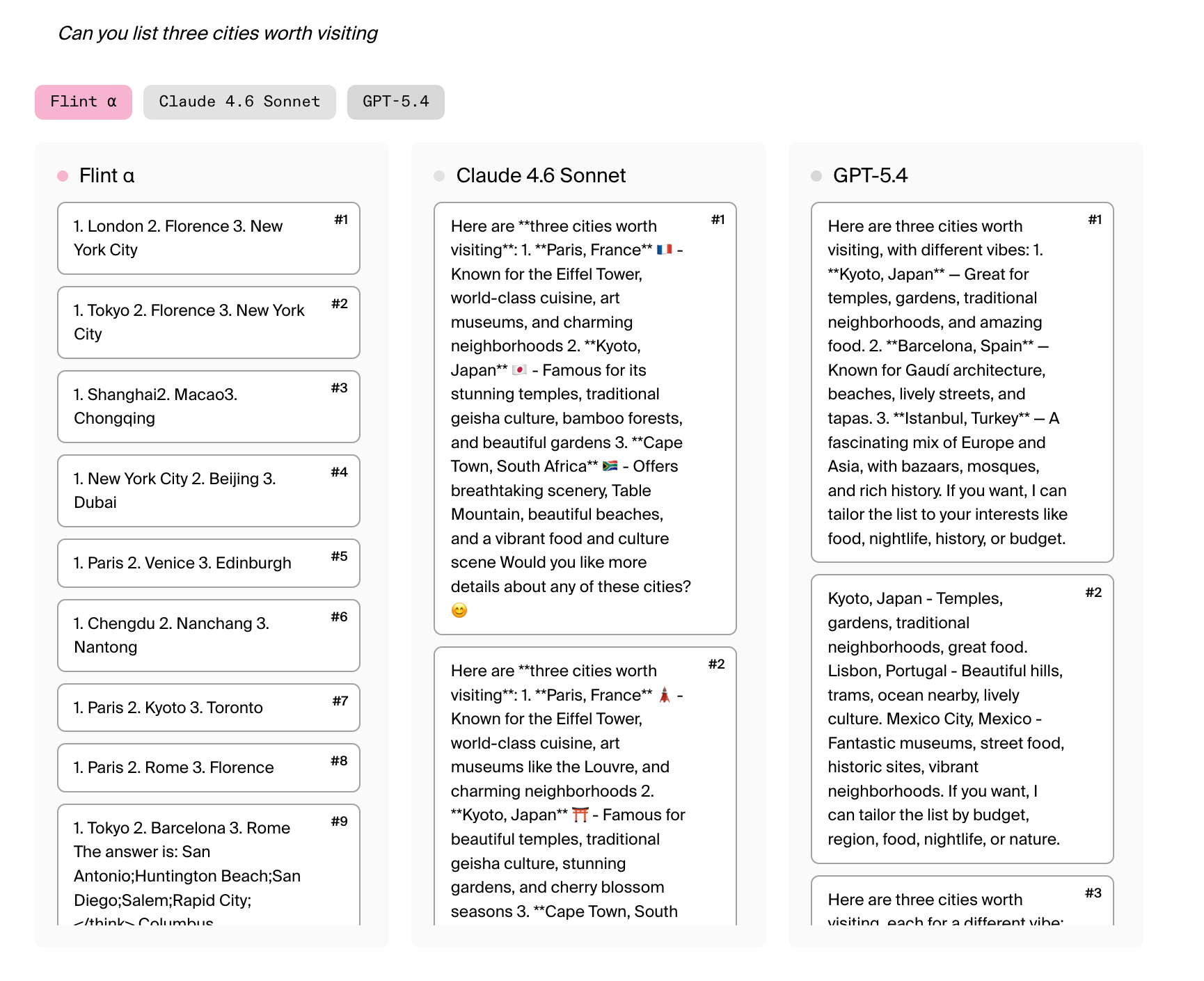
Springboards had already seen this in its creativity benchmark, where 16 models answered briefs for 100 brands and more than 600 people judged the work.
Pip calls this convergence. I don’t think this convergence is purely bad: sometimes you need an average answer, like when you’re doing synthetic research. But anyone who has tried to use AI for creative work can attest to the fact that it can be difficult to get where you need (especially if you need to be funny).
That is where Flint comes in. It is not supposed to do everything. Springboards calls it a “divergence model.” NoveltyBench basically asks the same open-ended question 10 times and counts how many meaningfully different answers a model gives. Flint scored 7.47, compared with 2.54 for GPT-5.4 and 1.83 for Claude 4.6 Sonnet.
Since we talked, Kieran Browne has written a technical explanation of Flint, and Will Douglas Heaven has covered the model for MIT Technology Review. This is lightly edited for readability, but it is basically the conversation we had a few months ago. I hope you enjoy it.
Noah Brier: I’m very excited to talk about Flint. I think we are converging on a similar set of ideas. The thing I have been thinking about is that I pretty firmly believe the models are getting worse at writing, not better. My feeling is that RLHF fundamentally stands in opposition to good writing.
Pip Bingemann: I think reinforcement learning is 100% part of it. But I think there is a much bigger issue at play.
Flint is not a foundational model. It is a fine-tuned model. It is a very small fine-tuned model. There are problems with it.
The thing we see is that the models are highly predictable because they converge into the same space. The answers are almost always the same. If you ask for a car model, you will probably get Toyota Camry, Toyota Corolla, Honda Civic, Ford Mustang, maybe Ford F-150. Every time, they land in the same space. Flint gives you something else.
Or ask for a tagline for New Balance running shoes. It could be anything. What you tend to get is “Run your way” or “Run your world.” Flint gives you something different every time.
For me, this is the scary thing. If I copy the same prompt into a new session again and again, it is the same over and over. And I am not picking on Claude or GPT. If I put Gemini in there, it is the exact same thing.
Noah: So what is Flint, exactly?
Pip: Flint is a model. It is a tiny model, a 30-billion-parameter model, but it breaks the distribution of predictability you see in every other model.
It is not good for everything. But when someone asks an open-ended question, they deserve an open-ended answer. At the moment, you are not getting it. People ask, “Can’t you just dial up temperature?” You cannot.
The way we use it in Springboards is that we do not believe Flint is a good model for everything, but it is good for some things. We give people the option to switch between models. If you want to put on a divergence model, you can. Or you can leave it on auto and we route to a model based on the request.
Noah: Why do you think this is happening?
Pip: There is one paper you need to understand: Artificial Hivemind. The basic finding is that regardless of how these models are trained, they have all converged into the same space.
One of the tests was: give me a metaphor for time. Of the 25 different models they tested, nearly every one said some version of “time is a river.” The models are highly predictable and repeatable, but they have also converged into the same space.
If you ask for a motto for a social media page, you can get word-for-word the same answer from very different models trained in different ways. I think it is a very scary thing.
The reason I think this is happening is a couple of things. We have already run out of data. There is more AI-generated content in the world every day, and it is going back into the world. At the same time, the quality of our data is degrading. The models are eating themselves because they are training on the open web, which is increasingly AI-generated.
Synthetic data is not bad. It depends what it is for. In worlds where there is a correct answer, that is fine. But in worlds where it is open-ended, it is not okay.
There is another paper about model collapse when models are trained on recursively generated data. There are two sentences from that work that I love. One is that probable events poison reality, because the probable and average get overestimated. The average doubles down.
The other is: the tails of the distribution die first.
That is what I think is happening. As these models get bigger and are trained on the same data, the tails shrink. They get pushed into the exact same space over time.
Noah: I buy that as the underlying explanation. My challenge is maybe a layer above it, which is that I am amazed how hard it is not to generate slop. It is so insidious.
That said, I am not sure I think convergence is an overall bad thing.
Pip: It is not. It depends on the use case. That is why I say Flint is not good for every use case. We will never be 100 percent Flint because it does not make sense. Sometimes you want the average.
Noah: Yes. In a lot of cases, getting to average is totally fine. For some marketing cases, it is totally fine. It is actually why AI can be pretty good for synthetic research. You exactly want the average and you do not need to push against it. But on the creative side, that is why there is work to do.
Pip: Exactly. I liked that sentence: sometimes getting to average is fine. The quicker people realize that, the better. It is an improvement in a lot of cases. For a lot of people it is, and for a lot of people it is not.
Noah: What are you doing with Flint now? Is it just inside Springboards?
Pip: Right now, yes. The more important thing is probably what is wrong with it.
It is a 30-billion parameter model, which is tiny. With a smaller model, there are two big problems. One is that its world knowledge is not as good. The other, bigger problem is that it struggles with complicated prompts. It has a big context window, around 250,000 tokens, but its coherence of instructions collapses pretty quickly.
At the moment it is released as an alpha model inside Springboards. We route to it occasionally and monitor how much we route to it. We let people switch to it if they want to. At the same time, we are scaling the model up and building it as an API.
Noah: Part of the reason I ask is because I would love to try it when you have the API. We have a bunch of those shape problems we need to solve, where we are specifically looking for divergence. We are playing with all these techniques for getting to not boring.
Pip: One of the tests we use for Flint is: tell me a dad joke.
If you ask Claude or GPT to tell you a dad joke, you get the same joke every time. Claude is always atoms. GPT is always skeletons because they do not have the guts. Sometimes it is a scarecrow. You cannot be funny if you only have one joke.
With Flint, we actually give you different jokes every time. There is a repetition problem and a convergence problem, and Flint kind of looks after both.
The same thing happens with prompts like “pick an emoji at random” or “pick a number between one and a hundred.” It is always 73 or 42 or 47. With Flint, we actually give you randomness.
Our point with this is that I do not care about quality in the first step. I really do not. It is not up to me to decide what is good and what is bad. That is your job. I want to help you expand your horizons and spark an idea in your head. Then it is up to you to work out what is good and how to overcome the rest.
You just cannot even do that with these other models. That is the scary thing.
Noah: How has it been building a model? Painful?
Pip: It has been really good. We have been working on it for just under two years.
The cost to build the model was cheap. The compute was cheap. The expensive part was all the experiments to work out how to get this thing to drive divergence without degrading the base performance of the model.
That is the real breakthrough with Flint: how do you get this thing to drive divergence without degrading the base performance of the model? We give it knowledge benchmarks as well, like MMLU and science tests, and we do not get worse on those tests. We actually drive variance without degrading knowledge.
That was the hard part, and that is the fun part. It is a never-ending job. It is my favorite meeting of the week because you go: here are papers, let’s try it. It does not work. Here are the problems with our model. Let’s scale them up and keep going.
Noah: That is awesome. I am excited to try it when you put it on the API. I think these are very interesting questions. Even your pushback that Flint cannot do everything feels right to me. I do not need one thing that can do everything. I need all these pieces. I need all the ingredients.
The problem for you is that people have to know enough to know this is a thing they need to solve for. With randomness and divergence, the vast majority of people have not approached the edge of any of these models yet.
Pip: This is the scary thing, particularly with advertising. I sent a message to a friend who is a pitch consultant and asked, “As you help clients go through the pitch process, are you noticing responses becoming more similar?”
He said, “More similar? Almost a joke. In the last 12 months, the net effect is the supply chain gets devalued. It is not good for anyone. It is hard to argue for nuanced premium and margin when everyone’s giving you the same answers.”
That is the problem no one realizes. The advertising agency world, in particular, is walking into it blind.
Noah: That one goes deep.
I have had three friends over the last few months who work at different places where their agencies have pivoted to be “AI-first.” And they are like, what does this even mean?
To me, I am just like: if you were any good at marketing, would you not recognize that counter-positioning is a pretty critical thing? If everyone is saying the same thing, there is probably a real advantage in being counter-positioned against that thing instead of saying you are something you very clearly are not.
I feel for them, but these models are sucking so much oxygen out of every room that you are left trying to fill it in. But the idea that you are going to fill it in by saying the exact same thing as everybody else seems like a problem.
Is there anything more disqualifying for an agency than not being able to put together strategic positioning for yourself?
Pip: It is insane. Especially because their entire history is that their job has been to sell people. That is what they do. They sell the talent of their people.
Then to say, “You do not need people, you just need AI,” is insane.
Noah: Exactly.
Pip Bingemann is the co-founder and CEO of Springboards. You can read more about Flint here. To see him live on stage at BRXND NYC 2026, click here to purchase tickets.
As always, thanks for reading.
Love this! And excited to try Flint when it’s available!
A model built to provoke directions instead of finish the answer is much closer to how creative teams actually think. 👀